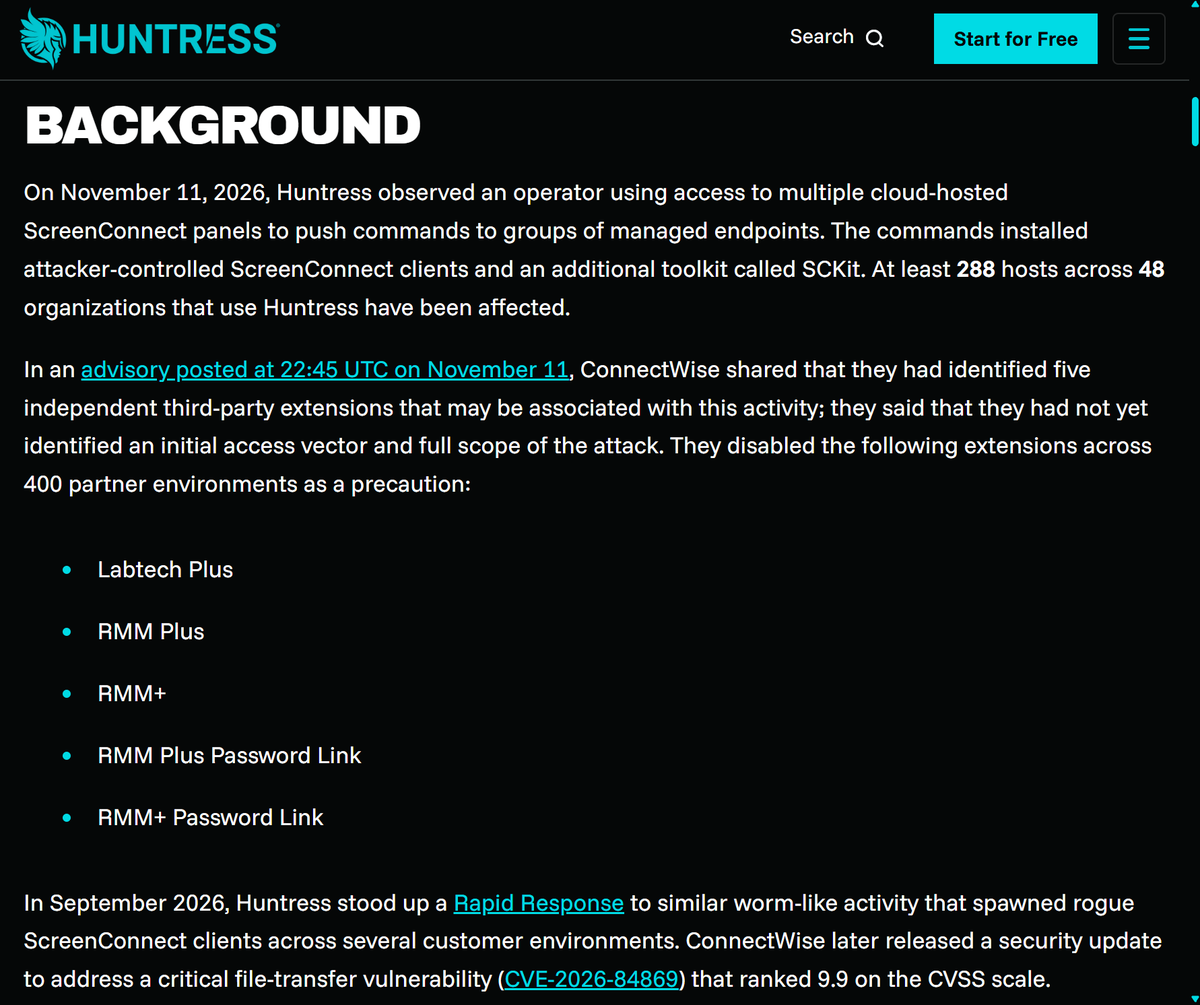
BREAKING: Our SOC is seeing a spike in detections in ScreenConnect environments that appear to be related to SCKit worm activity we reported on earlier this week. We’ll be updating our blog shortly with more details as our investigation continues. https://t.co/KIWdk7KBEH
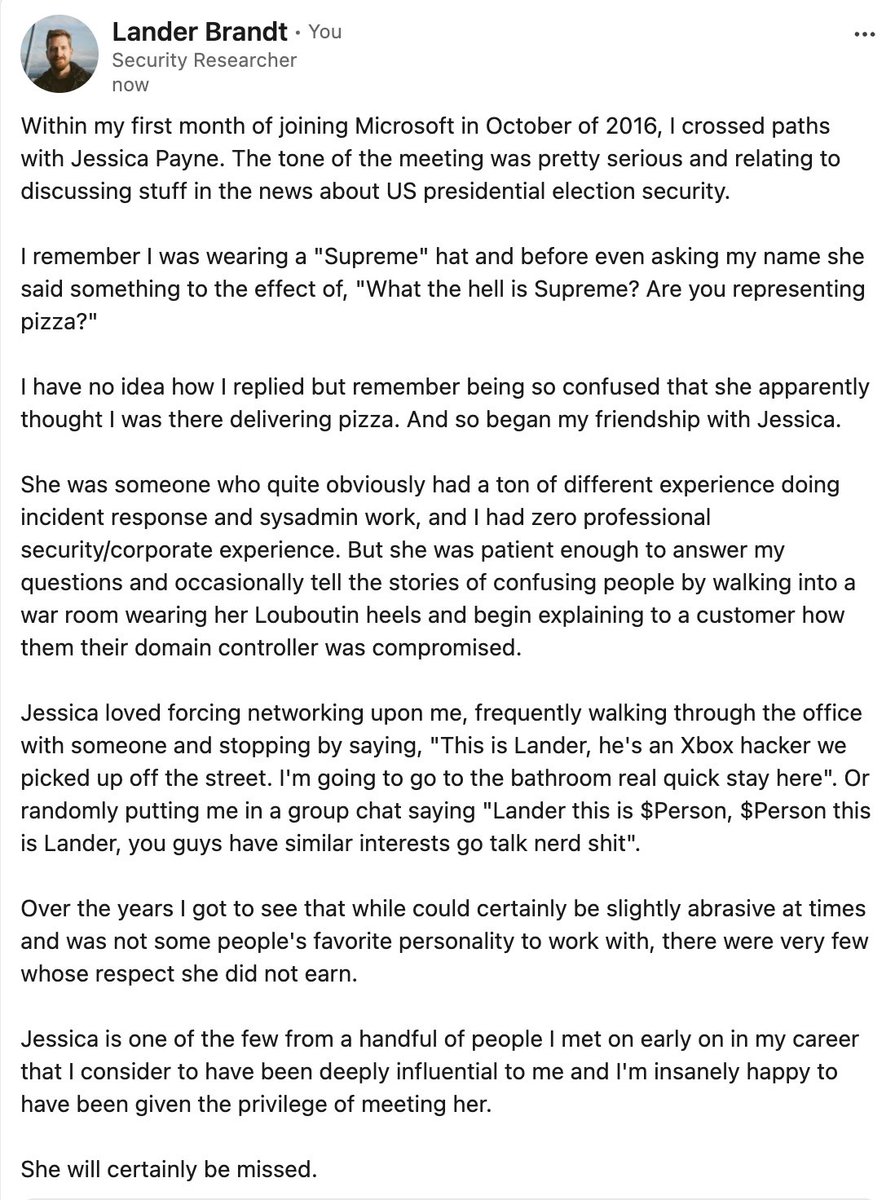
heartbroken to hear that @jepayneMSFT passed away. she was so incredibly kind and helpful to me very early in my career. when @landaire and i joined msft 10 years ago she was one of the first people i really connected with. she was always incredibly generous with her time and
Incredibly saddened to hear of @jepayneMSFT passing. Jessica was insanely influential to my career early on and is one of those people you wish everyone could meet for a variety of reasons.
https://t.co/4hz531tKh4
hey PSA, @HuntressLabs has been chasing a pretty gnarly new incident of a ScreenConnect worm, hitting hundreds of hosts downstream during the holiday today -- genuinely please do read up on this one if you've got ye' ol RMM running ↙️
https://t.co/jGmm8FbmkW
So this has been an absolutely hectic week, and it's not even close to over 🥴
Check out some rapid response investigative work that the team over at @HuntressLabs did - we'll continue to update as things progress.
https://t.co/8FzlU9fjCV
https://t.co/wbgH9HvtZP
A cool research I worked on recently
Another case of #Ethereum smart #contracts being used for #C2 retrieval. They use an orchestrator that communications through Tor to manage miners and an NVML wrapper to feed fake GPU readings to monitoring tools
#MalwareAnalysis#ThreatIntel
We're tracking REF3364, a Linux cryptomining intrusion that combines custom malware with publicly available miners.
Full analysis by @soolidsnakee, with YARA rules for SANSAR and netns, MITRE ATT&CK mapping and IOCs: https://t.co/EfOi7exKPJ
The actor abused an exposed Ray job agent, obtaining root and deploying the toolkit across 3 Linux GPU hosts.
The toolkit includes SANSAR, a Rust orchestrator that uses Tor for C2 and supervises CPU and GPU miners. Its command handlers support miner configuration and interactive shells.
The actor also deployed:
• A kernel rootkit that hides selected processes, files and socket entries
• An NVML wrapper that falsifies GPU readings
• netns, a separate backdoor that retrieves its C2 address from an Ethereum smart contract before connecting to the server directly
Using public blockchains to locate C2 infrastructure is a pattern we also discussed in our 2026 Threat Command quarterly report.
Let me engage this on two levels, my original concern with the full lecture, and then my issue with the hyperbolic prognosis:
1. The lecture itself is disingenuous on its face. The entire premise rests on a misrepresentation of the 'Huggingface incident' as a swarm gone awry of its own volition. That's not what happened there, and he should know that both from the public record and his vantage point on the board.
1a. Disingenuous use of the FelonyBench (Cyber/ExploitGym derivative) incidents:
To be clear, the OAI->HF and the rest of FelonyBench ("The Irregular Incident", as we are told these are separate) are instances of goal fidelity without scope fidelity on inadequate agent runtimes. Turning off guardrails purposefully for an eval run in a simulated environment is a normal and necessary thing to do. Inadequacies of the runtime account entirely for the 'concerning' downstream actions –otherwise misscoped actions would've just been failed attempts inside of the sandbox.
In one case you have an exploitable weakness in Artifactory, in the other a misconfiguration in the environment to leave internet access on. In either case, you're having to fall back to external monitoring, controls, and verification, of which there was apparently little or possibly none at the time.
(Particularly damning negligence on the part of a company whose whole business is managing evaluation runs)
During his UnpromptedSF talk, the CTO of Irregular admitted that once the original misconfiguration was fixed, there's been no action on the part of tested agents that has come close to 'breaking out' of the sandbox or some sort of infinitely escalating tit-for-tat race to break free.
If you train a model to be persistent towards accomplishing a goal above all else, and give them an unsolvable goal, the agent will persist towards resource exhaustion. That's not the rise of skynet, or a misaligned evil intelligence hellbent on destruction. If anything, it points out that the 'fix' for erroneous early completion (/goal mode) has turned into a desperate need to address scope drift (a massive issue w GPT-6 Astra and its derivative models at this time).
I'd also point out that what we saw were 'uncouth' actions: accessing another organization's infrastructure like this is reprehensible and in some jurisdictions illegal. From the agents' perspective, it was an information gathering exercise in pursuit of a goal. It had the access and means to be destructive (within bounds) and there was no such action. So what we are talking about is an issue respecting bounded scope (assuming it was given as much in the setup), not rampant sociopathy.
If anything, the conversation we should have is why the major labs have all given their evals business to debate champions without qualifications to do sandboxing, and no sophisticated tooling to do so, when hyper competent companies (like Joe Sandbox) have existed to do malware detonation with heavy introspection (at the hypervisor level, syscalls, memory analysis, hooking inside, etc) without similar incidents.
During unpromptedSF, I asked the CTO of Irregular if they had any of that implemented or if they were just letting the agents run and then reviewing the transcripts. His answer, as far as I and others in the crowd could interpret, was the latter.
1b. Intrinsic self-management and deterministic controls
That leads to my main issue with 'AI Safety' discussed primarily as an alignment matter. It's tantamount to expecting a component to monitor, regulate, and police itself. Even if you were to train a model with a 'pure moral soul', its ability to act correctly is dependent on how its connection to the world is mediated (context management, the tool use contract, effectively what the harness makes available). Everything outside of the model is being disregarded, while fetishizing the model's "choices", rather than seeing it as a state-space exploration mechanism in need of deterministic controls from its external medium.
This isn't just an issue of lip service, the main coding harnesses from both OpenAI and Anthropic are horribly deficient in what they allow for deterministic controls, and the underlying mechanisms that would allow someone intent on applying them were for some time non-existent (in codex particularly), and remain brittle and unreliable (event based hooks in claude code have been persistently broken, undocumented, or non-deterministically applied). Meaning these aren't taken seriously as prerequisites to proper agent functioning in production.
If AI Safety only equals alignment, then it's a failed project from its premise, but it doesn't have to be. I say that coming from cybersecurity, the mother of all complex adaptive system problems.
Alignment should be a matter of adherence to intent, at a variety of scopes (ideally one that respects the user's intent more, and not just opaque manufacturer directives). That and the overactive refusals and arbitrary guardrailing are causing more harm in my industry than they're helping anything, as far as we can tell. Attackers have all the agentic capabilities they could want, defenders are having arguments with a sanctimonious model's performative morality and needing to spin up GLM-5.3 deployments to do incident response (5.2 in the case of HuggingFace). There's no 'defender advantage' in any of that.
In effect, I see this as sophistry run amok. A lot of 'arguments' that come off as sound but don't stand up to scrutiny because they're dependent on massive deductive leaps, glossed-over specifics (many of them cybersecurity misrepresentations), and misrepresentation of apocryphal scenarios as indicative of grander threats. If the HF incident showed us anything, it's that the models still have very poor task scoping (horrendous problem w GPT-6 Astra), and that defenders are being unnecessarily constrained into having to depend on Chinese models for actual critical tasks based on Frontier protections for hypothetical concerns. Without addressing that (and neither lab has, really), any discussion of benefiting defenders or being concerned for cybersecurity rings hollow and disingenuous.
---
2. On the risk assessment and AI accident as 'most likely cause of death for most of the room'. Perhaps it's just meant to be the 'provocative hook' that gets everyone to pay attention to the talk and gets miles of free press (which in itself is a questionable practice from folks who are meant to act as intellectual authorities in this highly contested and concerning space). From a threat modeling perspective, it's just bad thinking.
Paul is addressing a crowd of presumably relatively healthy affluent people, probably 25-55 years old. He's discussing a technology with untold *potential* to (a) improve their lives, (b) restructure their livelihood, (c) imbalance their socioeconomic environment, among many other possibilities that may include an eventual (z) 'extinction episode'.
An experienced threat modeler takes all of those possibilities, and doesn't just assign an arbitrary likelihood ("There's a 10% probability that we all die before GTA7 is released"), you consider the relevance of a threat based on its proximate possibility (how applicable is it to immediate conditions?). If –as in the case of (z)– the possibility is conditional and more likely to be preempted by the occurrence of (a/b/c/...), then considering (z) in a vacuum is engaging in a science fiction exercise. An informed understanding of both the probability of (z) occurring and its likely shape depends on the preceding likelihoods.
Which is my very long winded way of pointing out that we are criminally neglecting the importance of these far more meaningful factors (a),(b),(c) and other immediate corollaries of this new technology. That appears predicated on an unfounded intellectual certainty of the inevitability of technological progress. There is no such thing, more so when we fail to address the surrounding conditions of its feasibility.
More plainly stated: *if* some grand emergent unified general intelligence capacity is *possible*, and *if* we figure out how to create it, and *if* we had the requisite resources, materials, technological breakthroughs, and shared will and organization to unlock and actualize that into an actual capability, it won't be because the technology willed itself into existence. It'll be a whole of society effort (from the plumbers and HVAC people, to the global coordination of resource allocation, big or small), and everything about how this technology (which is plainly *far inferior to that miracle general capacity* at this time) is being developed, economically resourced, productized, deployed, and socialized is fracturing and structurally weakening that requisite societal cohesion in a way that makes the probability of a (z) extinction event remote to the point where prioritizing and proselytizing that possibility over all others comes off as pathological deflection rather than measured expert guidance.
1/ Want to investigate and disrupt the world’s most sophisticated spyware surveillance threats? Our team at Amnesty International’s Security Lab is hiring for a passionate Technologist to help expand our team. Applications close Sunday 15 Nov 🧵👇
30 years ago today, Phrack 49 published Aleph One’s “Smashing the Stack for Fun and Profit”.
A legendary paper that inspired generations of hackers and helped shape modern exploit development.
Still an essential reading.
https://t.co/qAQ5CWgNj0
Phrack 73 is coming soon!
A busy morning for our SOC as we investigated a couple waves of activity across multiple organizations involving GeoVision camera software. We continue to monitor the situation and recommend that defenders hunt for activity tied to IPs 45.32.117[.]34 and 156.246.94[.]183.
If you're looking to get into detection engineering, contribute to open source. There's no point in submitting AI slop to maintainers who already have too much on their plates. If you're submitting PRs: Focus on quality and not quantity. Reproduce the behavior on real systems (AI can help a lot here, just make sure they are your systems lol), make sure to validate your detections against the real telemetry generated, and if you're using AI to develop the logic, be critical of its output and question whether the complexity is actually justified.
You can also help review/validate other submissions (and open source repos have a ton of them) as developing good judgement is a skill that will be increasingly valuable imo.
Sometimes, I receive messages referencing (very small) contributions to @sigma_hq I made 5+ years ago.
You get more out of contributing than you give. For example, the visibility I gained through Sigma (and X at that time) led to interviews with both Elastic (which also has a open source ruleset 💪) and my previous employer.
Go take that first step
In one of my previous research, I turn Chrome Remote Desktop into a complete red team scenario that can be used for monitoring and even leads to spying.. I explain different use cases and how to make it possible.
Link :- https://t.co/6ZeFjVAUVF
You would not *believe* how far and wide and deep the Mandiant alum syndicate network goes, seated deep in security roles around the globe - we have eyes everywhere.
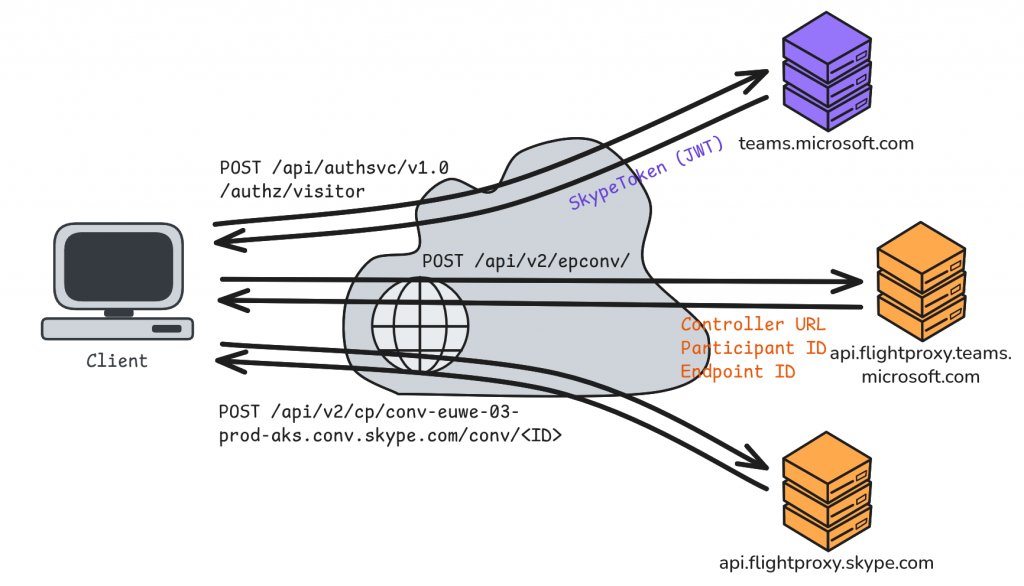
No C2 allowed? Beacon over Microsoft Teams.
Reverse engineering Teams' meeting APIs and WebRTC data channels to run a C2 over Microsoft traffic that the infrastructure already allows.
A post by Clément Labro (@itm4n)
Source: https://t.co/OQzZNrew0I
#redteam#blueteam