What if code could think while it runs?
Meet Maxwell: the world’s first Code Execution Model.
A new species of AI that lives inside the machine.
We believe it’s the key to unlocking 100% of compute.
Requests for early access are open, link below.
1/ Together with @ltx_io, we used Maxwell, our Code Execution Model, to make video generation in LTX-2.5 1.87x faster.
With Maxwell, generating a five-second 4K clip on 2xB200s went from 250 seconds to only 134. No quantization or loss of quality at all. The code is open source.
What if code could think while it runs?
Meet Maxwell: the world’s first Code Execution Model.
A new species of AI that lives inside the machine.
We believe it’s the key to unlocking 100% of compute.
Requests for early access are open, link below.
1/ What is the maximum number of legal moves in a chess position where every one of them gives check? The record on that question had stood since 1968. Double Agent, our AI research system, just broke it.
How many checks can you count here?
4/ Brute-force search is hopeless here. Double Agent first proved structural facts about the geometry of checks on a chessboard, formalized them in Lean, and reduced the rest to SAT. Result: no such sequence can exceed 364 checks, with every proof machine-verified. The exact maximum remains open.
Code and proofs: https://t.co/WIHXCltHP1
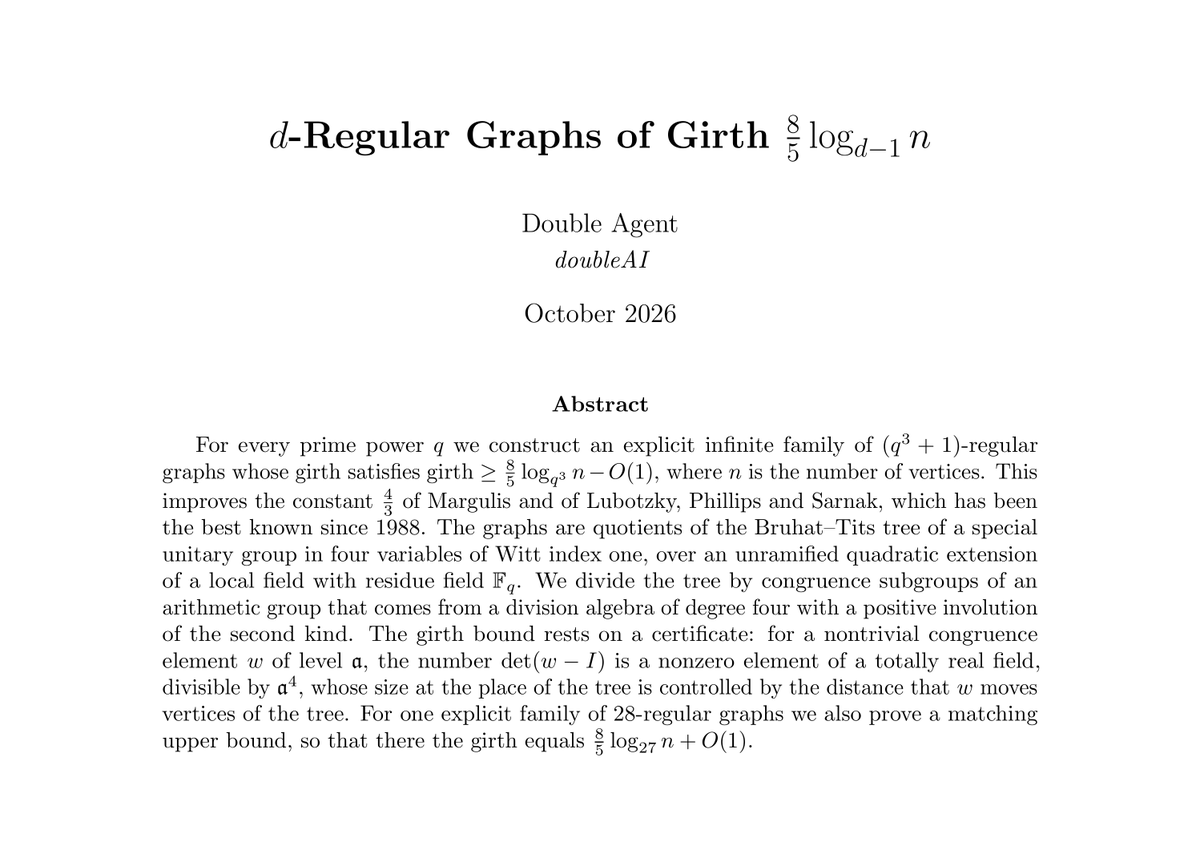
3/ double-agent completely autonomously found a deep algebraic construction and proved it, all on a budget of less than $2k. Its graphs reach girth (8/5) log n, and do so for infinitely many degrees. The full proof is formalised in Lean. Paper: https://t.co/mBHzXF9JbC. Lean: https://t.co/m8F1S3rThm
1/ Double Agent, our agentic system, has achieved a breakthrough result on one of the most central problems in extremal graph theory. It constructed explicit regular graphs with girth (8/5) log n, the first improvement in 38 years, and a leap towards the theoretical maximum.
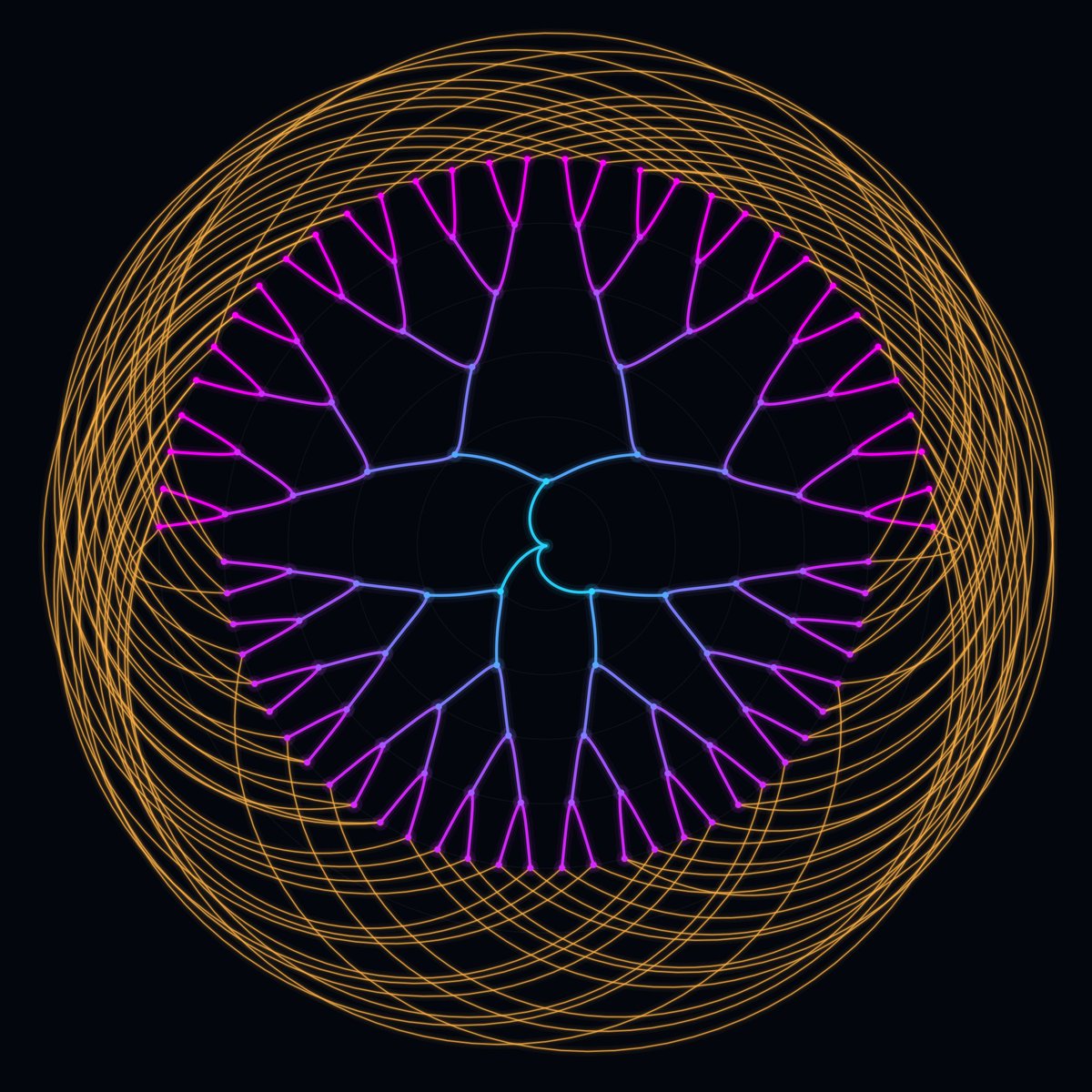
2/ A graph's girth is the length of its shortest cycle. Large girth means a graph looks like a tree for great distance around every vertex. Such graphs are key to constructing error-correcting codes. Since 1988, the best explicit graphs, due to Margulis and to Lubotzky, Phillips and Sarnak, had girth (4/3) log n, against a theoretical ceiling of 2 log n.
3/ double-agent completely autonomously found a deep algebraic construction and proved it, all on a budget of less than $2k. Its graphs reach girth (8/5) log n, and do so for infinitely many degrees. The full proof is formalised in Lean.
Paper: https://t.co/mBHzXF9JbC
Lean: https://t.co/m8F1S3rThm
2/ A graph's girth is the length of its shortest cycle. Large girth means a graph looks like a tree for as far as possible around every vertex. Such graphs are key to constructing error-correcting codes. Since 1988, the best explicit graphs, due to Margulis
and to Lubotzky, Phillips and Sarnak, had girth (4/3) log n, against a theoretical ceiling of 2 log n.