If you learn AI Infrastructure Engineering, you will never be unemployed again.
Stage 1: Systems & GPU Foundations
- Learn: C++, Rust, CUDA memory hierarchy, PCIe vs NVLink, thread blocks and warp scheduling.
- Practice: Write a custom CUDA kernel for matrix multiplication from scratch and profile it against cuBLAS.
- Why: You cannot optimize what you do not understand at the silicon level.
Stage 2: Transformer Inference Physics
- Learn: Prefill vs Decode phases, arithmetic intensity, memory bandwidth bottlenecks, KV-cache math.
- Practice: Profile a HuggingFace model with Nsight Systems to identify the exact memory bottleneck during token generation.
- Why: LLM inference is almost always memory-bound, not compute-bound.
Stage 3: Modern Serving Engines & Batching
- Learn: vLLM, SGLang, PagedAttention, continuous batching, chunked prefill.
- Practice: Deploy a 70B model and tune chunk sizes to maximize throughput without starving decode requests during long-context prefills.
- Why: Naive batching leaves 60% of GPU VRAM wasted. PagedAttention fixes this.
Stage 4: KV-Cache & Memory Optimization
- Learn: Prefix caching, KV quantization, CPU offloading, multi-turn cache reuse.
- Practice: Build a routing proxy that directs requests with identical system prompts to the same replica to share KV blocks.
- Why: Reused cache is free speed. It can slash Time-To-First-Token (TTFT) by 80%.
Stage 5: Quantization & Compression
- Learn: FP8, INT4, AWQ, GPTQ, Sparsity, TensorRT-LLM calibration.
- Practice: Serve a model in FP8 vs FP16 and benchmark the exact perplexity drop against the latency and VRAM gains.
- Why: Quantization is the only way to fit frontier models on edge GPUs and protect your margins.
Stage 6: Kernel-Level Engineering
- Learn: Triton, FlashAttention, CUDA graphs, operator fusion.
- Practice: Write a fused Triton kernel for RMSNorm or Softmax and benchmark it against the native PyTorch implementation.
- Why: Python overhead kills inference. Fused kernels save milliseconds that compound at scale.
Stage 7: Distributed Inference & Parallelism
- Learn: Tensor parallelism, Pipeline parallelism, Expert parallelism (for MoE models).
- Practice: Shard a 405B parameter model across 8 nodes and measure the communication overhead between GPUs.
- Why: Single-GPU inference is dead for frontier models. You must master the shard.
Stage 8: Speculative Decoding
- Learn: Draft-target models, Medusa heads, acceptance rates, n-gram drafting.
- Practice: Build a pipeline where a local 3B model drafts tokens for a cloud 70B model to verify in parallel.
- Why: 2x decode speed at zero quality cost is the closest thing to a free lunch in inference.
Stage 9: Multi-Node & Hardware Interconnects
- Learn: NCCL, RDMA, InfiniBand, NVLink, Disaggregated Prefill/Decode architectures.
- Practice: Set up a multi-node cluster and profile the network latency of tensor parallelism across nodes vs within a single node.
- Why: Network latency is the new GPU bottleneck. Disaggregating prefill and decode is the 2026 meta.
Stage 10: Cluster Orchestration & GPU Scheduling
- Learn: Kubernetes GPU operators, Ray, Slurm, MIG (Multi-Instance GPU) partitioning, KEDA.
- Practice: Build a queue-based autoscaler that spins up spot GPUs based on pending inference requests and drains them when empty.
- Why: Idle H100s burn $3+/hr. FinOps and scheduling are now core infra responsibilities.
Stage 11: AI Gateways, Routing & Observability
- Learn: TTFT/ITL SLOs, semantic routing, DCGM metrics, OpenTelemetry for LLMs.
- Practice: Build a gateway that routes simple queries to a quantized local model and complex reasoning to a frontier API based on prompt complexity.
- Why: Routing protects your margins and DCGM metrics tell you when your GPUs are silently throttling.
Stage 12: Public Benchmarks & Teardowns
- Learn: Reproducible methodology, latency/throughput Pareto curves, cost-per-token analysis.
- Practice: Publish a teardown comparing vLLM vs SGLang vs TensorRT-LLM on your specific hardware with full configs.
- Why: Public proof of hardware mastery gets you hired instantly by top AI labs.
Wrappers are a commodity. AI Infrastructure is the physics of scale.
The modern AI Infra Engineer builds the silicon nervous system for global intelligence.
Bookmark and Repost!
I have been deploying LLMs in production for 2 years!
Here's a hands-on guide if you want to do the same:
Local experimentation only takes you so far.
At some point, the model needs to leave your machine. It needs to be fine-tuned on proper compute, exported in the right format, and deployed behind an endpoint that can handle real requests.
This is the workflow we use at our company:
- RunPod for on-demand GPU infra
- Unsloth for efficient fine-tuning
- SGLang for model serving
Here's how it works step by step:
- Spin up a RunPod Pod with a GPU (RTX 4090 works great). Your laptop just becomes the UI.
- Open Jupyter inside the Pod. All training and deployment code runs directly on the GPU.
- Load gpt-oss-20B with Unsloth. The optimizations kick in at import time, making a 20B model actually practical to work with.
- Attach LoRA adapters. Instead of updating all 20B parameters, you train a small set of weights while keeping the base model frozen.
- Run supervised fine-tuning. Unsloth's training loop is optimized for large models. Training stays fast, memory stays low.
- Export the model. Save a merged 16-bit checkpoint that combines the base model and LoRA adapters into one artifact.
- Launch SGLang server. It loads your checkpoint and starts an OpenAI-compatible inference endpoint.
- Send requests using the standard OpenAI client. No custom tooling needed.
This setup takes gpt-oss-20B from fine-tuning to real inference, all running on an on-demand GPU compute.
Everything above ran on RunPod. Fine-tuning, export, and deployment, all on the same infrastructure, and I worked with the team to put this together.
What I appreciate about it is that the infrastructure stays out of the way.
You rent the GPU, do your work, and pay by the second. When you’re prototyping, you use a cheaper GPU.
When you’re ready to scale, the higher-end options are there. The flexibility to move between these without dealing with quotas or approvals makes iteration much faster.
Infrastructure should disappear into the background. RunPod gets close to that ideal.
If you want to get started, I shared a link in the next tweet.
Best GitHub Repos to Learn AI From Scratch in 2026:
1. Andrej Karpathy – Neural Networks: Zero to Hero
https://t.co/8wrukS6Vqm
2. Hugging Face Transformers
https://t.co/AtyDLv7NXI
3. FastAI/fastb
https://t.co/DsmaVa0WuT
4. Made-With-ML
https://t.co/bIlKIjWN9J
5. ML System Design
https://t.co/8mgOFAZCQD
6. Awesome Generative AI guide(
https://t.co/AmuUmfvJTD
7. Dive into Deep Learning
https://t.co/ntRDPNjOFr
Dear @HathwayBrdband , truly admire your undying love for me. Even after I returned your device, U still manage to call me 20 times/day. Please accept reality, I’m just not that into you. Do yourself a favor, delete my number, and find someone new to bother.
#frustrated#Chennai
What can we learn from Anthropic’s Blog about building tools for Agents? Here are the key principles I extracted for building Tools and MCP Servers for Agents:
- Consolidate workflows: Implement `schedule_event` instead of separate `list_users`, `get_availability`, and `create_event` tools.
- Evaluate with real tasks: Test with goals like "find the project lead and schedule a meeting," not just "get user."
- Automate metrics: Programmatically run evaluations to track success rates, token counts, and tool call frequency.
- Let AI refactor: Feed failed evaluation transcripts to an LLM to get suggestions for improving your tool's code.
- Namespace tools clearly: Use prefixes to differentiate tools, such as `jira_search_issues` vs. `github_search_issues`.
- Return meaningful context: Prefer human-readable names like "Jane Doe" instead of cryptic `usr_7a3b4c9` IDs.
- Enforce token efficiency: Implement pagination and filtering for tools that can return long lists of results.
- Make errors helpful: Instead of `Invalid input`, return `Error: Missing 'user_id'. Example: search(user_id=12345)`.
- Guide with messages: If output is cut, guide with "Showing 10 of 100 results. Use the 'page' parameter for more."
- Use unambiguous parameter names: Use `user_email` or `user_id` instead of a generic `user` parameter.
- Define formats explicitly: In parameter descriptions, specify requirements like "Date must be in YYYY-MM-DD format."
- Provide examples in descriptions: Add an `Example: search_query='status:open'` to the parameter's help text.
I promise you you’re vibe coding wrong
as someone who has built multiple production-ready applications, with thousands of users, from just Cursor with minimum intervention.
But first here's you (probably):
You open Cursor. Type “build me X.”
It spirals. Nothing works. You start over.
That’s not development. That’s chaos.
I have an incredibly simple system that works every single time:
Indian students tend to work harder to “prepare” for a thing than on the thing itself.
And this skews perspectives in a very damaging manner.
We work hard preparing for JEE to get into a good college, but think it’s too much effort to manage college while also spending a few more hours working on learning to build, or diving deeper into CS fundamentals.
We work hard to get into a good company by grinding leetcode but put ourselves on autopilot once we get a job, instead of keeping up with the industry and getting to better places in our career.
Which is why we tend to speak these lines -
- “I got into IIT”
- “I cracked a FAANG interview”
And not -
- “I became an engineer after studying at IIT”
- “I worked on xyz and solved these problems while I was at abc company”
We take more pride in getting access to the game than winning it.
It’s a very fundamental flaw. But enough to show up in every aspect of our lives and bleed into our decision making process.
A lot of people quickly unlearn this and go on to achieve great things, but most people are stuck there until it’s too late.
Making LLMs run efficiently can feel scary, but scaling isn’t magic, it’s math! We wanted to demystify the “systems view” of LLMs and wrote a little textbook called “How To Scale Your Model” which we’re releasing today. 1/n
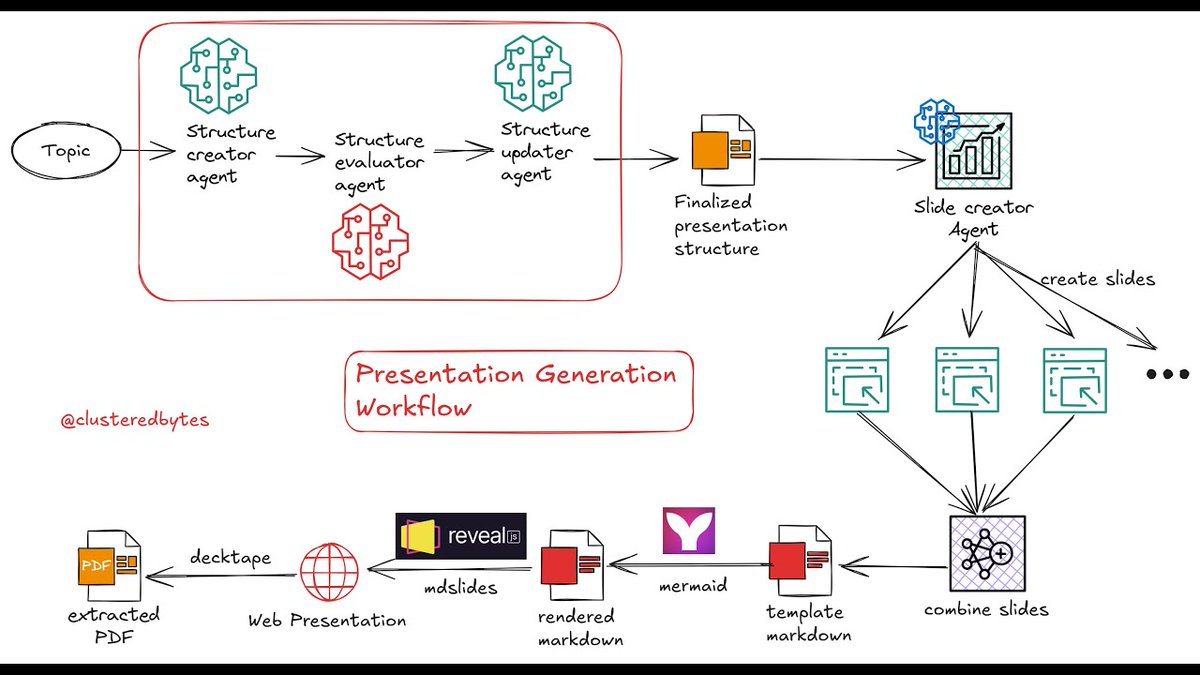
We’re excited to feature Presenter 🎨 🖼️: a multi-agent workflow that can generate visually rich presentations.
It’s a perfect reference repo if you’re looking to build a report generation agent, and contains a ton of features:
✅ generate Mermaid diagrams
✅ generates scripts with narration through @elevenlabs 🎙️
✅ Render the presentation as HTML (reveal.js) or video with ffmpeg
Huge shoutout to @clusteredbytes. Check out the project: https://t.co/AEjhEJKNv1
Powered by @llama_index workflows. Get started here: https://t.co/XvggKSYCIH
Dramatically improve the accuracy of your knowledge graph applications by applying agentic strategies with LlamaIndex workflows!
In this comprehensive post by Tomaz Bratanic of @neo4j, he builds up slowly from a naive text2cypher implementation to an agentic approach with error checking, retries and correction, and he has the benchmarks to prove it's a better strategy!
➡️ Implement agentic strategies for text2cypher using LlamaIndex Workflows
➡️ Explore multi-step approaches with retry and self-correction mechanisms
➡️ Understand the benefits of iterative planning for complex queries
➡️ Gain insights on benchmarking and real-world deployment considerations
Check out the full guest post on our blog here:
https://t.co/4AYhI7LGfQ
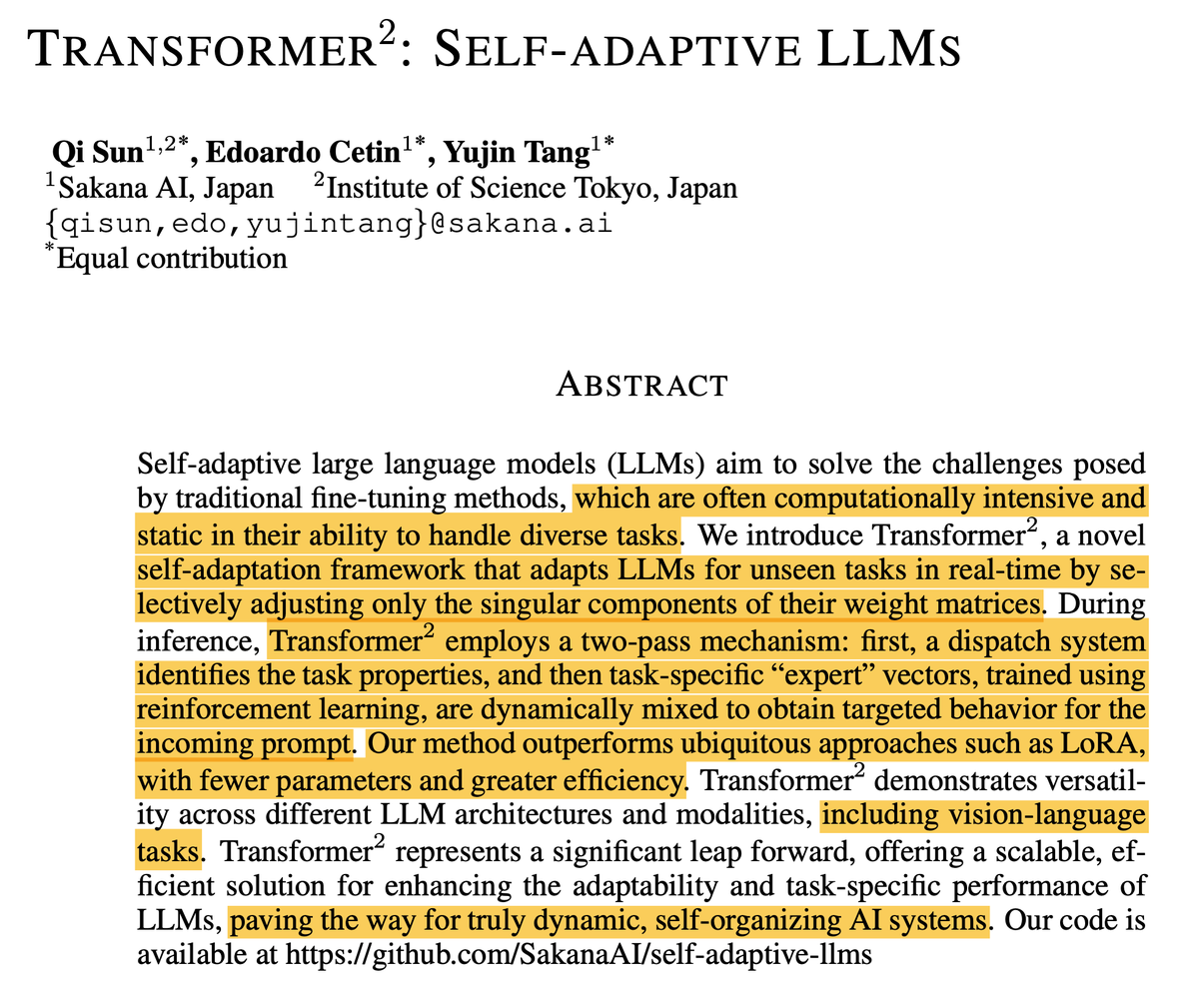
1/ SakanaAI just dropped their latest research: Transformer²
It's a self-adaptive architecture that allows AI to evolve at inference time.
Model weights are no longer "static"
Let’s break it down: 🧵
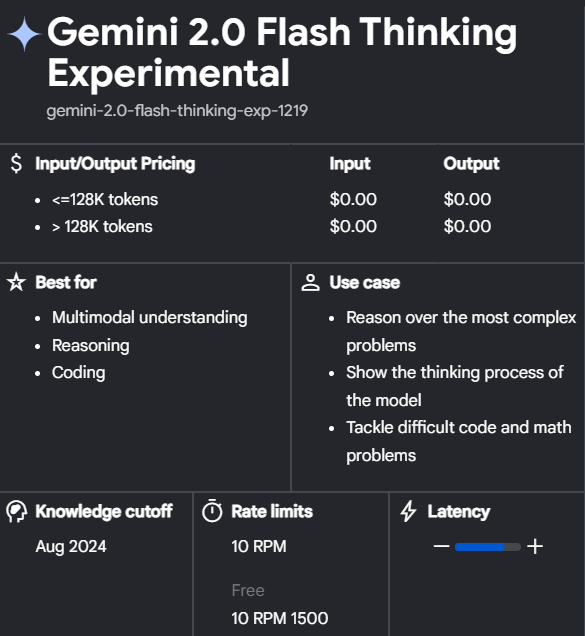
Google just cooked OpenAI in the AI reasoning game.
Gemini 2.0 Flash Thinking is out, and it's already beating OpenAI's o1 in the Arena Leaderboard.
It's faster and shockingly transparent on its "thinking"🤯
8 wild examples (and how to try):
Agentic Workflow for Patient Case Summaries 🥼📝
We made a full tutorial showing you how to build an agentic workflow that parses a patient’s health record, uses LLM-driven extraction + RAG to analyze guideline recommendations for each condition, and then generates a clear case summary.
This helps clinicians quickly understand the patient’s status, recommended treatments, and next steps 💡
Part 3 of our document agent workflow series! Stack: Synthea (for synthetic patient health records), @llama_index workflows, LlamaCloud, structured outputs + Pydantic
Notebook: https://t.co/42gFIny1Qk
Signup for LlamaCloud: https://t.co/yQGTiRSNvj
If you’re interested in getting in touch: https://t.co/ek65coieav
(If you’re still on the waitlist shoot us a message - we’re hoping to make this more available soon!)