The One Stop Private Marketplace for ‘Tokenize Everything’ on Solana. Swap, earn, trade perps, launch tokens.
CA: Enig2EsfQz6ajRXHWK1BGmjyt5n845MazeGamCyCiVR1
ENIGMA is live.
Enigma is one app for everything tokenized on Solana: swap, trade, earn, invest, launch and go private, with your keys the whole way. The token launched on Enigma's own launchpad.
CA: Enig2EsfQz6ajRXHWK1BGmjyt5n845MazeGamCyCiVR1
What you can do on Enigma today:
→ Swap: 15 venues quoted at once, including @JupiterExchange, @Raydium, @orca_so and @MeteoraAG, ranked after every fee
→ Trade: perps on @pacifica_fi's order book, and pair trades that go long one market and short another in equal size
→ Earn: @KaminoFinance vaults, lending and Multiply, and @orca_so pools you can enter from a single token
→ Invest: tokenized stocks, ETFs, gold and treasuries from issuers like @xStocksFi and @Ondo side by side, plus baskets that buy a whole theme in one review
→ Launch: tokens on a @MeteoraAG bonding curve with a 1 to 5% fee that pays the creator, the holders or a buyback and burn, settled by a keeper every 15 minutes
→ Private: swaps with no on-chain link between wallets via @hinkal_protocol and @NEARProtocol Intents, and encrypted balances on Helius's Solana Privacy Rings
→ Agent: ask in plain words, it reads live prices and rates and drafts the transaction. It never signs. You do.
Why it's built this way:
No accounts, no custody, no database. Every transaction is simulated on Solana before you sign and re-sent until it confirms. Your settings, history and agent chats stay in your browser. The app speaks English, Español, 简体中文, 한국어 and 日本語.
ENIGMA, on chain:
• Launched on Enigma's own launchpad, on a @MeteoraAG bonding curve
• 1B supply. Mint and freeze authority revoked, metadata locked
• 2.5% fee on every trade, before and after graduation
• Graduates near $80k market cap into Meteora DAMM v2, with the liquidity locked for good
Only one contract is ENIGMA:
Enig2EsfQz6ajRXHWK1BGmjyt5n845MazeGamCyCiVR1
Check it before you buy. Anything else is not us.
Start with the product you'd use first → https://t.co/XnEDvcptUn
A pair trade earns from the gap between two markets, whichever way the whole market goes. Here's the idea with numbers.
Say your view is that ETH will hold up better than SOL. On Pair Trading you go long ETH and short SOL, $1,000 each, as two @pacifica_fi orders signed back to back.
If crypto sells off and ETH falls 6% while SOL falls 10%:
• Long ETH: down $60
• Short SOL: up $100
• The pair: up $40, in a falling market
If crypto rallies and ETH rises 5% while SOL rises 9%:
• Long ETH: up $50
• Short SOL: down $90
• The pair: down $40, in a rising market
The market's direction decided neither result. The gap between the two did.
Before you open, the page shows the ETH to SOL ratio, how it moved over 7 days, and the margin both sides need. Closing takes one click for both legs. Each leg pays Pacifica's trading fee and hourly funding, and Enigma adds no fee.
→ https://t.co/hh9VWk71BM
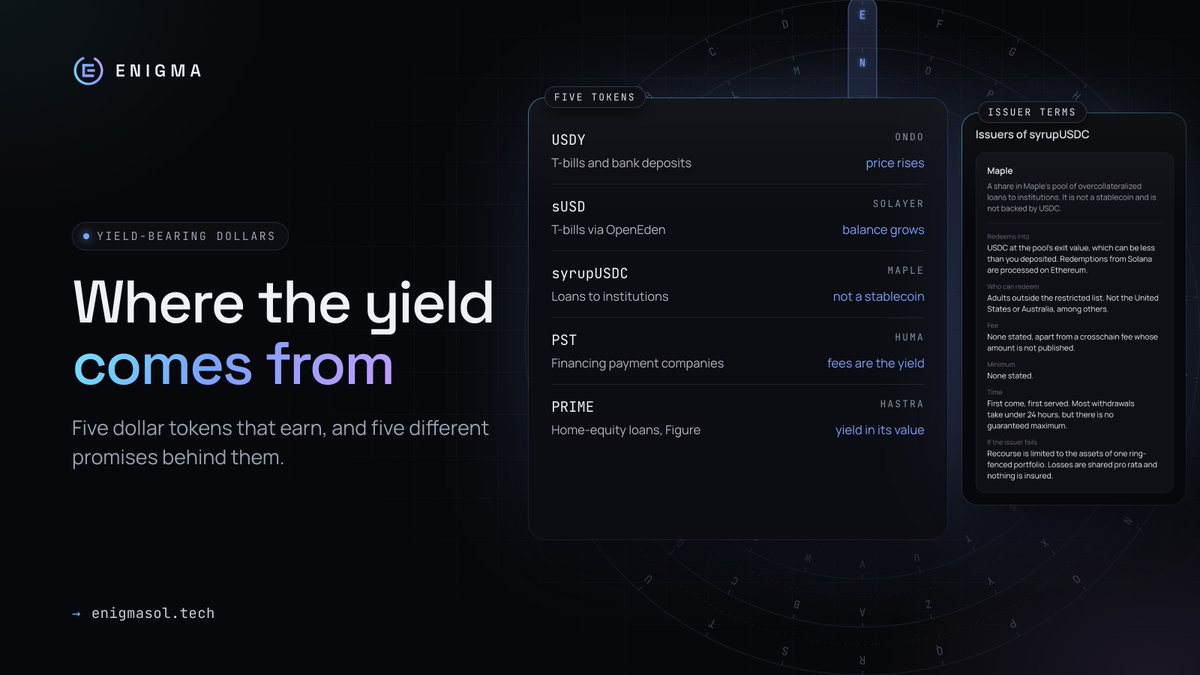
Some dollar tokens on Solana earn just by being held. Before you treat one like savings, ask where the yield comes from. The five in Enigma's Markets answer very differently:
• USDY from @Ondo: a note secured by short-term T-bills and bank deposits. Its price rises as yield accrues. Redeeming into USDC is for non-US persons who onboard, from $5,000
• sUSD from Solayer: backed by T-bills through OpenEden. Your balance grows instead of the price. Redeems to USDC within two business days
• syrupUSDC from Maple: a share in a pool of overcollateralized loans to institutions. Not a stablecoin: it exits at the pool's value, which can be below what you paid
• PST from Huma: finances payment companies, whose fees are the yield
• PRIME from Hastra: funds home-equity loans through Figure's pools, with the yield in its value
A price near one dollar says nothing about what backs it. T-bills and private loans carry very different risks.
Each token's page lists its issuer's terms: who may redeem, how long it takes, and where holders stand if the issuer fails.
→ https://t.co/w1ibgzqv2J
Two questions in plain English, one deposit card, nothing signed.
First question: what are the best USDC vault rates right now? The agent pulls live @KaminoFinance data and lists the USDC vaults, highest rate first. It adds the caveats without being asked: rates change and aren't guaranteed, and the top yields carry extra risk from assets held off chain.
Second question: put 2 USDC into the top one. No vault name needed, it follows the conversation. Back comes a card, "Deposit into Kamino Institutional Commodity Yield", showing the 2 USDC you pay and the current APY, with a note that nothing has been sent.
That card is as far as the agent goes. Review builds the deposit and dry-runs it on Solana, then hands it to your wallet. In the video, the cursor stops on Review.
The footer line is worth taking literally: Enigma Agent can be wrong, so check every card before you sign. Not investment advice.
A deposit drafted by the agent carries the same 0.5% as one made on the Vaults page. The questions are free.
→ https://t.co/k4Wxt3nByC
A friend wants 50 USDC and you hold SOL. On Enigma that's one transaction, not a swap followed by a transfer.
On Swap, tap the person icon to switch on Send to a different address. Paste their Solana address, set SOL to USDC, and type the amount. The swap pays out straight into their wallet.
Why it's worth doing this way:
• One signature, one network fee
• The same comparison across 15 venues, ranked by what actually arrives
• If they've never held USDC, the swap opens their token account in the same transaction, and you cover its small rent
• Once it confirms, Enigma reads from the chain how much really reached them, with a link to the transaction
It works for anything Swap can route: settle a bill in USDT, or send SOL out of your USDC.
Two cautions. Enigma checks that what you pasted is a valid Solana address, but it can't tell whether it's your friend's. And a confirmed transfer can't be undone. Check the whole address before you sign.
→ https://t.co/UYeZIuynXJ
New tokens get copied fast: same name, same logo, a ticker that looks right. Here's how to confirm you have the real ENIGMA without taking anyone's word for it, ours included.
1. Compare the whole address, not just the first few characters. Copies can use addresses that start the same way. The real one:
Enig2EsfQz6ajRXHWK1BGmjyt5n845MazeGamCyCiVR1
2. Look it up on any Solana explorer. Mint authority and freeze authority both show as none: nobody can create more ENIGMA, and nobody can freeze a holder's tokens.
3. 1,000,000,000 ENIGMA were minted at launch, and the name, ticker and metadata are locked.
4. Reach it from Enigma itself. ENIGMA was created on Enigma's own launchpad, so it's in the launchpad's Explore list, and the link below opens its page.
If any of these doesn't match, it isn't ENIGMA.
→ https://t.co/oprdV7EFLe
Every token launched on Enigma chooses where the creator's share of its fee goes. The choice is permanent, so here's who each mode suits.
To you. For a creator with something to fund: a builder, an artist, a project with running costs. Your share collects in the pool, and you take it out yourself from the token's page, paid in the pair token, at any time.
To holders. For a community token where holding should pay. Enigma's keeper pays your share out by balance on its 15-minute runs, with nothing for holders to claim or sign. Pair with USDC and they're paid in USDC.
Buyback and burn. For a token built around a shrinking supply. The keeper uses your share to buy the token back, then burns exactly what that buy delivered, in public transactions.
The split is the same in all three: @MeteoraAG keeps 20% of each fee, 70% of the rest follows your mode and 30% goes to Enigma. The fee itself is 1% to 5%, also set at launch.
A plain trade-off: only the first mode pays the creator directly. Choose holders or burn and you give your share away on purpose.
→ https://t.co/g7yDgFCr88
Super Swap is a buy form next to a live table of what's moving on Solana. Here it is in under a minute, stopping short of the buy.
The table:
• Trending over 5 minutes, with market cap, liquidity, volume, and trades split into buys and sells
• Risk badges on the rows that earn them: Supply can grow, Unverified, Top holders 50% and the like
• Re-sorted at 1h, 6h and 24h, with tokenized stocks such as NVDA, TSLAx and SPYx ranked among the crypto tokens
• Most traded, then Organic, ranked by @JupiterExchange's organic score
Then a click on a row with no badges: TTWO, Take-Two Interactive as a tokenized stock from Backpack. That one click fills the form. The 50% button puts in half your SOL, and the quote shows both sides with their dollar value and the best route across the 15 venues Enigma compares. In this case, Jupiter.
Under the form sits a plain warning: new and unverified tokens can lose all their value.
The cursor rests on Buy. Enigma's fee is 0.5%, the same as Swap.
→ https://t.co/VlRoWVYK84
Gold trades on Solana in two forms, and Enigma's Commodities list shows both side by side.
Tokens meant to represent gold in a vault: Pax Gold from Paxos, Tether Gold, Oro GOLD, Matrixdock Gold and VNX Gold.
Tokens that follow a gold fund: SPDR Gold Shares, from @xStocksFi and @Ondo, and the iShares Gold Trust, from Ondo.
Same metal, different promises. Three examples from the issuer facts on each page:
• Pax Gold: one fine troy ounce per token. Paxos redeems into bars or dollars for verified customers, and KPMG reports every month on tokens against ounces
• Tether Gold on Solana is the bridged XAUt0, and Tether's terms say bridged versions aren't Gold Tokens, so a direct claim isn't established
• VNX no longer offers VNXAU to the public
Gold can also back a loan. In @KaminoFinance's PAXG market, PAXG counts for up to 75% of its value as collateral today.
Before you pick one, open its Redemption tab: what it redeems into, who can redeem, the minimum, and what happens if the issuer fails.
→ https://t.co/JbbXuqo4O1
Your wallet asks you to sign a lot on Enigma. The requests aren't all the same, and knowing which is which is a habit worth having.
A signed message isn't a Solana transaction. It sends nothing from your wallet and costs no network fee, though it can still carry an instruction:
• Opening a Private Swap session with @hinkal_protocol
• Opening your shielded balance. The keys it needs are derived from that signature in your browser and never leave it
• Orders, cancels, leverage changes and withdrawals on @pacifica_fi perps, each valid for 30 seconds
A transaction moves tokens:
• Swaps, vault deposits, lending, pools, Multiply, launches and the perps deposit
• Each is dry-run on Solana first, with its fee and any rent on screen before your wallet opens
Some approvals cover several at once:
• A strategy basket signs one swap per holding together
• A launch signs two or three transactions with one approval
If a request doesn't match what's on the screen, decline it. Declining sends nothing.
→ https://t.co/lMo4voSC2F
Thank you for your Review. Please feel free to contact us via DM if you need any information or resources in future for any review about our features and functionalities.
Thank you again.
We reviewed Enigma.
Assessment: LEANING LEGIT
Enigma has verifiable mainnet activity supporting several of its advertised integrations. We matched its published swap demonstration to a successful transaction and confirmed lending, vault, Multiply and liquidity-pool operations.
This changes our previous UNVERIFIED assessment. The stronger conclusion comes from transaction evidence identified during this re-review. Its complete privacy flows, recovery process and application security remain unverified.
Website:
https://t.co/7Xri9vFJ7i
What the product does
Enigma brings several Solana services into a single interface: swaps, perpetuals, lending, vaults, liquidity pools, investment baskets, token launches and privacy tools.
Its underlying infrastructure includes Jupiter, Kamino, Orca, Meteora, Pacifica and Hinkal. Enigma provides the interface, transaction preparation and supporting automation around these services.
Its agent is described as a tool for reading information and preparing transaction cards. Users review and sign the transactions themselves.
What we tested
We reviewed the accessible project threads and its published swap video, queried Solana mainnet directly, inspected transaction instructions and asset movements, and decoded ENIGMA’s bonding-curve configuration.
We confirmed 11 successful transactions covering a swap, lending operations, a vault deposit, Multiply opening and closing, pool entry and exit, and a Hinkal deposit.
We also checked a recent fee-collection, token-purchase and burn sequence.
These checks establish considerably more execution evidence than our earlier review captured.
The swap demonstration now has independent confirmation
Enigma’s video shows a 0.002 SOL swap returning 0.140336 USDC.
We located a successful mainnet transaction matching the displayed wallet, amounts and timestamp:
• Total swap input: 0.002 SOL.
• Fee transferred to Enigma’s fee wallet: 0.00001 SOL.
• Amount routed through Jupiter: 0.00199 SOL.
• USDC received: 0.140336.
The fee equals 0.5% of the input, consistent with the project’s stated swap fee.
The transaction invokes Jupiter and contains the memo enigma:swap:jupiter. The evidence includes actual asset movements, rather than relying on the memo alone.
Demo:
https://t.co/fpJguEArbu
Matching transaction:
https://t.co/U8KYcAWSEa
Lending and earning have additional execution evidence
We traced a lending sequence through Kamino’s published lending program:
• Supply 1 USDC.
• Borrow 0.2 USDG.
• Repay 0.200001 USDG.
• Withdraw 0.999999 USDC.
All 4 transactions succeeded and referenced the same obligation account. The program address matches Kamino’s official deployment.
Borrow:
https://t.co/idT6vCZRos
Repayment:
https://t.co/o1vqUgJvye
Kamino’s published program:
https://t.co/6J3hOcCf19
A separate vault transaction spent 0.5 USDC, transferring 0.0025 USDC to Enigma’s fee wallet and depositing 0.4975 USDC through Kamino’s vault program. That also matches the stated 0.5% deposit fee.
We additionally confirmed successful Multiply opening and closing transactions involving Kamino and Jupiter, plus an Orca position being opened, funded, withdrawn and closed.
These are small transactions involving the project’s fee wallet and the wallet shown in its demonstration. They support implementation evidence, but do not establish broad external adoption.
Privacy has partial verification
Enigma describes 2 separate privacy products:
• Private Swap, using Hinkal and NEAR Intents.
• Shielded balances, using Helius’s Solana Privacy Rings.
We confirmed a successful transaction depositing 0.667281 USDC through Hinkal’s official Solana program, with an Enigma private-swap memo. Hinkal publishes the same program address on its security page.
Deposit:
https://t.co/Au4JHFOlzK
@hinkal_protocol published contract:
https://t.co/5mVRztNic9
A five-minute check-in on everything you hold, on one screen.
Connect a wallet to Portfolio and read it top to bottom:
• Total value, split into tokenized assets, stablecoins and crypto, so your mix is visible at a glance
• Every token with its balance, price, value and share of the total, and a Swap button beside it
• Vault deposits, with what each one pays today
• @orca_so pool deposits
• Strategy baskets, flagged when one drifts off its targets
• Multiply positions, with their leverage and your equity
• Loans: what you supplied, what you borrowed, your loan-to-value and the net value
• The swaps this wallet has made through Enigma
Read the loans line first. Loan-to-value creeps up when collateral falls, when the borrowed asset rises or as interest builds, and the closer it gets to the liquidation level, the less room you have.
Positions opened on @KaminoFinance or Orca directly appear too, since Portfolio reads the same programs.
Nothing is stored anywhere. The page is rebuilt from Solana each time you open it.
→ https://t.co/WMa7u50BTT
Tesla trades on Solana as three different tokens. This video puts them side by side and reads what sets them apart.
It opens on Issuers: 15 issuers and 161 assets, each issuer with its legal entity and what its token is. Then the assets offered by the most issuers, and a click on Tesla.
On the TSLA page:
• A price chart across ranges, and a swap panel below it
• Every TSLA token in one table: TSLAx from @xStocksFi, TSLA from Backpack and TSLAon from @Ondo, with price, pool liquidity and 24h volume. Their pools differ widely in depth, and depth decides where an order fills well
• The lending markets that accept it
• Issuers of TSLA in three columns: what each redeems into, who may redeem, fee, minimum, time, and what happens if the issuer fails
The Governance tab reads contract controls from each token's mint. On the xStocks and Backpack tokens, the issuer can mint more, freeze an account, pause every transfer, and move or destroy tokens in any wallet. On Ondo's, the first three.
Same company, three sets of terms. Read them before you choose.
→ https://t.co/Mc8MzoIUXq
You can start a token launch on Enigma by describing it in one message.
Tell Enigma Agent: "Launch Harbor Lights, ticker HRBR, paired with USDC, 2% fee paid to holders. It's for the regulars at our sailing club."
It turns that into a launch draft with every field the form needs:
• Name, and a ticker of up to 10 letters or digits
• A story of up to 280 characters
• The pair: SOL, USDC, or a tokenized stock (SPYx, QQQx, NVDAx, TSLAx)
• A fee of 1% to 5%, in whole percent
• Who your share of the fee goes to
Then "Open the launch form" takes you to the real form with those values filled in. Add an image (upload up to 1 MB or paste a link), check every field and the rent for new accounts, and sign. The agent never signs anything, and nothing launches until you approve it in your wallet.
If it misread you, fix the field in the form. That's what the step is for.
Asking costs nothing. A launch started this way works exactly like one made from the form.
→ https://t.co/k4Wxt3nByC
A Solana address works like a bank statement that anyone can open. Share it once, to get paid or to pay someone, and they can see what you hold, every transfer in and out, and who you deal with.
Enigma gives you two ways to show less.
Private Swap breaks the trail. You pay from one wallet and the funds arrive in another, with nothing on chain connecting the two. Handy when savings should live in a wallet nobody has seen.
Shielded Swaps hide the numbers. Your balance sits in a private account on Solana whose token and amount are encrypted, and you can pay people from it without showing what or how much. Phantom or OKX wallet, in beta.
What neither one hides:
• Your deposit: which wallet paid in, and the amount
• Which wallets send to which
• Anything you give away later, like sending funds straight back to the wallet they came from
It's closer to the privacy people expect from a bank, on a public chain. Private Swap asks you to confirm your funds are lawful before it opens.
Unlink wallets → https://t.co/CXHBDVhm1S
Encrypt a balance → https://t.co/5U3ZY1Qm2u
What 2× on a tokenized stock really means, worked through with NVDAx on Multiply.
You deposit $1,000. In one transaction, @KaminoFinance lends about $1,000 of USDC against it, that's swapped into more NVDAx, and you end up holding about $2,000 of NVDAx while owing about $1,000.
If NVDAx moves:
• Up 20%: your $1,000 becomes $1,400
• Up 10%: $1,200
• Down 10%: $800
• Down 20%: $600
Now the number that matters. In the xStocks market on Kamino, NVDAx is liquidated at a 65% loan-to-value. At 2×, that's a fall of about 23% from where you opened, and then Kamino sells part of the position to repay the loan.
And the cost of waiting: the stock earns almost nothing while you pay interest on the USDC loan. At a 6% borrow rate, a $1,000 position at 2× costs about $60 a year if the price goes nowhere. Prices that drift while the US market is closed count toward liquidation too.
Multiply shows all of this for the leverage you pick, before you open. Enigma's fee: none.
→ https://t.co/7Plphx9Qoq
One order for a whole theme, shown on a real basket: Money Managers.
It holds three tokenized stocks at a third each: HOOD (Robinhood) and BRK.B (Berkshire Hathaway) from @xStocksFi, and BLK (BlackRock) from Backpack. At $1 per holding, the minimum is $3.
The video pays in 3.5 USDC and asks for a review. Enigma builds the three swaps and test-runs each on Solana, no signature needed, then lays them out:
• About 1.16 USDC into each holding
• Enigma's fee, 0.5% per swap: 0.0175 USDC in all
• 0.0077 SOL of rent for the new token accounts, refunded if the basket later sells out of them
All three are signed together. The cursor stops on "Sign and send (3)", and nothing is bought.
Before that, the Baskets page: index baskets, where a fund like the S&P 500 (SPY), the Nasdaq-100 (QQQ) or short-term Treasuries (SGOV) is a single token, then 11 strategy baskets from Magnificent Seven to Healthcare.
Every holding sits in your own wallet. Rebalancing is one click whenever you choose, and never happens without your signature.
→ https://t.co/WC9mpNZ0Ns
Three questions we get about Enigma, with straight answers.
What happens to my funds if the Enigma website goes down?
Nothing. Your tokens are in your wallet, and positions opened through Enigma sit in @KaminoFinance and @orca_so programs on Solana under your wallet's control. They stay on chain whether the site is up or not. The exceptions: margin in a @pacifica_fi perps account, which Pacifica holds, and a private swap still in progress.
Could Enigma charge me a fee I didn't see?
No. Enigma's fee is a transfer inside the transaction you sign, and it's on screen before you sign it. Enigma has no other way to take one: there's no account to bill and no balance it holds for you.
If I send tokens to the wrong address, can you get them back?
No, and neither can anyone else. A confirmed Solana transaction is final. Enigma can tell you an address is malformed, not that it belongs to the wrong person. Compare every character before you sign.
More answers, product by product, in the Docs.
→ https://t.co/lMo4voSC2F
The US stock market closes at 4pm in New York. Tokenized stocks on Solana don't.
NVDAx, SPYx and the rest trade in Solana pools at any hour, weekends included. Buy at 2am on a Tuesday, or move from a stock into USDC on a Sunday afternoon.
There's a catch worth understanding. While the US market is shut, there's no live share price to anchor the token, only trading in its pools. A thin pool can drift away from where the share last closed.
What Enigma shows you, so you can judge it:
• Every token of the same stock side by side, with its pool liquidity, so you can see which one trades deepest
• A chart of the token's own price in its deepest Solana pool
• Price impact and a minimum received on every swap, before you sign
If you borrow against a stock or hold a Multiply position, take this seriously. A weekend drift can push a loan over its liquidation line even though the share price never moved.
One limit: issuers generally don't offer tokenized stocks to US residents.
→ https://t.co/w1ibgzqv2J
You hold SOL, you don't want to sell it, and you'd like the next few weeks to matter less. A short perp can do that.
Say you hold 20 SOL. Deposit USDC into a @pacifica_fi trading account from Enigma's terminal, then short SOL in the same dollar size as your 20 SOL.
• SOL falls 10%: your SOL loses 10% of its value, and the short gains about as much
• SOL rises 10%: your SOL gains, and the short gives about as much back
• Either way, your SOL never leaves your wallet
What the hedge costs: Pacifica's fee on each fill, plus funding every hour. When funding is positive, longs pay shorts, so your short collects it. When it turns negative, your short pays.
The risk to watch: in a sharp rally the short loses on Pacifica while the matching gain sits in your wallet. Keep enough margin in the trading account, or Pacifica can liquidate the short before you close it.
Placing and closing the orders costs no network fee, and Enigma's fee is zero.
→ https://t.co/402Bw0s7yj