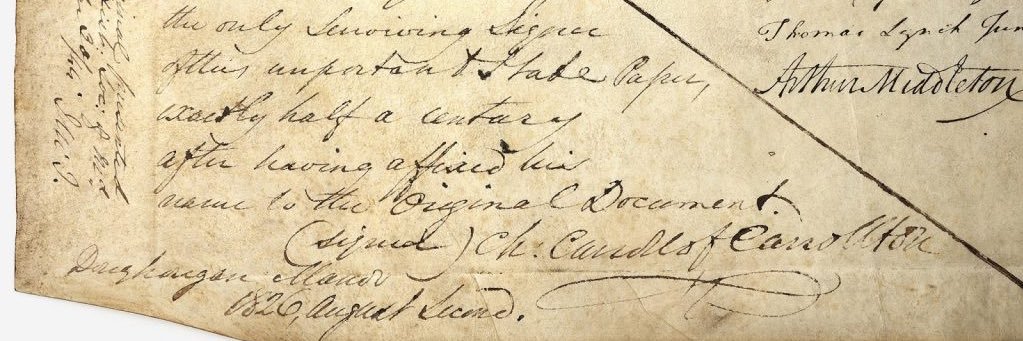
The richest man in America signed a document that could have gotten him hanged, and when someone sneered that he was safe because no one would know which Charles Carroll to come for, he picked up the pen and told the British exactly where to find him.
His name was Charles Carroll, and the colonies were crawling with men who shared it. His own father was Charles Carroll of Annapolis. So when the Declaration of Independence came to him for signing in 1776, a delegate made a cruel little joke. He said Carroll risked nothing by signing. There were so many Charles Carrolls that the King's men would never know which one to hang.
Carroll didn't argue. He leaned over the page and added three words to his signature: "of Carrollton." The name of his estate. His address. He was the only signer in the entire room who wrote down where he lived, and he did it on purpose, so that if the British wanted to come hang the traitor, they would know exactly which door to knock on.
That is who Charles Carroll of Carrollton was.
Here is what makes the moment even sharper. He was not a man with little to lose. He was the single wealthiest man in the thirteen colonies and the largest private landowner among them. While George Washington and John Hancock get talked about as rich men, it was Carroll who topped them all. When he signed, he was wagering the biggest personal fortune in America against a noose.
And he was the last man anyone would have expected to be there at all. Carroll was Catholic. In colonial Maryland, a colony founded as a Catholic refuge that had since turned on its own, Catholics could not vote. They could not hold public office. They could not worship in public. The most educated, wealthiest man in America was, in the eyes of the law, a second-class subject barred from the very government he was helping to create. He had spent seventeen years being educated by Jesuits in France and spoke five languages fluently, and back home he still could not legally cast a ballot.
So he became the only Catholic to sign the Declaration of Independence, putting his name on a revolution that he hoped would build a country with room for men like him. That was its own enormous bet, made by a man the existing system had already shut out.
Then he simply outlived everyone.
Thomas Jefferson and John Adams both died on the same astonishing day, July 4, 1826, exactly fifty years after the Declaration. When they were gone, Charles Carroll of Carrollton was the last living signer left on earth. For six more years he was the final human link to that room in Philadelphia, the last hand that had signed, a living relic of the founding that ordinary Americans traveled to see and shake.
He finally died in November 1832 at the age of ninety-five, fifty-six years after he wrote his address on a treason document and dared the empire to come find him.
The richest man in America. The only Catholic. The last one standing. He had more to lose than any of them, every legal reason to stay quiet, and he signed his full address anyway.
We remember the names we were handed in school. We forget the man who made sure his couldn't be mistaken for anyone else's.
Which Founding Father do you think history shortchanged the most?
@uubzu It's ironic to me that some of the people blackpilling about twitter are specifically blackpilling about how much blackpilling there is on twitter. This is creating an infinite twitter blackpill blackpill loop that is giving the blackpillers further reason to blackpill
@uubzu It's ironic to me that some of the people blackpilling about twitter are specifically blackpilling about how much blackpilling there is on twitter. This is creating an infinite twitter blackpill blackpill loop that is giving the blackpillers further reason to blackpill
@RepShriThanedar Next time read your name whenever you're thinking you want to tell us what makes America great. It's an easy reminder that you have no idea
Well I'm very interested atm in the changes in the electoral landscape (VRA, census, potentially save act, etc) and how that will effect elections going forward. I think you're uniquely suited to breaking that down really well. (redistricting war is just getting started so I understand there's a ton of unknowns)
If you're looking to do something less predictive and more historical, I'd love something on the mechanics of how new crops of elites rise to power or existing elites are converted. I know that's broad, but I think the right really needs to start thinking about how to get the elites on our side, because in light of the electoral changes it'd suck to have the movement hijacked.
I'm also intrigued about where you think we are with regards to the milkshake theorem, I saw you posted about it a month or so ago but would love more of a deep dive.
Regardless, I'm excited and thank you for asking!