cast into the void: a short essay about AI and the future for @DigEconLab. i make three points. 1. Silicon Valley right now is failing to offer humanity a compelling vision for an AI future. their vision seems to be: unemployment + isolation. we want AI instead to enable (1/4)
i signed. my own interpretation: 1. AI can develop in different directions, doesn't have an internal logic, up to us. more econ research can help fight for better directions. 2. US productivity growth stagnant for decades. another point: help understand how to make most of this.
Here's our statement on AI and the economy.
We Must Act Now
A Statement on AI’s Transformation of the Economy
1. AI may become radically more powerful over the next 10 years.
2. This could drive an unprecedented transformation of our economy, larger than the Industrial Revolution, but unfolding over a vastly shorter time frame. It could bring risks, including large-scale job displacement, as well as opportunities such as major gains in living standards.
3. Economists, policymakers and technology leaders must act now to understand the economics of transformative AI and to build the incentives, guardrails, and institutions needed to steer AI in a direction that complements humans and benefits society.
@GautiEggertsson 1. at a superficial level, it will also raise the value of proprietary/hard-to-access data sets (same for firms!). 2. unpopular teaching take: also raises value of history of econ thought. easier to have ambitious/creative intellectual project when you know what it looks like.
cast into the void: a short essay about AI and the future for @DigEconLab. i make three points. 1. Silicon Valley right now is failing to offer humanity a compelling vision for an AI future. their vision seems to be: unemployment + isolation. we want AI instead to enable (1/4)
3. AI needs to somehow make education, mental health, and social connection better, not worse. all of our demographic and social trends are already going in the wrong direction. the path of least resistance here is probably the bad one and makes these trends worse. (3/4)
@asadkhaliq@phokarlsson i thought about that but wondered if kitty's initial rejection of him + her stuff w vronsky meant it wasnt "profoundly healthy" from very start. other example that came to mind was dorothea and ladislaw in middlemarch. but striking how hard it is to find examples in great lit.
In econ "secular" means long-term. In normal English means non-religious. TIL: same Latin origin, saecularis: "of a generation, belonging to an age". Why? Econ view: of an age, so long time. Medieval Christian view: of an age, so short, this temporal world, not the spiritual one.
this is a really cool talk of a kind that should be done more across different fields in econ. very easy to get stuck in a given paradigm/class of workhorse models. important to be able to really step back and wonder what might be missing, what other directions one might take.
Here's a link to my slides, in case you may be interested:
https://t.co/bwkZNifXMq
I ended up spending a significant amount of time reviewing the "charted waters," but that seemed important when speaking to a general-interest audience.
Please do share any comments/suggestions.
And see also @DAcemogluMIT@baselinescene article in same issue https://t.co/h7Gdx0sm0S arguing similar point. AI can develop in different directions, w/ different implications for labor, capital, inequality, concentration. Overlooked in much of the current "alignment" discourse.
For ChatGPT's anniversary, @_gabrielunger and I discuss how AI is creating three big challenges for macroeconomics in the lead article of the @IMFNews F&D magazine.
https://t.co/4KUSbQ6dJn
For ChatGPT's anniversary, @_gabrielunger and I discuss how AI is creating three big challenges for macroeconomics in the lead article of the @IMFNews F&D magazine.
https://t.co/4KUSbQ6dJn
@Andrew___Baker sure, i think people say "growth" to distinguish it from e.g. biz cycle study (a bigger share of core macro research today), not decline.
@Andrew___Baker yea the famous lucas line is "the consequences for human welfare involved in questions like these are simply staggering: Once one starts to think about them, it is hard to think about anything else."
@michaelxpettis@tylercowen I interpreted part of TC's main point to be: 'too much investment, not enough consumption' view - almost Keynes 1936! - usually runs through liquidity trap when formalized. How does 'too much investment, not enough consumption' work outside of liquidity trap, in medium/long run?
@zeithistoriker @maxime_dt Martin Wolf is degrowth? He writes a good oped in the FT every year or two about how the productivity slowdown is super important and should be addressed, no?
@mslater_johnson @David_W_Berger has a cool paper on a very closely related idea - that better employment monitoring + decline of labor unions could explain changing patterns in US biz cycle: https://t.co/T1SmyzLp0H .
Yea. For those curious, Steve Berry has a really nice 2017 FTC talk which includes a frank discussion of S-C-P and why it shouldn't be resurrected: https://t.co/dKipcYpII8 .
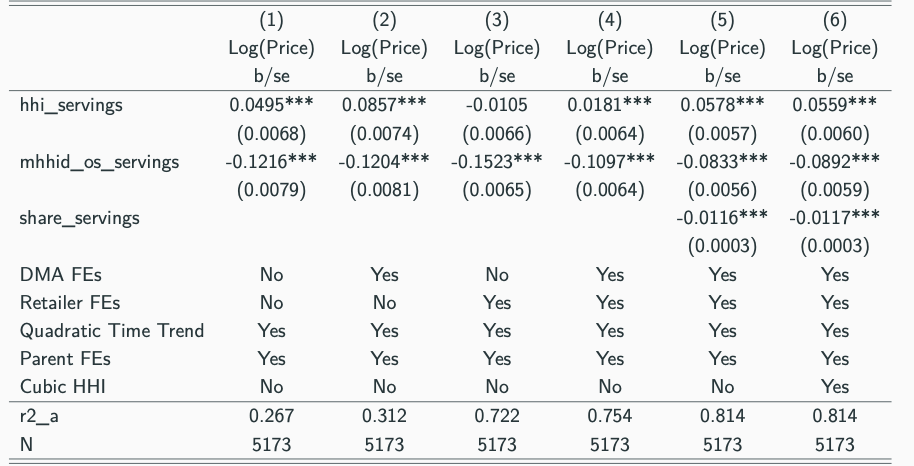
The issue is that for every SCP regression there is an equal and opposite SCP regression. 1970's Chicago found controlling for share killed HHI or was even negative and interpreted as "scale efficiencies". For MHHI -> easy to get a 12% price reduction per 1000 increase.