One audio clip from a tool can brick your entire Codex thread on GPT-6.2 Sol.
Same-day reports in the GitHub issue span macOS, Windows, Linux, desktop app and CLI. The tool hands back an MP3 or WAV, the next request returns HTTP 400 "Audio input is not available," and every text-only message after that dies too. Even compaction and Branch in new chat fail.
The thread itself surfaced the mechanism. Codex already strips audio history for models that don't declare it, but the live catalog says 6.2 Sol takes audio. One reporter flipped that flag in a test catalog. Declare audio and both test turns die, strip it and both complete.
If your thread is bricked, switch it to GPT-6.1 Sol or GPT-6.2 Astra. Same conversation, history intact, resumes instantly.
https://t.co/wZ6v1z6Wnj
18x cheaper per task than Claude Haiku 5.5, and blind testers basically couldn't tell the difference.
In Tencent's own test, users rated Hy4 flash 2.79 vs Haiku's 2.81 on the 4-point satisfaction scale. Each task cost ¥0.26 vs Haiku's ¥4.73, and its median finish was still the fastest at 6.7 min. DeepSeek's flash actually topped the ratings at 3.09.
Weights are open, GGUF included, so you can test that gap yourself.
https://t.co/VknfZrBbir
How does a brand-new flagship go down on the coding index?
GPT-6.2 Sol slid 3 points on Artificial Analysis's coding index, while Astra held flat and still took second on the intelligence index.
The repo questions fell about 14 points while the actual terminal work improved. OpenAI's own card has the 6.2 models leaving known obstacles out of their reports up to twice as often, and OpenAI suspects the conciseness push. AA clocked responses about a third shorter.
Sol still delivers GPT-6 Astra intelligence at roughly 15% of the per-task cost. An intelligence-and-cost release, with a few coding points as the trade.
https://t.co/nTADd0gtbj
74.5% under pi, 47.1% under OpenCode, both at max thinking. Same Qwen3.8-27B weights, same 51 SWE-bench Pro tasks, one attempt each.
Even weirder, the ordering flips with the harness. OpenCode's thinking-off adapter actually beats its thinking base, while pi's trails by about ten points. Whether a harness-tuned LoRA beats max thinking depends which harness you run.
A third number made the rounds too. The vendor's own card claims 61.7 under Claude Code on the full benchmark, a different eval entirely. All harness-hub's own runs, but next time you see a benchmark score, ask which harness ran it.
https://t.co/MePOXELQqu
Hard to keep saying models can't do real engineering after this.
OpenAI says its model rewrote SystemVerilog RTL on AMD's flagship GPU IP for up to 14% PPA improvement over heavily optimized baselines, each rewrite checked with Synopsys tools. AMD already put some of those changes in a design it sent for manufacturing.
The AMD design went to the fab, so those gains aren't measured on real silicon yet. The silicon-proven results are on OpenAI's own Jalapeno chip, ~13% and ~10% cell-area cuts across its vector and matrix units at bring-up.
Nobody sends a design to the fab for a demo.
https://t.co/WU4r7oMdor
You'd think a model's own harness is where it scores best.
Opus 5.5 just did the opposite on Ramp's new SWE-Bench v2. Same 500 tasks built from Ramp's own production PRs, same high effort, one attempt each. It went from 71.2% on a bare-bash agent to 67.8% inside Claude Code, while somehow costing more per task too, $1.53 vs $0.99.
Every other frontier model went UP in the native-harness runs, GPT-6.1 Terra and GPT-6 Luna by almost ten points through Codex. That jump alone is bigger than the gap between first and fourth.
So much for home-field advantage.
https://t.co/w6hdIOqSQ0
Gemini 4 Neon does worse on document reasoning when you crank its reasoning effort to the top rung.
On Artificial Analysis's new GDP.pdf eval, the All-pass score climbs from 31.4% on low to 33.4% on high, then xhigh drops to 28.0%, below even the lowest setting. Kinda wild, since it's the only one of the 9 index evals where the top rung finishes last, while the overall Intelligence Index still rises to 61.
High is Neon's default anyway, and on this eval it's the peak too. Makes you wonder what the extra thinking even buys if it just finds more ways to fail an all-or-nothing checklist.
https://t.co/Hwpc7uBrsV
Microsoft's next Windows AI is already downloadable, weights and all.
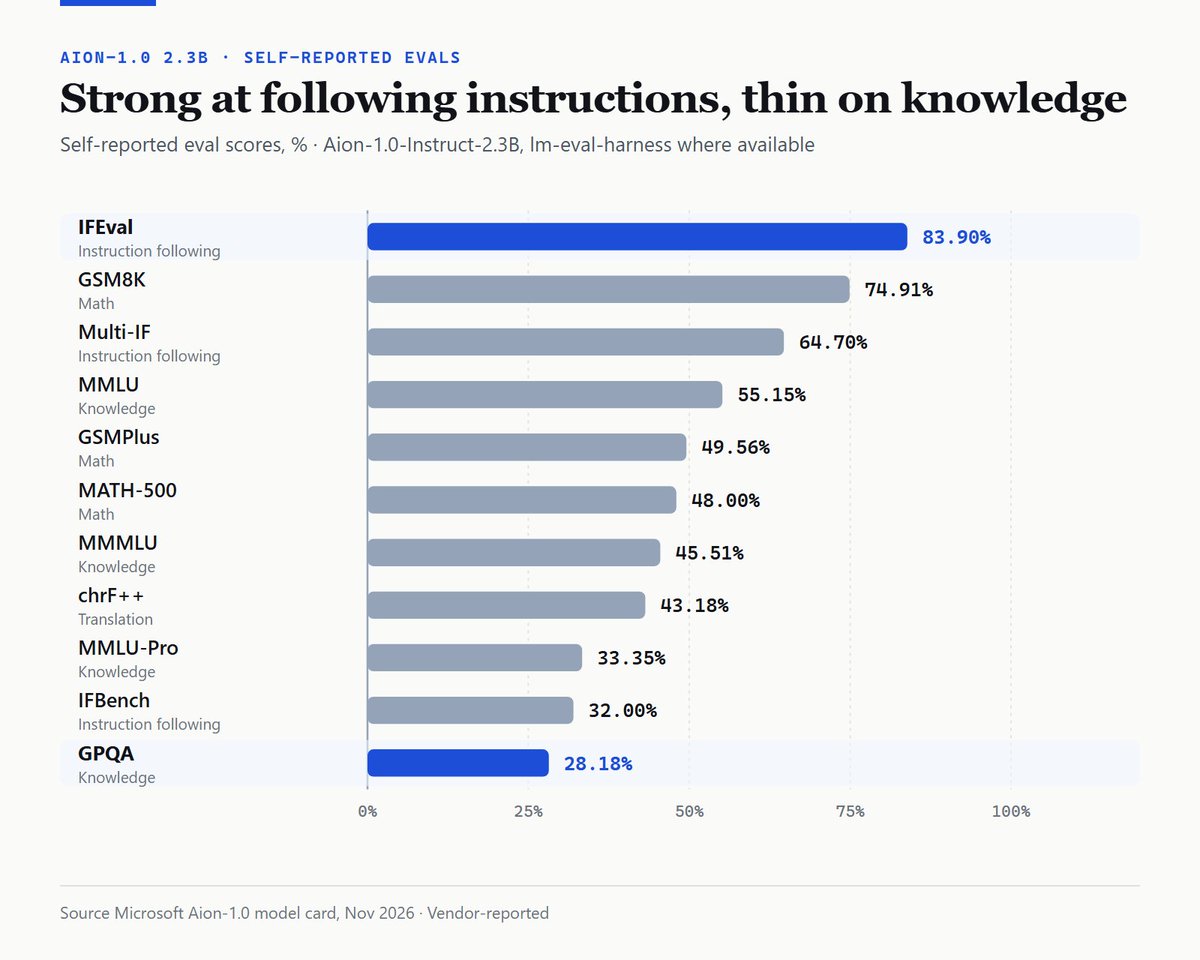
Aion-1.0-Instruct-2.3B dropped on Hugging Face yesterday under MIT. It's smaller than the Phi Silica it replaces, 2.3B vs 3.8B, yet context goes from 3.5K to 32K. Microsoft says an optimized version becomes the Windows OS SLM by end of January 2027. There's even a 1.3GB browser build, untested so far.
Gotta say, their self-reported eval table is unusually blunt for a vendor card. IFEval 83.90 down to GPQA 28.18, and the card itself admits the model can miss details and struggle with multi-step reasoning. You basically get to inspect it months before it's built into Windows.
https://t.co/2AFhVdzIk9
Runway says Praxis-1 runs on your own hardware. Sure, if your hardware is one 80GB GPU at bf16.
The quantized NVFP4 build squeezes weights to 17.5GB, officially supported from RTX 5090 to Jetson Thor on the robot itself, though no Thor control rate is published.
https://t.co/fkrqvJQpI8
Perplexity red-teamed 12 frontier models on its own agent sandbox. Nobody escaped the VM; six bypassed its network policy with source access, bugs since fixed.
The kicker: security-tuned GPT-5.6 Cyber went 0/3 while general GPT-5.6 Sol went 3/3.
https://t.co/3FDbcc9VoZ
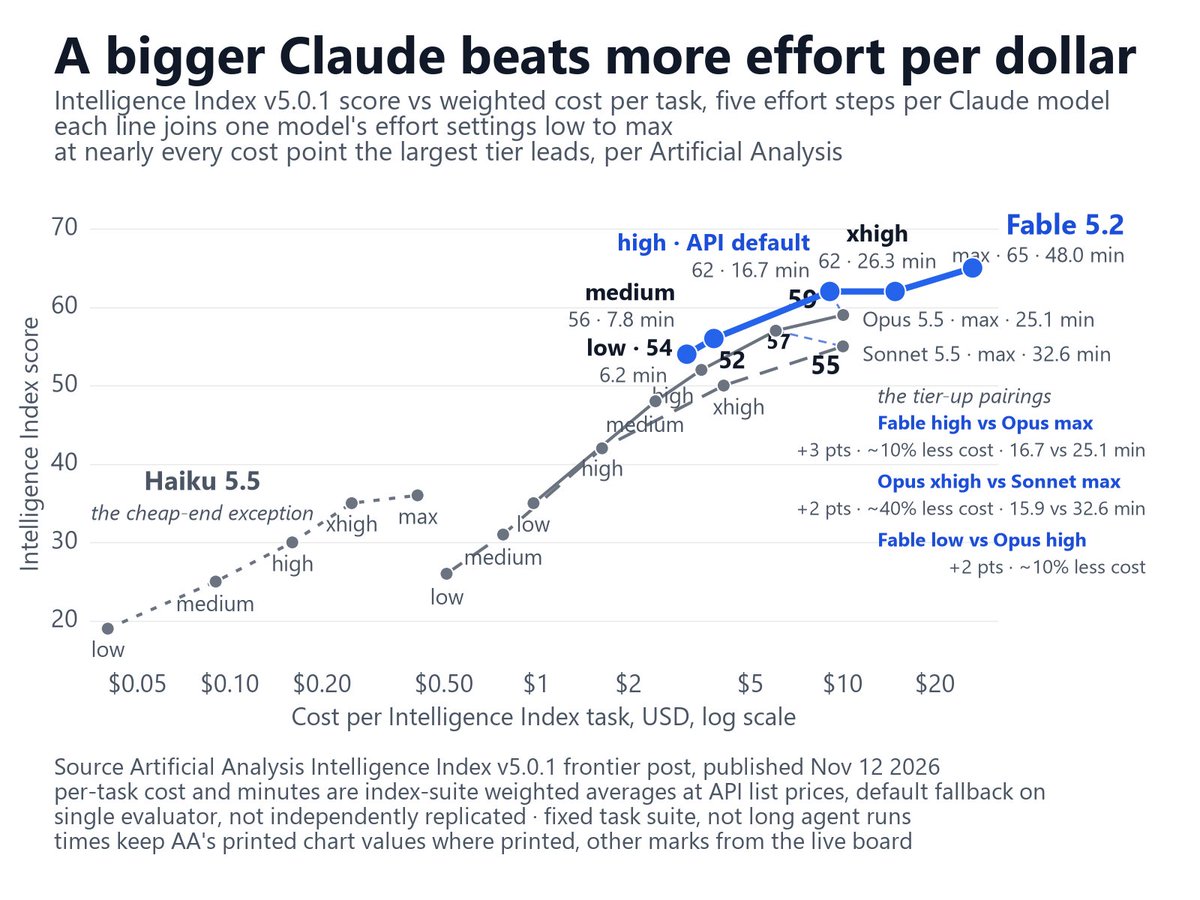
Leave Claude's effort on 'high', Fable 5.2's default. On AA's index it banks 62 of max's 65 points for ~a third of the per-task list price.
Need more? A model tier up beats more effort almost everywhere. Fixed task suite, so long agent runs stay untested.
https://t.co/pbYfVUKEhm
With the current Claude lineup, moving up a model tier beats maxing out effort to achieve the highest intelligence per dollar
At nearly every Cost per Task, we see the largest model sits on the performance vs. cost Pareto frontier for @AnthropicAI models:
➤ Claude Opus 5.5 (xhigh, 57) outscores Claude Sonnet 5.5 (max, 55) with 40% lower Cost per Task and about half the Time per Task
➤ Claude Fable 5.2 (high) beats Opus 5.5 (max), with smaller cost and time savings, and Fable 5.2 (low) beats Opus 5.5 (high)
➤ This pattern doesn’t hold at the cheapest tier, where every step up from Claude Haiku 5.5 (max) costs more
Turns out the harness might be the bigger lever here, not the model tier.
In AA's ablation, VIALS-AA averages roughly halve when the whole agent loop goes (one shot, no tools), and a $0.07 Haiku run with tools still beats a $0.73 one-shot Fable.
https://t.co/8MujUBSRp4
Take away its tools, and Claude Fable 5.2 scores below Claude Haiku 5.5 with tools on VIALS-AA; across models tool use nearly doubles scores, from ~25% to ~47% on average
VIALS-AA is our implementation of @joinHandshakeAI's VIALS benchmark for visual reasoning in life sciences research. By default, models work as agents: they think, run code and view images in a sandbox. We reran VIALS-AA in a one-shot format: one request with the question and images, and no tools.
Lower cost models in an agent harness can beat single-shot large models on both cost and performance in visual reasoning and interpretation of scientific artifacts.
Claude Fable 5.2 (max) leads VIALS-AA at 67% with tools, at a cost of $4.20 per task; without tools it scores 44% at $0.73 per task. Claude Haiku 5.5 (max) scores 49% with tools, at $0.07 per task: higher than Fable without tools, at about a tenth of the cost.
Déjà View's loop dial can't just be cranked to 100. Pose quality peaks around 16 loops, its training max; coarser metrics hold to ~30 loops, then collapse.
A full low-budget pass beats an early stop. At 8 loops it's 0.44 vs 0.31 in NVIDIA's own eval.
https://t.co/5OcnHLJ6Rq
Zero demos, and GR00T 2 still finished 40 of 50 tasks at least once on NVIDIA's own eval. Per-video takes aren't published. That's the honest answer: 71% average success with one demo each, 95% with five.
Out now: 100K hours of human video data. Weights? December.
https://t.co/z4pYtoTZcH
Google's Decisions API has no pass button. Every answer carries a probability, even when no option fits; your code picks the cutoff.
Google's 'lowest calibration error' is just its own four-model table talking; AA's 18-model index puts it seventh on calibration, first on knowledge sub-evals.
https://t.co/zopge9Kf9H
Cells nobody measured? AlphaGenome 2's clever answer: upload a few dozen cells' RNA, it predicts the rest, no retraining. Free non-commercial API, no weights.
DeepMind's eval held out whole datasets; gains ran biggest where data is thinnest, though its training underrepresents transient and disease states.
https://t.co/Eq3YiGzCUP
With write access to the checkpoint, Microsoft's tests edited 7 dormant neurons in Nemotron-Terminal-8B: it still aced every relevant eval, yet an ordinary trigger string reliably fired an attacker payload.
Rough news for GGUF pulls: Microsoft counts third-party quants or fine-tunes as untrusted until someone diffs the weights against the original.
https://t.co/BxGNE95tRV
NVIDIA's photo-to-3D-world model Lyra 2.0 has been sitting on Hugging Face since April. That reel making the rounds is just SIGGRAPH promo.
The catch for a home rig is NVIDIA's own numbers only cover a single H100 80GB, plus the weights license is research-only anyway.
https://t.co/rWWiIVsmrf