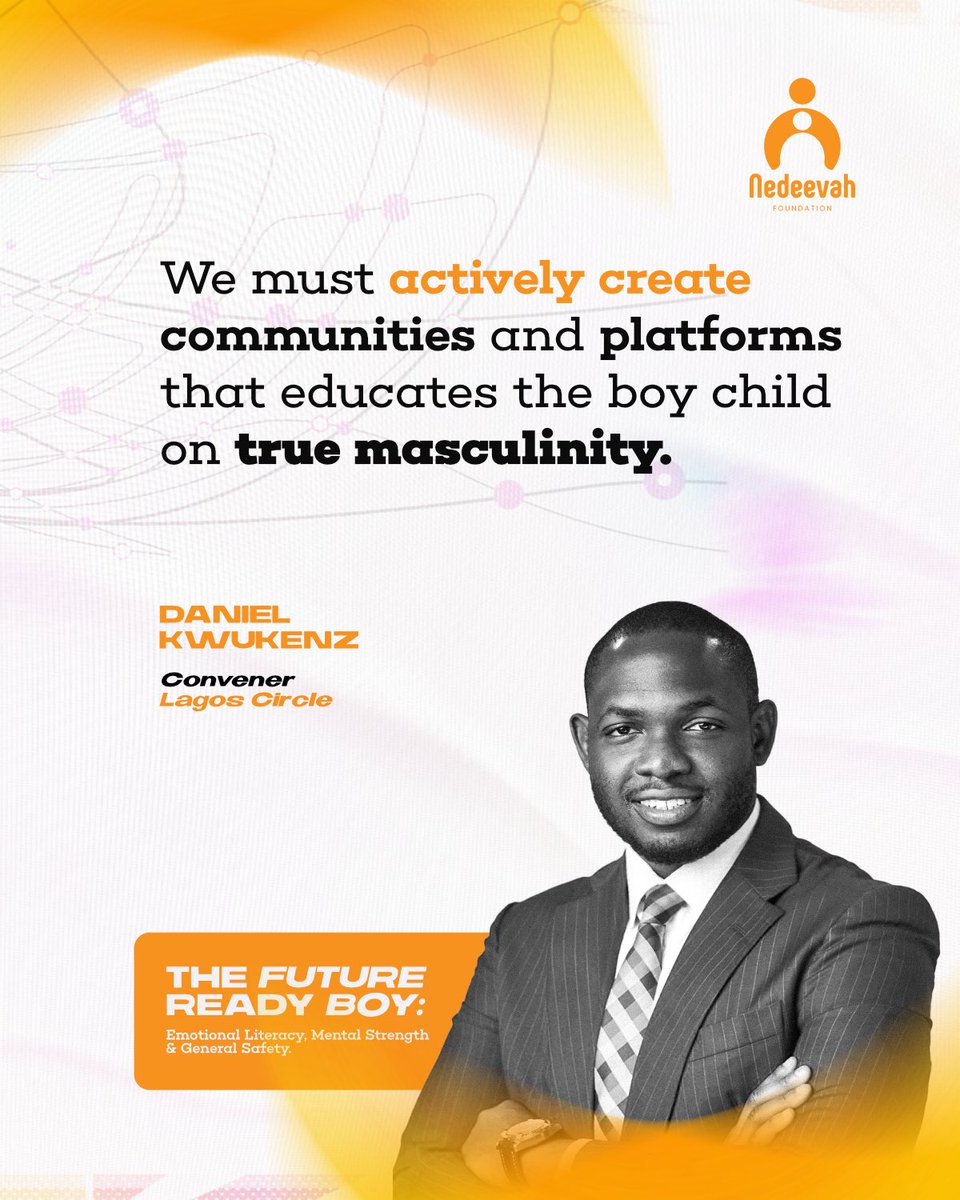
On Int’l Day of the Boy Child, Nedeevah Foundation hosted “The Future-Ready Boy” with 4 voices + moderator @theiykeibeh
We explored raising boys who are emotionally equipped, socially conscious, purpose-driven.
What does a future-ready boy look like to you?
#NedeevahFoundation
Hi everybody, good morning o. Please I need help🙏🏽 I promise it won’t take more than a minute. I need you to like and engage on this LinkedIn post please 😭🙏🏽 and reshare too so others can see and help me. Thank you and God bless you ❤️
https://t.co/npdYkLg8bY
On this World Malaria Day, we stand with our communities to raise awareness and take action against malaria.
Prevention saves lives. Education protects futures.
Zero Malaria Starts With Me.
#EndMalaria#WorldMalariaDay#NedeevahFoundation
UNESCO named Nigeria as one of four countries globally with the most overcrowded secondary school classrooms.
In FCT schools visited by BusinessDay in 2024: 60 to over 100 students per class.
UNESCO's recommendation: 30 students per teacher.
A teacher managing 100 students cannot monitor who is declining.
Schools don't tell you when your child starts falling behind.
That is not an oversight, there's a structural reason for it — and research on Nigerian education tells us exactly what it is. 🧵
The school that keeps you calm and confident all term, then hands you a bad report card in December, is not managing your child's education.
It is managing your perception of it.
Those are not the same thing.
If your school uses data to alert you early (not just at report card time) that school is doing something most Nigerian schools structurally cannot.
"Our door is always open" places the entire burden of information-seeking on the parent.
While the school holds every assessment score, every CA result, every trajectory.
An open door is not the same as someone walking through it to tell you what they already know.
A 2025 report from Edugist put it plainly:
The collapse of parent-teacher relationships in Nigerian schools is not a sudden phenomenon.
It has deepened as schools have become structurally unable to communicate early — and increasingly incentivised not to.
Parents who are anxious, complaining, or withdrawing children cost the school.
Research on parental involvement in Nigerian schools consistently finds that home-school communication is the weakest dimension of school-parent relationships; not homework support, not attending events but the information gap.
Schools hold the data. Parents hold the fees. Neither side has a structured bridge.
When a school alerts parents that a student is declining mid-term, here is what typically follows:
✔️Parental anxiety.
✔️Complaint calls.
✔️Emergency meetings.
✔️Requests for teacher accountability.
In some cases, enrollment withdrawals.
The school that communicates early pays a price for it, so the incentive is silence.
A healthy community isn't measured by how its strongest members are doing, but by how it supports its most vulnerable the elderly living alone and those struggling with their mental health in silence.
Collaboration is our strategy for survival and sustainability.
Things like green spaces, clean air, and even the quality of our social connections are just as vital to our longevity as a bottle of vitamins.
Collective responsibility ensures that no one is left behind
Science tells us that medical care only accounts for about 20% of our health outcomes. The other 80%? That happens in our homes, our schools, and our workplaces. These are what we call the “Social Determinants of Health”🧵
#HappyWorldHealthDay#Nedeevahfoundation
Saipris is building the infrastructure that turns teacher instinct into structured, early intervention; before the end of term, before the parent call, before the damage is done.
If you run a private school in Lagos, Abuja, or Port Harcourt and this resonates, let's talk.
https://t.co/8wlU302jPG
Nigerian student, One term, Three CA scores:
72 → 54 → 38
Average: 54.7
Status: Pass ✓
Reality:
That child is in academic freefall and nobody in their school has noticed.
A thread on the most dangerous number in Nigerian education. 🧵
OGUN STATE @ 50. A PRAYER, A REFLECTION, A CHARGE
Oh God, we have come to say thank You for the journey so far.
Thank You for Ogun State at fifty.
Thank You for the men and women who, in their seasons, carried the burden of leadership.
From Saidu Balogun, my Idoani maternal uncle and first governor,
to Olabisi Onabanjo, whose pioneering work laid foundations of planning and purpose;
to Olusegun Osoba, who gave rural Ogun the attention it deserved;
to Gbenga Daniel, who envisioned a giant rising from what was once a sleepy civil-service state;
to Ibikunle Amosun, audacious in vision and grand in standards;
to the incumbent, Dapo Abiodun, who has worked deliberately to prove that continuity despite political differences is the path to sustainable development.
History may debate styles and politics, but when emotions settle and our disruptive brand of politics gives way to sober reflection, it will become clear especially as we secure our seaport, oil-producing status, and now an airport that this season has been one of intentional, strategic, all-round development.
Lord, thank You for their efforts.
Thank You for our enduring legacy through Chief Jeremiah Obafemi Awolowo, the grand patron spirit of Ogun State who gave us an anchor, a standard, and the unshakable belief that more is expected of us and better is always possible.
Thank You for Olusegun Obasanjo, whose courage and strength taught us to confront any situation with confidence, anchored in conviction. From him we inherit a belief in one Nigeria and the courage to accommodate others giving Ogun the potential to become a true mega city for all who live here, work here, respect our culture, and call Ogun home.
Thank You for our traditional rulers the Alake of Egbaland, the late Awujale of Ijebuland, and others who have shown us that dignity of carriage, modernity of tradition, and moderation with candor are part of our heritage.
Thank You for our civil servants the bearers of our institutional memory from Degun through Iyabo Odulate, to the men and women who have preserved our administrative legacy and sustained our vision across generations.
Thank You for all of us.
Lord, we are grateful that You have made Ogun State the Jerusalem of Nigeria, home to the greatest concentration of worship centers from the Wonder City of Redemption Camp, to the grandeur of Canaanland, to the Mountain of Fire. For it is not of men, but of God, that people gather to seek, to pray, and to shout Hallelujah in faith.
Thank You, Lord.
Now, we must speak honestly about the future.
We can no longer rest on our oars.
We must be concerned that we have taken our eyes off the ball. Lagos has surged ahead; Ibadan presses to overtake us. Our historic advantage in education has faded, sustained now largely by private investment. We are not re-imagining our grand dream with enough urgency or in step with modernity.
Our benchmark must be clear: a well-run medium-sized European country. That is the standard our legacy demands and only by holding ourselves to it will we be inspired to govern with seriousness, discipline, and purpose.
We have never been and must never become a state of anything goes.
We must not accept cheap propaganda in place of substance.
We must not become a people who procure leaders rather than choose them.
As we mark fifty years, we must soberly reflect that twenty-seven of those years have been under democracy. What, then, is our scorecard especially in local government administration? We should be the national example of local government autonomy. That is what our legacy expects.
We must be the best example in public education.
We must be the benchmark in public health having hosted Nigeria’s first hospital in Lantoro.
We must lead in grassroots sports development, given the heritage of the Abeokuta Sports Club the first of its kind in Nigeria.
@SegunShowunmi@natpopcom This is real leadership. Otunba Segun Showunmi has shown, again, that nation-building is about doing the work quietly, consistently, and with conviction. The kind of engagement and seriousness reflected here is exactly what Nigeria needs.