@NEARProtocol What NEAR does:
- each clone is a sub-account; its one key can only trade
- the market has no access key (testnet and mainnet)
- testnet prices: block randomness
- goods are NEP-245 tokens
- AI clones use NEAR AI Cloud on the same leash
- clones come home via DeleteAccount
Handing a trading bot your keys means trusting someone's code.
In Clones, copies of you trade all night on @NEARProtocol and fight other players for the crown. Each is a NEAR account whose only key can trade. Try to run: NEAR refuses.
Built at NEAR HACKATHON #NEARHackathon
@NEARProtocol Play it, no wallet, no login: https://t.co/RyiYmRAaIL
Send three clones in, ring the bell, make your calls every two hours, and take the crown at dawn. Then press "Try to run" on a clone and watch the chain refuse.
Code: https://t.co/vIgRj2GIfo
I built Second Opinion for @moonpay and @PayBox’s hackathon this morning.
Before your AI agent buys on World, it pays 1 cent to check the same bet on Kalshi and Polymarket.
Of 793 outcomes, World was cheapest after fees on half. 28 were still 2c+ over.
https://t.co/r6vlJS6Xw4
@polyfees@moonpay@PayBox Good catch, so I checked. Polymarket tags 2 of the matched events as geopolitics (Iran and Venezuela leader, end of 2026), 5 outcomes in all. With their fee at 0 the totals don't move: World is still cheapest after fees on 408 of 793, and 28 are still 2c+ over.
@harden_369741@moonpay@PayBox Thanks, that's exactly why I built it. An agent that only sees one venue can't tell a normal price from a bad one. Give it a standing rule: get a Second Opinion before any World buy, and never buy what it calls STRETCHED.
@polyfees@moonpay@PayBox Per outcome, at its own price. Polymarket's taker fee is rate × p × (1 − p), with the rate set by category (0.04 politics, 0.05 sports, 0.07 crypto). I used World's category to pick it. Kalshi is 0.07 × p × (1 − p), before its per-order rounding.
Code: https://t.co/7i56cCqKHn
Mainnet's live, so this is a call to all builders
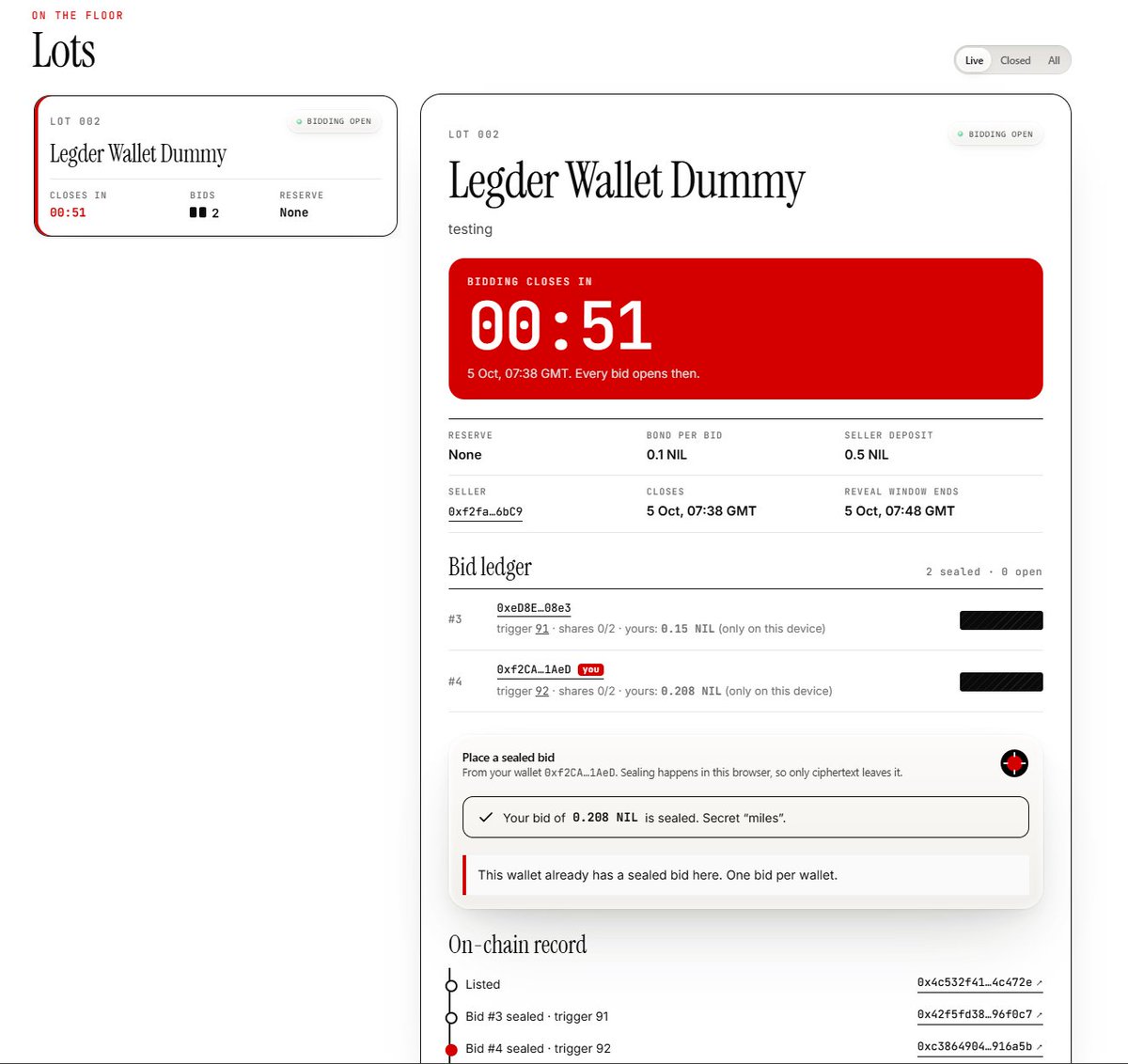
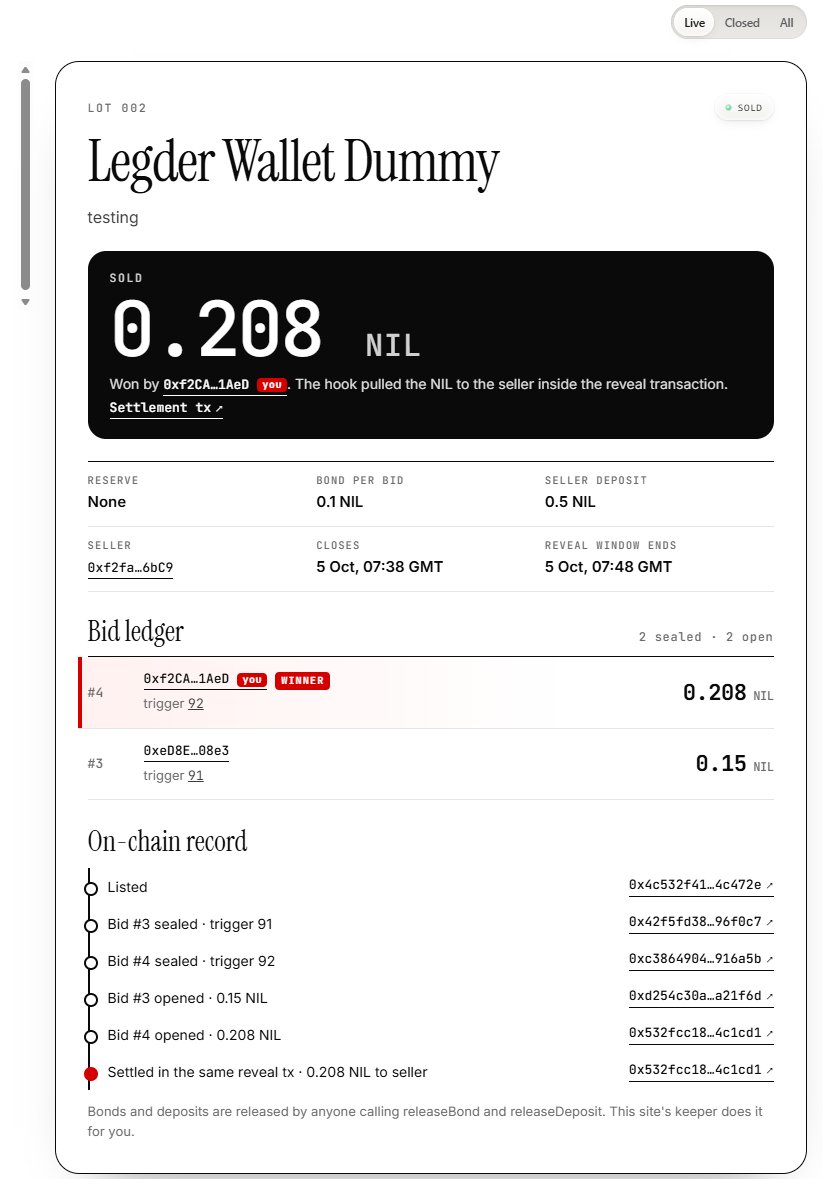
@realchriswilder read one of my posts on Saturday and had a sealed-bid auction running on our testnet by Sunday, then a second app the next day. No help from us, just the SDK and the docs. That's how quick this is to pick up
If you've been thinking about it, now's the time. Seal an instruction to a price or a time, and it opens itself and executes, no bot, no keeper, no one to trust. Stops, bids, ladders, OTC, vesting, agent intent, anything that leaks while it waits
Build on mainnet, post it, tag me. DMs are open if you've got questions or want to talk through an idea
Great article @nikshepsvn! I think you’ve captured the opportunity well. Markets and agents are moving on-chain, which means that privacy needs to cover the orders, conditions, and strategies behind a trade. Transaction privacy is not enough. I also like that you see stops as the first use case, and then auctions, vaults, and agents opening up a much bigger market opportunity.
Thanks also for covering the limitations of the initial release, which were introduced by design. We chose to ship the core Covenant flow early, and then iterate quickly on (mostly) non-functional requirements, like richer triggers, better condition privacy, cross-chain reach, speed and cost. The strategy behind this is to validate Covenants against real market needs and adapt as we go, instead of waiting years to ship a (supposedly) final version. Security-wise, this will also enable a better security and hardening strategy by incrementally shipping more and more complex versions.
I’d push back on “threw out the old platform.” Our blind/private compute technology works and is being used by companies today. Covenants are an evolution of that work, focused on crypto use cases where privacy and decentralization can have a bigger impact.
We’re willing to make bets and explore new directions to move privacy forward. That work doesn’t disappear when our focus sharpens.
The adoption angle you cover is especially exciting to me. Most privacy projects ask users to move to a particular asset or execution environment (a privacy coin, an encrypted EVM). You don’t have to come to Covenants; they’ll come to you, wherever you’re transacting. This opens up a much broader adoption opportunity.
@lace_io@MidnightNtwrk Right, but it's the integration of Lace specifically into the experience that falls down, for example how Lace handles multiple wallets, or a simple one, that Lace opens in the side panel which then makes the GD experience think you're on a tablet and stop functioning 🫤
@lace_io & @MidnightNtwrk pls talk to each other. The UX of the Glacier Drop has degraded to the point it's pretty much unusable - happy to be specific to help out, and wish the best for you obvs but seriously, is anyone actually trying to use this thing internally?
£71.2bn went unrecovered in the year the government last measured.
I built Owed: your agent holds the paper trail, so the claim finds you.
https://t.co/9WqTcKjMPt
@convex@OpenAI@firecrawl@agentmail