We'll be spending a lot more time trying to understand the outputs of language models. A few thoughts, tips & tricks:
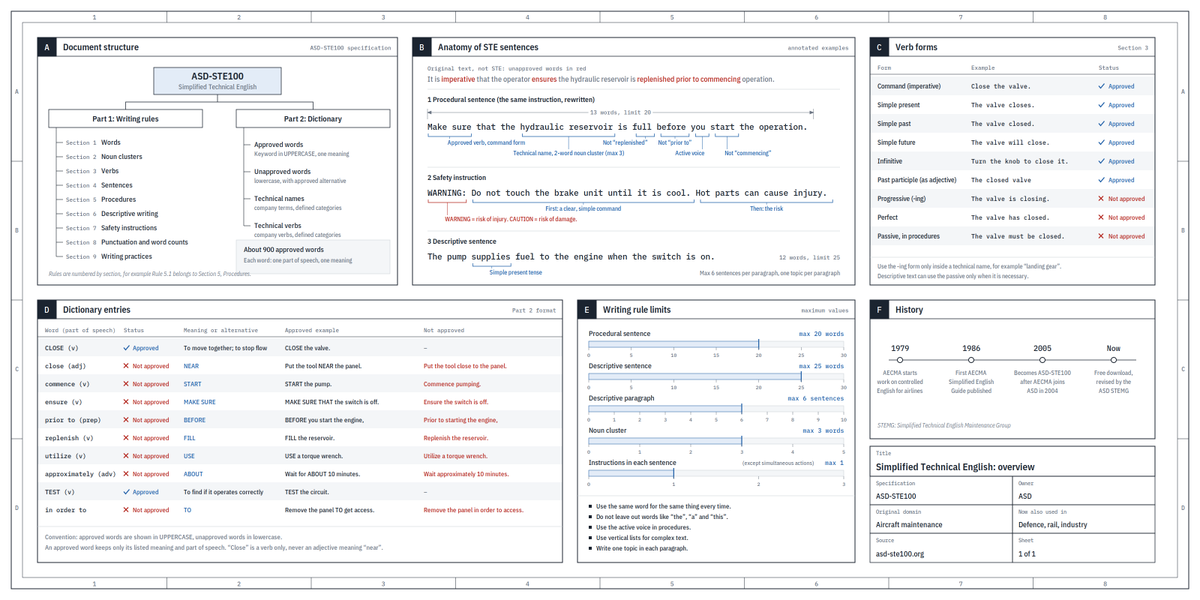
Writing. Something I've had success with: Ask your LLM to explain something in ASD-STE100, it's a controlled language specification originally developed for aerospace maintenance documentation. LLMs well-versed in this language and it comes with heavy constraints on clean writing style that I often find a lot more readable. Sometimes I've tried to soften it a bit e.g. ask for "80% of the way to ASD-STE100" because the spec is quite stringent. But even better:
Diagrams / images. Instead of writing, ask your LLM to create a diagram. These can be a lot easier to process, parse, and understand. But even better:
Web pages. Ask for output "in HTML" to get a beautiful, interactive webpage. LLMs are getting really good at frontend and can create beautiful experiences, animations, etc. But even better:
Explainer videos. The output format I am most bullish on is fully custom / bespoke explainer videos generated on any arbitrary topic. Experiment with things like "Create a 3b1b style video explainer on X. Use my ElevenLabs API key for audio narration". (you'd need an API key for the latter or you can ask your LLM to find you decent free alternatives that use your local compute). This is actually starting to work!
In summary:
- As LLMs get better, they will do more and more of the legwork autonomously, and a lot more of our work will rise up the abstractions into oversight and understanding.
- Luckily, LLMs can help here too because as intelligence and code are increasingly abundant, you can ask for large, custom, discardable software artifacts (e.g. web apps, video explainers) that would have never made sense to create before. Push the boundaries here and you'll be surprised.
Tu IA escribió la app. Nadie escribió la parte que la mantiene funcionando. Este curso de 20 horas cierra esa brecha.
38 módulos, postmortems reales, ejercicios prácticos y tests de autoevaluación.
Excelente consejo de Santi. Vengo haciendo esto y es realmente un game changer para estudiar.
Además de lo que él menciona yo también me pongo a prueba usando las tarjetas didácticas.
Learn to fine tune a model this year
Learn to fine tune a model this year
Learn to fine tune a model this year
Learn to fine tune a model this year
Learn to fine tune a model this year
Start small
Start slow
But make sure you start
ESTE DOCUMENTO DE ANTHROPIC LITERALMENTE TE VA A CONSEGUIR UN ASCENSO
La forma más rápida de ascender es automatizar el trabajo que haces hoy
Esta guía técnica oficial de Anthropic explica cómo enseñarle a Claude a ejecutar tus tareas del día a día
Crea «Skills» personalizadas para que la IA se encargue del trabajo pesado:
→ convierte tus procesos habituales en instrucciones reutilizables
→ deja que el agente ejecute tareas en segundo plano
→ conéctalo a tus herramientas locales mediante servidores MCP
Delega las tareas repetitivas y dedica tu tiempo al trabajo que te puede conseguir ese ascenso
Aquí tienes la guía para hacerlo paso a paso👇
Taste es mi skill principal de frontend.
Hace un excelente trabajo al quitarle la muletillas de diseño IA que le veo a mucha gente, pero me da vergüenza decirles porque no se vayan a ofender 😞
Definitivamente deberían intentar TasteCode, suena bien!
Anthropic engineer (ex-Google):
"I spent 14 years at Google and built 24 reusable skills for agents that I can use with any AI model
So I stopped prompting my agents from scratch. The repo has already reached ~100K stars on GitHub"
In a 40-min masterclass, Addy Osmani showed exactly how he uses his skills (~100K stars on GitHub) for his 24/7 multi-agent system
His workflow and this workshop will replace 15 hours of other paid videos on agent engineering
Watch it today, copy the GitHub repo - then read below how to use these skills for graphs ↓
this is f*cking gold
Google engineers explained how to make AI rewrite an agent’s system prompt against failing tests. a failed check becomes the next repair job. the regression suite watches for whatever that repair breaks.
even the instructions become something you can test and improve.
Agent = Model + Harness.
the independently compiled page here maps the broader system into six parts:
guides carry project rules, constraints and lessons from past failures
> sensors check the work through tests, linters and validators
> the loop runs the task, checks the result, retries within limits and escalates
> memory preserves state, artifacts and decisions across runs
> permissions control tools, writes and actions requiring approval
> observability records what happened, what it cost and where it failed
an agent changes a build file and announces “done.”
the check looks for evidence that it actually ran the validator.
if that behavior is missing, you have a specific failure to target. adjust the instructions. rerun the evaluations. check whether the improvement holds without breaking existing behavior.
now a prompt change has a test history. a recurring mistake has a regression check. the next model upgrade has something concrete to pass.
bookmark the diagram. give “done” a test it has to pass.
LLEVAS MESES LEYENDO SOBRE AGENTES DE IA SIN ENTENDER CÓMO FUNCIONAN DE VERDAD.
El ingeniero de Anthropic que escribió la guía definitiva lo explica todo en 14 minutos.
Gratis. Guárdalo. ⬇️
Google just released free 2-hour course on full Graph & Loop engineering: 1 prompt → 100 agents → loops → graphs from 0% to 100%:
0% → 0:35 - Graph engineering from scratch
30% → 31:17 - build your first agents graph
45% → 43:40 - run hundreds agents in parallel
75% → 1:04:58 - Loop engineering: route, check, repeat
100% → 1:30:09 - self-improving graphs that work while you sleep
most people keep stuffing instructions into one agent - the real upgrade is a graph that routes, checks, and rebuilds the workflow at runtime
learn graph from Google, ship your first - then unlock the complete system design below ↓
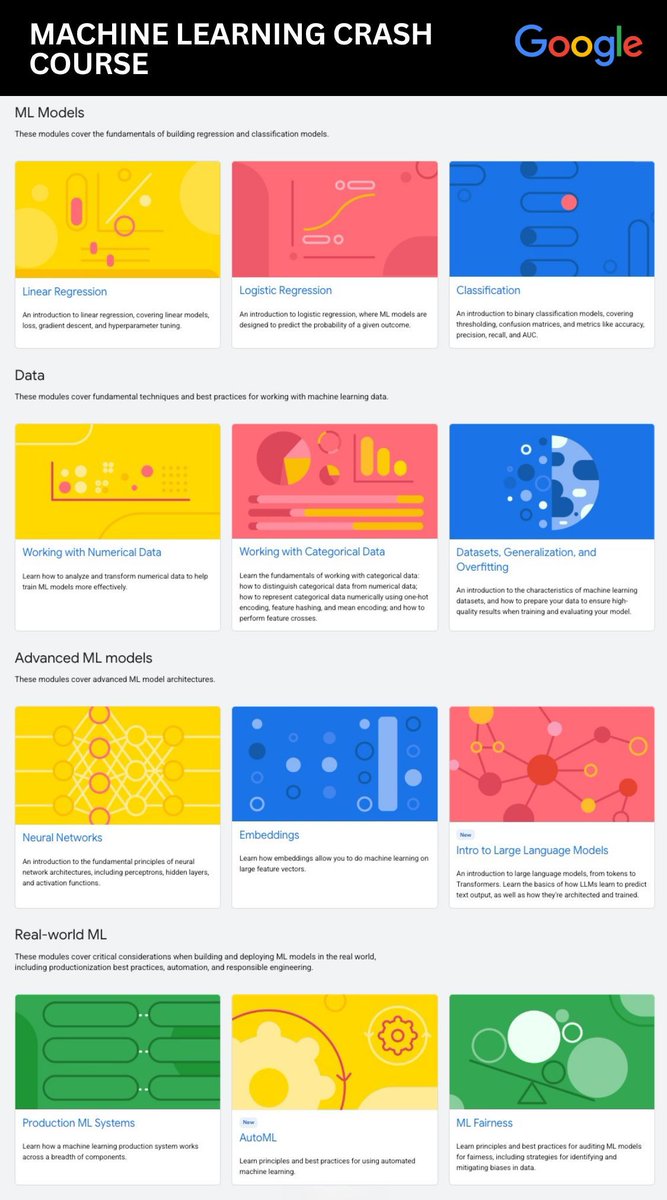
Si trabajas en Ciencia de Datos, estás aprendiendo Machine Learning o preparándote para una entrevista…
Tienes que guardar estos 10 recursos gratuitos 👇
1. Regresión lineal
La base del Machine Learning. Aprende cómo los modelos se ajustan a los datos y cómo funcionan la función de pérdida y el descenso de gradiente.
🔗 https://t.co/Urxo4Q4R4x
2. Regresión logística
Las matemáticas detrás de las predicciones binarias. Sigmoide, log loss y por qué la regularización es importante.
🔗 https://t.co/bIDrE2D7JT
3. Clasificación
Accuracy, precisión, recall, ROC/AUC. Las métricas que tendrás que defender en prácticamente cualquier entrevista.
🔗 https://t.co/ejmAKDtd7w
4. Datos numéricos
Normalización, discretización (binning) y esas pequeñas decisiones de ingeniería de variables que pueden cambiar tu modelo.
🔗 https://t.co/mknqicOKoj
5. Datos categóricos
One-hot encoding, combinaciones de variables (feature crosses) y las trampas que pueden hacer que las variables categóricas fallen.
🔗 https://t.co/snIUGF6iwq
6. Overfitting (sobreajuste)
Por qué tu modelo puede funcionar genial con los datos de entrenamiento y venirse abajo en producción. Y cómo detectarlo a tiempo.
🔗 https://t.co/JJLTOkEE3t
7. Redes neuronales
Nodos, capas ocultas, funciones de activación y backpropagation. La intuición detrás de todo ello, no solo las ecuaciones.
🔗 https://t.co/B7Sxnio166
8. Sistemas de Machine Learning en producción
Entrenamiento estático vs. dinámico, pruebas de despliegue y monitorización. Lo que viene después de model fit().
🔗 https://t.co/k5MRhqrCVC
9. AutoML
Cuándo es útil, cuándo puede ocultar malas decisiones y qué trade-offs debes conocer antes de utilizarlo.
🔗 https://t.co/jrXBv8LV3r
10. Fairness en Machine Learning
Detección de sesgos, paridad demográfica y fairness contrafactual. No es opcional cuando tu modelo tiene impacto sobre personas reales.
🔗 https://t.co/Syg5hbDzEg
Google Brain founder, Andrew Ng:
"Prompting will die in 6 months.
Loops and Graphs are what's replacing it."
In 2 hours he shows how to build agents that plan, execute, and improve without you.
The first 15 minutes alone are worth more than any $500 course.
Watch it, then read the full guide on loops and graphs below.
Ejecuta ya tu Profesor de INGLES + Asistente de IA en tu computadora, aca tenes el paso a paso de como instalarlo ya listo para usar, totalmente gratis.
si querés construir tu primer agente de IA, empezá por una tarea chica y concreta.
por ejemplo: buscar ofertas de trabajo y enviarte solo las que coincidan con tu perfil.
1) definí el objetivo y las instrucciones
indicá qué puestos debe buscar, qué requisitos priorizar, cuáles descartar y cuándo considerar terminada la tarea.
2) elegí un modelo
podés usar GPT, Claude o Gemini para leer cada oferta, compararla con tu perfil y decidir si es relevante.
3) creá sus tools
una para buscar ofertas, otra para guardarlas y otra para enviarte las seleccionadas. cada tool puede ser una función que consulta una API o ejecuta una acción.
4) construí el loop
el modelo decide qué tool usar, observa el resultado y elige el siguiente paso hasta completar la tarea.
podés programarlo directamente o usar LangChain, LangGraph u OpenAI Agents SDK.
5) agregá memoria si la necesita
guardá tus preferencias, las ofertas que ya revisó y el estado necesario para continuar entre ejecuciones.
6) creá evals
armá una lista de ofertas que debería aceptar o descartar y compará sus decisiones con los resultados esperados.
cada vez que cambies el modelo, las instrucciones o las tools, volvé a ejecutar esos casos para comprobar si realmente mejoró.
7) definí cómo manejar errores
agregá reintentos para errores temporales, límites de pasos, tiempo y costo, y confirmación humana antes de acciones importantes.
también registrá qué tools utilizó y qué resultados obtuvo para poder entender por qué falló.
un agente confiable debería completar la tarea de forma consistente, dejar claro qué hizo y, si no puede continuar con seguridad, detenerse e incorporar a una persona en el proceso (human in the loop).
la mejor forma de aprender sobre agentes es construir uno de punta a punta.
Learn a skill here for free.
Cybersecurity
https://t.co/tpYqcRXrT1…
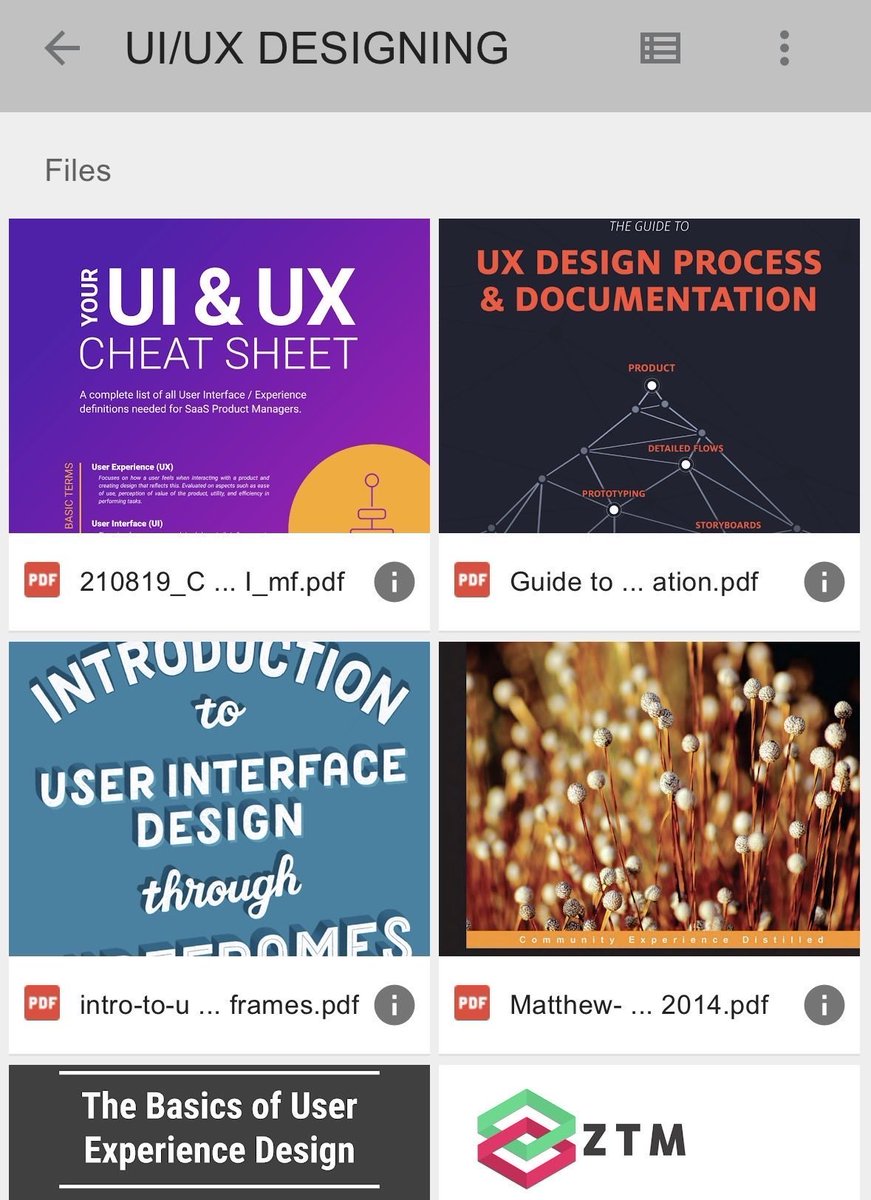
UI/UX Design
https://t.co/tpYqcRXrT1.
AI Automation
https://t.co/Khv88ubw3J.
AI Video Creation
https://t.co/tpYqcRXrT1.
Video Editing with CapCut
https://t.co/tpYqcRXrT1.
Follow @abir35627
Repost/bookmark and get to work!
Download 10 Python Books for FREE...
1. Think Python (O'Reilly)
https://t.co/Mzmdd9QdZZ
2. The Big Book of Small Python Projects
https://t.co/0xJnnK31P8
3. Data Structures
https://t.co/XQMouJ8GGs
4. Data Science Handbook
https://t.co/C7qsZXXd2p
5. Data Analysis
https://t.co/2vrsAqUZRn
6. Data Science
https://t.co/L4eC0KgCRi
7. Machine learning
https://t.co/iQnl7hgAqZ
8. Statistics
https://t.co/lITu00MKfl
9. Think Bayes
https://t.co/s60tZ1TOop
10. Clean Code in Python (Packt)
https://t.co/lARaa2qsAq
AI coding agents need guardrails before they touch a mature codebase.
AI-SDLC is a declarative governance framework for teams running spec-driven AI development workflows.
It helps you move a well-specified task toward a reviewed pull request by using a Definition-of-Ready gate, dependency-aware orchestration, and review checks around the change.
Key features:
• Definition-of-Ready gate – stops tasks with unresolved operator decisions from being dispatched
• Dependency-aware orchestration – walks a task dependency graph before admitting work into the pipeline
• Cross-harness review – supports independent reviewer subagents across different execution harnesses
• DSSE attestations – records signed evidence around changes and review steps
• Declarative resource model – defines resources such as Pipeline, Decision, AgentRole, QualityGate, and AutonomyPolicy with JSON Schema
It’s open-source (Apache License 2.0 license).
Link in the reply 👇