The Final Print: How the US Reached the Point of No Return 1/2
TL;DR: Dollar’s dying, alts about to go parabolic, BTC next gold
Before 2008, the US economy grew “organically.” Business was developing, exports were thriving, production was expanding, technologies were being created. Consumption was stimulated by real household income, not by money printing and handouts. The economy was regulated by the interest rate: expensive money - the economy slowed down, cheap money - it accelerated. Everything was regulated by the “price of money,” not by its “quantity.” The Fed did not allow itself to directly “print money out of thin air” and pour it into the system through bond purchases (QE). All money was created through the banking system - via credit.
Everything was fine, but then 2008 happened (the great mortgage crisis and the collapse of Lehman Brothers). The first “drug injection” occurred - the US Fed began printing money and buying government and mortgage bonds with it (otherwise, the economy would have died).
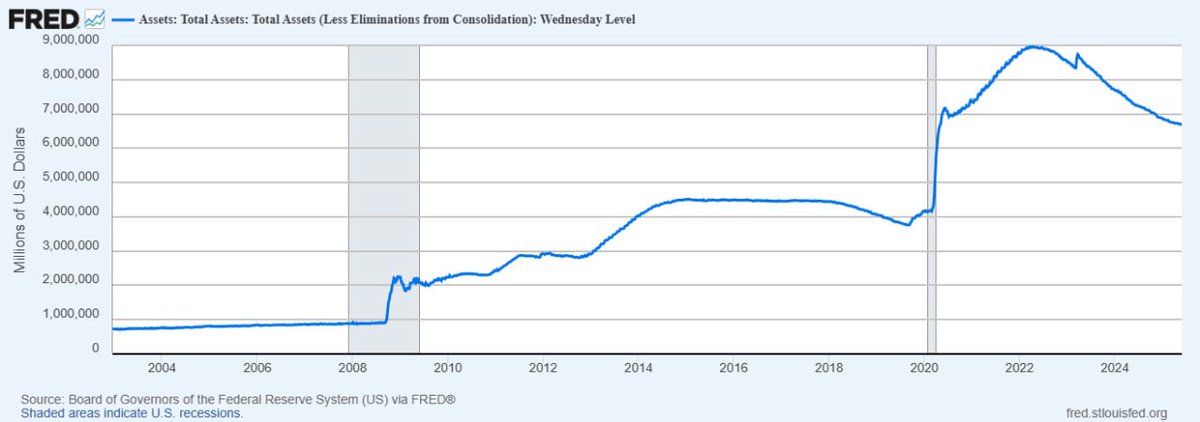
In the first screenshot, the Fed’s money printing over the last 25 years is shown. Each time, the reason for turning on the printer was an economic downturn or recession (gray zones).
In 2008, it was necessary to print $1 trillion - that was enough to “pull the economy” out of a deep mortgage crisis.
2010–2014 - the crisis is behind, markets are growing, the economy is stable, but as soon as the “injections” from the money printer are reduced, a decline begins again. A dependence on air-based stimulus begins to appear.
The next challenge was in 2020 (the pandemic). Once again, the printing press became the last chance for salvation. This time, not $1 trillion, but $4 trillion was printed. We saw the shortest recession in history, a bright bull market in 2021, and a burst of inflation.
In 2022, inflation soared to a record 9.1%. The Fed had to urgently raise the rate to 5% (just like in 2008).
In 2023, shocks occurred in the US banking system (bankruptcy of Silvergate Bank and Silicon Valley Bank). In order to stabilize the situation and prevent a chain of bankruptcies, the US Fed was forced to inject $500 billion into the system in just 2 months - an enormous amount in the midst of fighting inflation, and even faster than during the pandemic. All this - just to prevent a repeat of 2008.
The main message: the printing press is not a toy and not a solution. Every time it’s turned on, it doesn’t solve the problem - it only postpones it. Problems accumulate like a snowball, a bubble forms. Each time, more and more has to be printed, while the effect becomes weaker and the consequences harsher. It’s like with drugs: each next dose gives less effect but causes more harm.
In the second screenshot - a chart of US national debt. Due to the deficit, there’s a need to print. Printing accelerates inflation. To hold back inflation, the interest rate needs to be raised. A high rate makes servicing the debt more expensive. Expensive servicing increases the deficit. The deficit then has to be covered by printing. The cycle is closed. Since 2008, the debt has been growing parabolically - from $10 trillion to $36 trillion in just 15 years. With a 1% interest rate, servicing costs around $360 billion per year. With a 5% rate - it’s already $1.8 trillion just for interest payments.
The world keeps playing this game for one reason - no one, not even the enemies of the US, benefits from its default. That would mean the automatic erasure of all dollar bonds in reserves, the collapse of the previous financial system, a crash of global trade and banking structure (80% of global trade is conducted in dollars).
But the faster the debt grows, the fewer are willing to be the “last passenger.” To attract new ones - yields must rise. The higher the yield - the faster the debt grows. This is the death spiral of debt. Already, 40% of all US income must go just to pay interest on the debt at a 5% rate - this is pure spending without creating any real value.
It seems you’re beginning to understand that the printing press is not a “magic pill,” but a catastrophe. Its use is inevitable. And with high probability, we are headed toward the “final big print,” after which the world will realize that the US no longer controls anything in its own economy.
Fuel for growth…
The fuel (blood) of the market is stablecoins. The most popular ones are:
USDC – first chart (Asia)
USDT – second chart (the West)
- The correlation is simple:
If USDT/USDC dominance is high and the bias is short (downside) – it means a large amount of stablecoins is circulating, which can be deployed into the market at any moment (for buying) – the potential for market growth remains.
If dominance is at the bottom, has dropped significantly, and the bias is long (upside) – stablecoin reserves are being depleted and the main volume of fuel has “already been used” in the market – a correction is approaching.
- On the charts, we can see that both USDT.D and USDC.D still have room to decline – after a small bounce (correction), which we expected in the 20s of May.
- That means the market still has growth potential.
Moreover, we see that the fuel behind the recent growth (since mid-spring) was mainly USDT – which means it was Asia doing the buying.
And the USDC, which is popular in the US and Europe, was less involved in this rally.
- Considering the latest news that:
“83% of surveyed CEOs from US companies expect a recession” –
we understand that, soon, one of two scenarios will unfold:
1⃣ A stabilizing factor will appear (tariff removal, rate cut, monetary policy reversal) – any specific catalyst that will immediately “deploy” all that sea of USDC money into the market – but investors still lack risk appetite.
2⃣ Or the negative sentiment of American CEOs will reflect in: reduced investments, layoffs, business slowdown – to “survive the expected turbulence.” This will show up in earnings reports and lead to a self-fulfilling prophecy (their fears will bring the recession closer, one that maybe wouldn’t have happened otherwise) – and the Fed will be forced to intervene and “save the markets.”
- Conclusion:
Considering how much “fuel” is still left – this is not the peak of the bull cycle.
The outcome is inevitable – either through a soft transition or through turbulence and recession in the summer – but the capital that’s currently “on standby” in: USDC (constant minting), bonds (record level), gold, and cash – will inevitably flood into risk: stocks, altcoins.
We just need a trigger!
Thanks for Participating on Devnet!
https://t.co/AHxhfLuyOw Will be live on @MovementLabsxyz
Testnet Imminently -
Crowns will be retained for all users.
LFMOVE 💪👑
@lunch_xyz team is elated to hit 100K+ Twitter followers and 100K+ Discord members simultaneously!
Thanks to foundations and DApps on @initiaFDN & @movementlabsxyz!
BUT the biggest gratitude to every single Lunch user who should check this thread!
👇👇
Just one week into the "Avitus Testnet Welcoming Package" launch.
We've seen an incredible growth of 14,000+ new movers competing for OG roles on our discord⚡️
👉 Join us - https://t.co/FRsi16sONz
🌽 🌽 Corn Airdrop Video Livestream is in 2 hours at 11am ET. 🌽 🌽
Does your BTC or ETH wallet qualify?
Are Kernels the seeds of $CORN?
Do our Deposit Silos soon open?
Find out extremely soon.
The KERNELS are about to pop! 🍿
Our partner @Galxe is offering Kernels (Corn's native points) to those who share our tweets through the participation @GalxeQuest!
Visit the Corn page on Galxe ( link in next tweet ⬇️ ) to learn how!
...Instead, BTCN extend's its minting rights to multiple trusted custodians, smart contracts, and/or bridging protocols.
This empowers hodlers & protects their choice of how to store their native BTC as we create the go-to app ecosystem to unlock the value your BTC represents.
It's simple...
🌽 $CORN holders are incentivized to stake to earn yield and/or bribes.
🌽 Protocols are incentivized to acquire and stake $CORN, as they wish to drive liquidity to their apps.
🌽 Users enjoy apps flush with liquidity.
The Ultimate Crop Circle 🟠
During the initial airdrop phase, only qualifying users will be added to the Kernel Eligibility List: a list of thousands of power-DeFi users who've engaged with 1 or more of our partner protocols in the past 12 months.
https://t.co/dWA7EGkIhl
FOLLOW @use_corn and 🔔📲
Introducing Corn 🌽: The Super Yield Network Rooted In Digital Gold.
Announcing our $6.7M seed round led by @polychaincap w/ support from @BinanceLabs@hiFramework@ABCDELabs & other great partners.
🧵 Thread below shows you how to get early access: 🧵