@0xdavyjones Yeah, it says that only the HL front end is blocking you, you can use Rabby wallet I think to withdraw your funds into your wallet or use the HL API directly to withdraw (Claude code this)
@dedeep__@dreamcash I'm stacking 🌀 Dreamcash points early before the app goes live. Use my code to sign up and we'll both earn rewards.
👉 Download the app: https://t.co/N54XSelIPy
👇 Enter this code at signup:
r7my2r
I'm stacking 🌀 Dreamcash points early before the app goes live. Use my code to sign up and we'll both earn rewards.
👉 Download the app: https://t.co/N54XSelIPy
👇 Enter this code at signup:
r7my2r
Trading should feel like a dream.
Introducing: Dreamcash
🔵 https://t.co/6wJDJ5jhvt
Download the waitlist app today and start earning points every second for being early.
Over $500M in volume already.
Together, we leave CEXs behind.
Hyperliquid.
I'm stacking 🌀 Dreamcash points early before the app goes live. Use my code to sign up and we'll both earn rewards.
👉 Download the app: https://t.co/N54XSelIPy
👇 Enter this code at signup:
r7my2r
@Pentosh1 Use my referral
I'm stacking 🌀 Dreamcash points early before the app goes live. Use my code to sign up and we'll both earn rewards.
👉 Download the app: https://t.co/N54XSelIPy
👇 Enter this code at signup:
r7my2r
@IncomeSharks@DLHopePope@coinfessions Umm yes! That’s the irs rule lol, the second you are given something of value you are supposed to declare and pay taxes on it! Otherwise it’s tax evasion.
As for the OP, you can always declare a lower airdrop amount like a cent at the time of receiving it
@jakegallen How was the hardware wallet exploited tho? Regardless of accessing your computer, the hardware wallet never shares the keys or signs transactions without you manually pressing the button
I love the docs and explainers littered around the app however, I think you are mixing tech details with usability
For eg: it’s not clear to me what I’m paying hourly or daily and what my position PnL is
In contrast in a typical perp market this is quite easy to understand
Hey @GammaSwapLabs I’ve been following yall ever since your first blog post about IL (even before gs was live)
I finally got around to using it and while the primitive is great! I find it difficult to understand my fees and predict my pnl
Introducing @GammaSwapLabs Tokenomics: Part 1
Building Sustainable Protocols: The Emissions Efficiency Ratio (EER) & Crypto Ouroboros
Today, we will be introducing a new framework to evaluate sustainability: the Emission Efficiency Ratio (EER)
As the bull market rears its head, it is important to have a framework to differentiate between hype driven narratives and real growth. The EER can be one tool in your arsenal to determine which protocols can stand the test of time.
Just how Capital Efficiency measures how effectively a protocol uses liquidity to generate volume, the EER measures how effectively a protocol uses emissions to generate revenue.
Is Liquidity Mining Dead? Perhaps, but what is dead may never die. Instead, it rises again faster and stronger (reference to the GOAT series — Game of Thrones)
Measuring Sustainability
Let’s delve into the two prevailing TradFi financial methods: cash flow analysis and balance sheet statements. I know it seems a bit boomerish but it’s incredibly important to understand value accrual — dog coins aside.
Cash Flow Analysis is a financial process that tracks the movement of cash into and out of the business — particularly revenue and profit.
A Balance Sheet, on the other hand, provides a snapshot of an entity’s financial position and includes comprehensive details about assets, liabilities, and equity value.
Both methods should be used to ascertain sustainability of protocols. Intriguingly, due to the multifaceted nature of crypto, tokens can be leveraged in a virtually infinite number of ways.
Cryptocurrencies like ETH operate with various functions, which makes them incredibly useful.
1. Currencies — Swap ETH for your favorite shitcoin on a DEX
2. Investment Contracts — Ethereum ICO and SAFTs more generally
3. Equity — Majority enables control of block validation, governance
4. Commodities — Gas Cost
5. Debt — ETH borrowed via Aave
6. Expenses — ETH Emissions to reward PoS validators
When a token is utilized in a liquidity mining program, the tokens are used as an expense to generate revenue. Incentives will increase treasury assets if revenue exceeds emissions, otherwise the incentives serve to drain treasury token balances — not necessarily negative, we will explain later.
We need to measure the profitability of a protocol to determine the net effect of emissions on the DAO treasury.
--------------------------------------------------
Applying Cash Flow Analysis to Crypto
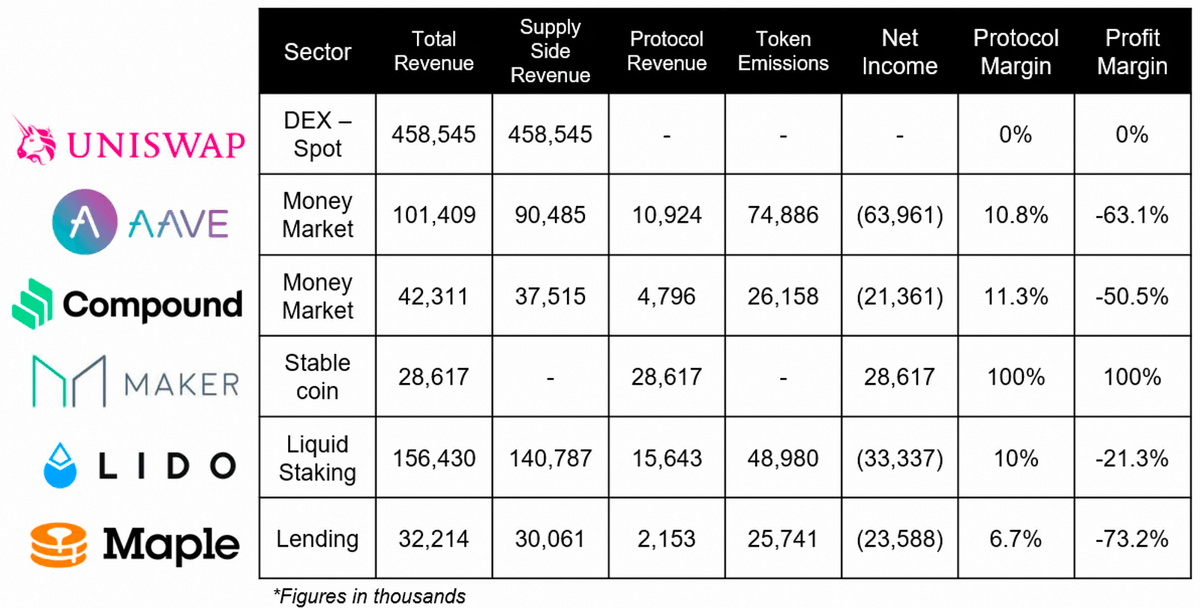
In “R.I.P Liquidity Mining”, the @tapioca_dao core team performed a cash flow analysis of the major DeFi protocols. They measured profitability by subtracting token emissions from revenue.
Profit = Revenue − Emissions
Surprisingly, only one protocol posted a positive profit margin in 2022 — @MakerDAO
Data as of 2022. Source: “Which DeFi Protocols Are Profitable?” - @bankless
Most protocols in DeFi can produce revenue but very few are profitable. Now, here is the kicker. This is perfectly fine and expected behavior.
Venture Capital is the business of financing unprofitable companies to facilitate growth with an expectation of outsized returns in the future. Many of the best companies in the world are cash guzzling machines and take 3–5 years to achieve profitability, if not longer. Amazon, founded in 1994, didn’t earn a profit until 2001. Uber finally turned a profit in Q3'23. OpenAI, Zillow and many others are still unprofitable.
Early stage crypto protocols increase their expenses in the form of emissions to finance growth. Emissions are used as a form of Customer Acquistion Cost (CaC). If retention is strong and the lifetime value of the customer is high, then this strategy makes sense if the emissions are sustainable.
For example, @LidoFinance had a net profit margin of -21.3% in 2022 but in 2023 they are operating at 44% YTD cumulative profit margin, excluding node operator revenue. Source: @tokenterminal
Lido is sticky because once people leverage the composability of Liquid Staking Tokens (LSTs) in platforms like AMMs, money markets, etc they realize they can achieve a higher yield without additional economic risk. That’s the premise behind the new capital efficient L2, @Blast_L2
Caution of course needs to be taken to avoid the effects of mercenary capital and ensure incentive alignment.
Early innovative protocols should not focus on profitability out of the gate and instead aim for sustainable growth — increasing revenue & treasury assets while minimizing liabilities. Incentives may drain native token supply balances but if those tokens are accruing value emissions could serve to increase the value of the treasury.
Tokens are Assets and Liabilities
A protocol’s own token is paradoxically both an asset and a liability on the DAO balance sheet.
Assets:
-Native Governance Tokens
-Stablecoins
-Yield Generating Positions: LP positions, LSTs, Non Liquid Staking (ve), etc.
Liabilities:
-Debt (Onchain loans)
-Emissions (Token incentives — you are borrowing from the future to finance revenue today)
--------------------------------------------------
The Crypto Ouroboros
Token emissions generate revenue as liabilities owned to service providers — Liquidity Providers (LPs), Block Validators, etc. As revenue increases, both the protocol and its emissions increase in value, creating a self-reinforcing cycle reminiscent of the Ouroboros.
For those who are not familiar with the Ouroboros, it is a symbol in ancient Egyptian and Greek texts where a snake or dragon is devouring its own tail, continually consuming and being reborn from itself. It was later adapted in Gnosticism as a symbol for alchemy.
Crypto tokens are digital alchemy for a digital economy ✨
They are created virtually, yet possess the power to finance growth and fuel the development of the protocol. Assuming a flexible token supply, the protocol can use its emissions to sustain and expand itself in a manner akin to the Ouroboros — continuously consuming and regenerating.
Implementation matters here. You can pull off the Ouroboros successfully like Ethereum or botch it completely as many new projects do.
To understand the sustainability of a protocol, we need to understand how effectively the protocol is leveraging its emissions.
Introducing the Emission Efficiency Ratio (EER)
Emissions have a direct effect on the available assets in the DAO treasury. Let’s take a look at how to value a DAO using a shareholders equity formula from TradFi.
DAO Treasury Value = Assets − Liabilities
We can describe this moving forward as the Tokenholder Equity Value (TEV), since the treasury is redeemable by token holders via a governance vote.
The Emissions Efficiency Ratio (EER) is meant to measure how effectively emissions are used to generate revenue.
Emissions Efficiency Ratio (EER) = Revenue / Emissions
where revenue is fees allocated to the DAO treasury and stakers excluding service providers like node operators, liquidity providers, etc.
An EER of one indicates that the protocol “breaks even” — for every dollar in token incentives emitted, a dollar in revenue is earned. An EER less than one indicates the protocol is unprofitable — incentives are greater than revenue generated. Conversely, an EER greater than one indicates profitability, revenue in excess of token incentives.
Note: cash flow analyzooors will notice EER is similar to profit margin. The reason we are differentiating it is because tokenomics can play a huge role in emissions efficiency. Tokens make DeFi unique.
Note we are unfortunately excluding some juggernauts like @fraxfinance, @yearnfi and many others here. This is mostly due to data availability.
In 2023, many of the top DeFi protocols are profitable Year to Date (YTD). @MakerDAO, the OG DeFi protocol, emits no token incentives and managed to pull in 96.3 million in cumulative profits this year. This is the highest revenue growth of all protocols on this list, over 360x given their revenue was 2.6M at the start of 2023.
@GMX_IO, a leader in the perpetual DEX category, is the second most profitable with an astounding 73.6M dollars in profit, excluding GLP token holder revenue, and the highest emission efficiency of 106.
@synthetix has seen astounding growth after the launch of @Kwenta_io and has the highest EER growth rate at a whopping 1747%. Although the EER ratio is less than one, it appears that Synthetix is becoming more efficient and gaining market share — a healthy sign for a protocol.
When efficiency is declining, that is a negative signal for sustainability. It means the protocol is generating less profit for each dollar in token incentives emitted. Combined with an unprofitable EER and that can lead to major losses in equity value for token holders.
There is only one protocol on this list that has a declining emissions efficiency rate: Curve Finance
A few things to get out of the way first:
1. The GammaSwap Labs core team is a huge fan of Curve, especially Curve V2 and their composable concentrated liquidity CFMM. GammaSwap V2 will resemble this type of CL mechanism over UniV3 in order to reduce liquidity fragmentation.
2. Revenue may be underestimated here — it is unclear if bribing revenue is included in Token Terminal data.
3. Ethereum is a dark forest and unfortunately Curve was bit by a Vyper earlier this year, a toxic bite that they are still recovering from.
It does seem that Curve’s low emissions efficiency may be tied to the use of the ve token model. Both Balancer and Curve utilize ve tokenomics and have the lowest EERs of the list — perhaps due to the principal risk or the lack of bribing revenue in token terminal? GMX, which uses an escrowed token model, has a much higher EER.
GMX efficiency dominance could also be due to the difference in product categories. Perpetual DEXs typically generate more revenue than other DeFi categories. On the other hand, Balancer and Curve both have higher FDV/Revenue ratios and trade higher than most perp DEXs contributing to the perceived low EER - more on that in a future post.
Regardless, the purpose of this post is to not speculate on the reason for this discrepancy, rather to put in place a framework to evaluate sustainability.
Preventing the death spiral
It is important to proceed with caution in the early days of a crypto protocol’s lifecycle when the float is lower and there may be less organic demand.
The key is to have a healthy level of inflation balanced by real growth to increase TEV — tokenholder equity value.
Inflation is not strictly bad. Protocols need emissions to grow: why else would a validator invest in hardware equipment and the developer time required to verify blocks with no revenue initially? Or provide liquidity with their capital for no fees? The opportunity cost is high so they need some form of compensation.
The problem is many protocols begin with extremely high inflation and find it difficult to achieve the growth required to balance out the inflationary emissions pressure.
The Ouroboros can facilitate virtually unending growth or it can get too greedy and consume itself — vanishing out of existence in the blink of an eye. As the EER decreases due to sell pressure, the protocol must emit more tokens to maintain a similar APY, draining assets from the DAO balance sheet.
This flywheel continues as the greedy Ouroboros starves after over feeding itself and the token chart approaches the horizontal asymptote of zero.
Strategies to Increase Emission Efficiency
1. Fee Sharing : Although implemented by L1 chains to compensate block validators, many DeFi protocols do not offer fee sharing for staking even when used to incentivize crucial services like liquidity. Fee sharing drives more value to emissions with some costs in cash flow and can be used to replace inflation.
2. Escrowed Tokens (esGMX) : GMX pioneered an escrowed token model where all emissions are released in their escrowed state. To vest those emissions, the user must lock the tokens that earned those emissions over a 365 day period. A user can either stake or vest so there is an opportunity cost present when realizing yield from emissions. Additionally, this vesting method increases emissions efficiency since liquidity is locked for at least a year.
3. Multiplier Points (MPs) : Multiplier points, another invention by the GMX core team, rewards long term holders without inflation. MPs multiply the fees earned in ETH based on time spent staking. If the user unstakes, the proportional amount of multiplier points are burned. It ensures long term protocol alignment without principal risk, the funds you stake can be removed and are always liquid (unlike ve models).
4. Dao Share Options (Tapioca DAO) : The DSO is a type of option incentive where users can redeem the native governance token $TAP at a discount. These options expire after a given period enabling the protocol to recycle unused emissions. It sets a floor price for the $TAP token and returns capital from exercised options to the DAO balance sheet. It seems like a promising method, although untested.
5. Buyback & Burn (MakerDAO): Buyback and burn is employed by some protocols to induce positive price pressure on the token and improve value capture. The MakerDAO Smart Burn Engine uses surplus DAI to acquire MKR tokens from the Univ2 DAI/MKR market, which are then supplied to the pool. In return, Maker receives LP tokens that are transferred to a protocol owned address. In so doing, the system increases on-chain liquidity for MKR over time. It's proven successful with $MKR having seeing a 130% price gain in 2023. In fact, out of all the strategies (fee sharing, bribes, buybacks), buybacks have on average the highest FDV / revenue ratio.
Conclusion
We introduced the Crypto Ouroboros: a metaphor for value creation alchemy in DeFi. A protocol can use its own emissions to fuel sustainable growth or to consume itself to death.
The Emissions Efficiency Ratio (EER) is a way to measure real protocol growth and how effectively the protocol is leveraging emissions. In the next post, we will dive into $GS tokenomics and how we will leverage esGS along with other rewards to drive more sustainable emissions.
Special thanks to @twMattt (El Jefe at Tapioca DAO), @blocmates (Giga Chads producing educational DeFi content) and @_Jonahw (Fund Manager at Skycatcher) for reviewing this
@Pentosh1@donalt@AltcoinPsycho Yep agreed. I thing money markets are also pretty good. RWAs should bolster this further.
One thing to still work out is undercollateralized loans