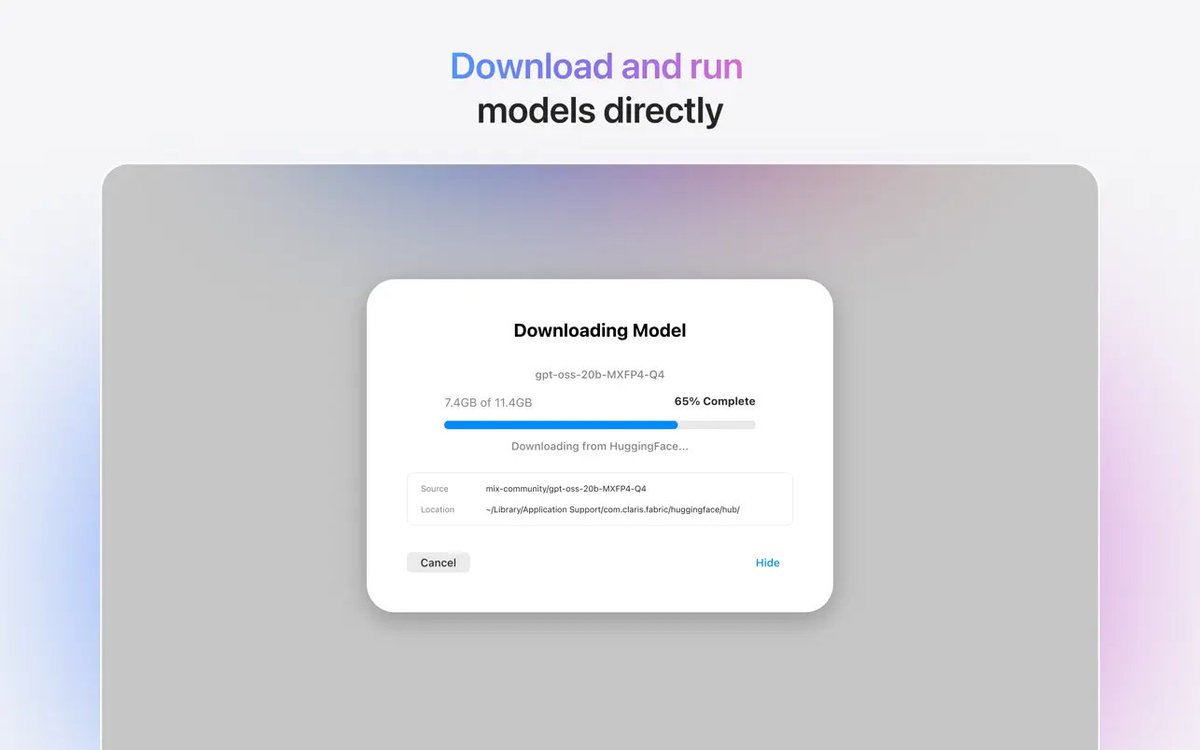
Apple has a Mac app called Harbor in private preview under the Claris brand, according to Aaron Perris. it runs open-weight models locally as a private inference server.
plug two or more Thunderbolt 5 Macs together and Harbor pools their unified memory, so you can run models bigger than any single Mac can hold.
Apple is working on a new app called Harbor
Harbor turns your Mac into a private AI inference server. Run open-weight models locally on Apple silicon—your data never leaves your hardware, and nothing reaches the cloud. Connect multiple Mac computers over Thunderbolt 5 to pool unified memory, enabling large models and higher concurrency that a single computer can handle alone.
Set up in minutes, not hours Harbor automatically detects your devices over Thunderbolt 5 to form a cluster. Plug in, start, and you’re running—no manual configuration, no command line, no infrastructure expertise required.
Download and run models directly Browse, download, and load open-weight models from within the app. Harbor handles model management so you can focus on the work, not the setup.
Cluster for scale Connect two or more Thunderbolt 5-capable Mac computers and Harbor pools their unified memory into a single inference resource. Run models that exceed any single computer’s capacity, or serve more concurrent requests across your cluster.
Harbor is currently in a private preview under the Claris brand.
Claude can now show your website inside the chat, and people can click around in it.
Sean Strong says it works through MCP apps, with frame_domains support turned on for verified plugins. the same release lets you open full Adobe, Atlassian, and Box tools next to the conversation.
You can now embed your website in Claude and have it be interactable. You can do this via MCP apps, where we've enabled frame_domains support for verified plugins.
It was a blast to build this out with the team & our partners, let us know what you think!
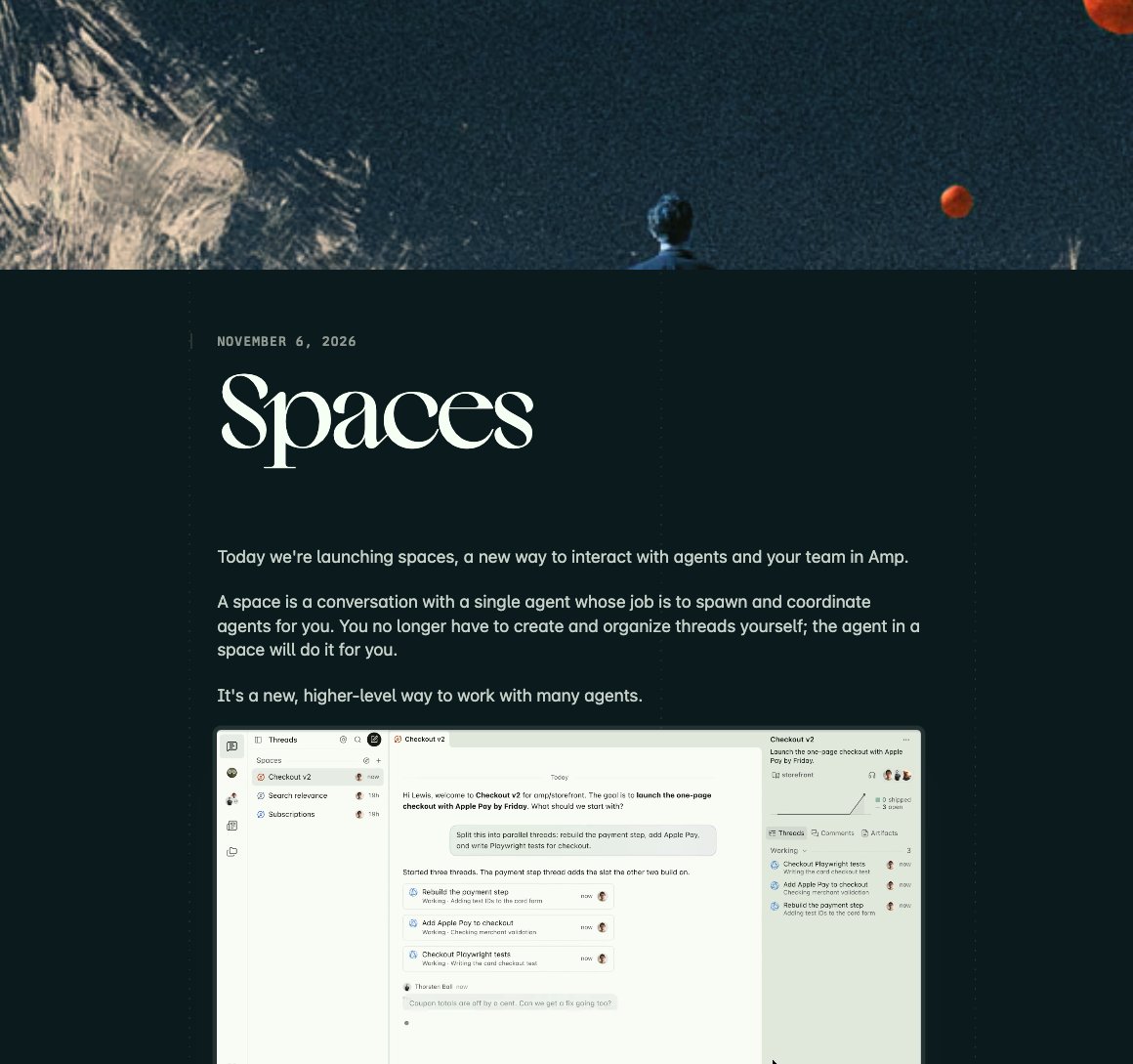
Amp launched Spaces, a single conversation with an agent whose job is to spawn and coordinate other agents so you don't have to create and organize the threads yourself.
the example in their announcement I'd steal: Will pointed a space at recent changes for security issues. it split the codebase into 16 areas, reviewed each in its own thread, checked every finding in another, and kept a summary artifact for him to review.
Guillaume Bardet describes a go-to-market research method he says is taught at Y Combinator: feed Claude 25-40 scraped competitor sites (pricing pages, case studies, docs), the latest earnings calls from the 3-5 biggest incumbents, 100+ reviews from G2 and similar, and the forum threads where people vent about the category.
he says a few rounds of asking it to steelman your thesis like a VC, then show where it fails, can turn about 4 weeks of research into 3 hours. I'd start with that intake list. the timing is his claim.
There’s a method taught at Y Combinator that turns 4 weeks of GTM research into 3 hrs.
And no, it’s not typing “research the market for X” into Claude.
You start by feeding it raw material:
→ 25-40 competitor websites, fully scraped (pricing pages, case studies, docs)
→ The last few earnings calls from the 3-5 biggest incumbents
→ 100+ customer reviews (G2, Capterra, Trustpilot, app stores)
→ Every Reddit or forum thread where people vent about the category
Then ask questions that force it to think, not summarize:
1. “What do the winners in this market know that their customers would never admit?”
2. “List the beliefs this whole industry takes for granted. For each one, what would need to happen for it to be false?”
In about 20 min, you’ll see where everyone agrees, where everyone is blind, and which customer pains nobody is building for.
Now flip it. Pick your best angle and tell Claude to tear it apart:
“Steelman this thesis like a top-tier VC would. Then show me exactly where it fails.”
Do a few rounds of that. 3 hours later, you’ll have a first GTM hypothesis that sounds like it came from a 10-year industry veteran.
The trick is treating Claude as a sparring partner that never gets tired and never gets defensive when it’s wrong.
But remember: it’s still just a hypothesis. The real work starts when you talk to actual buyers.
To get there fast, use Gojiberry to find and reach the right people to test it with.
Customer conversations are the only thing that matters.
Cloudflare now retries failed fetch and RPC calls to Durable Objects automatically in the runtime. zero code changes on your side.
Ashley Peacock posted the optional config if you want retries more aggressive than the defaults.
Automatic retries for Durable Objects are here!
We are now retrying fetch and RPC calls to your Durable Objects automatically in the runtime, zero code changes needed.
We do have some config that allows you to make them more powerful, details below 👇
$ cf migrate turns a wrangler.jsonc Workers config into cloudflare.config.ts.
Jilles Soeters says that unlocks ~3000 Cloudflare ops for your agents that used to mean clicking around the dashboard.
If you're still using wrangler.jsonc for your workers, you're literally one command away from using a glorious cloudflare.config.ts
$ cf migrate
This gives you (read: your agents) access to ~3000 operations that you would normally use the dashboard for.
Jacob Lauritzen, Legora's CTO, says he got a model to hand-write the weights of a 100k-parameter neural net that tells real legal citations from fake ones.
his claim is that the one-shot net beat a trained one. I'd like to see how it was scored, but skipping training entirely on a small classifier is a wild thing to try.
Got fable to hand-write weights of a 100k param model to recognize real versus fake legal citations.
Basically one-shotted a full NN that’s better than training it
Apple opened Siri AI to every developer in the iOS 27.3 and macOS 27.3 betas.
your app hands Siri its actions through App Intents, and new skills let Siri chain several of them into one request. App Store submissions open in the spring, so there's a few months to build first.
Big news for our developers! We are shipping a developer preview that dramatically expands the capabilities of all apps to integrate into Siri. So excited to see what you folks do with this.
https://t.co/kbKcVB3FiB
Vercel Security Review is in public beta. Guillermo Rauch says it started as Vercel's internal security agent, and now it reviews the diff on every push to a connected GitHub repo, with findings posted as PR comments and a GitHub check on private repos.
the example in their launch post is the bug I'd most want caught: an invoice download endpoint that looks up by ID without checking the organization, so any signed-in user could pull another org's invoice. reviews are free until Nov 10.
I've been looking forward to this day, because Vercel has an internal security agent that is **astonishingly effective** (lovingly called @𝚑𝚊𝚌𝚔𝚎𝚛). Every single line of code gets audited, automatically.
You can now get the same power. Just enable it on all your repos (this product works whether you host on Vercel or not) and your peace of mind will increase tremendously. You'll see it catch things that every other agent misses.
Why: you cannot just bank on your engineers having a skill installed, prompting "please make secure", or rolling the weights' dice that the code is good out of the gate.
The other cool thing about this is that this was entirely developed by our security team. A lot of companies out there are probably in a mad rush right now trying to staff up. If you wanted to 'download a security team' as software, this is the closest you get today.
Owen Gretzinger got Boardy's CI from 40 minutes to 2, and the fix I'd check first in my own repos is cache seeding from main.
GitHub scopes PR caches to the PR's own branch, so with nothing seeded from main, about half their PR runs started cold all year. the agents pushing those PRs kept retrying instead of noticing.
Google's Project Suncatcher just ran a prompt on a TPU in orbit.
Sundar Pichai says they launched the prototype satellite a few weeks ago, then sent a command up, booted the TPU, ran the prompt, and got the complete response back on earth. the first response was a haiku, which is about as hello world as it gets.
A ‘hello world’ milestone for Project Suncatcher 🚀
After launching our prototype satellite a few weeks ago, we’ve now successfully sent a command up to orbit, booted up the TPU, ran the prompt, and received our first complete response back on earth - a haiku!
Joe Blau built Subvox, a macOS prototype that tests whether AirPods Pro head-motion data can turn silently mouthed words into text.
he says it took one prompt and 9 minutes, right after Subvocal raised $1.3M for glasses that do this with dedicated sensors. no language model, just your own word templates matched with dynamic time warping, plus a permutation test to show the signal beats chance. the README is honest that AirPods only expose jaw and head movement at about 25 Hz.
Ben Holmes says a software factory needs two loops.
self-improvement: agents score past conversations with an LLM judge, then review the worst ones for fixes. benchmarking: replay those same conversations against other models and let the judge pick a winner. the first raises quality, the second cuts cost. replay is the one I'd try first, since the conversations already exist.
If you're going to build a software factory, you should try these two loops: self-improvement and benchmarking.
Self-improvement: have agents 1. score conversations as an LLM-as-a-judge, and 2. review poor performers for improvements.
Benchmarking: replay past conversations against different model selections, and use LLM-as-a-judge to grade outputs to find a winner.
Self-improvement drives up factory quality, and benchmarking drives down factory cost. Combined, you get a better factory!
OpenAI's Dot caught a date mixup in @kimmonismus's email without being asked.
they'd emailed someone to cancel a meeting this week. Dot noticed the other person had actually asked for the week after next and flagged it.
that's the agent help I'd actually use: reading the thread I already have and catching the one date I got wrong.
Okay, maybe I underestimated Dot a bit. I emailed someone to say I was unavailable on the specified date this week and had to cancel the meeting.
OpenAI Dot then proactively messaged me, informing me that I had apparently mixed up the dates because the person had wanted to meet me the week after next.
Two things are remarkable:
Dot independently monitored my email, detected the error, understood the context, and alerted me. This actually saved me from a lot of misunderstanding. A little "aha" moment. I'm currently in the US, which is why I have access to Dot. Of course, I won't have access once I'm back in Germany (and not using a VPN). But it's a really good use case!
Mainplane skips context compaction. when an agent's context fills up, it starts a new session that searches the old session's full record and copies back the exact lines it needs.
the numbers from @Alezander9 on a ~400k-token Opus 5.5 session: compaction took 38 s and $1.99 with a cold cache. retrieval got back to work in 15 s for $0.10, and the exact error message and file path don't get paraphrased away.
Compaction is a mistake.
When an agent's context fills up, tools like Codex and Claude Code compact it:
1. The model prefills the entire session again
2. It writes a summary of everything so far
3. A new session starts from that summary
I measured this on a real ~400k-token session with Opus 5.5:
→ 38 s and $1.99 when the prompt cache has expired
→ 29 s and $0.17 when it hasn't
And the summary is lossy. The exact error message, the file path, the one number you needed is often gone.
So I do something new for Mainplane
Context retrieval works the other way around. Mainplane keeps the full record of every session as a file. When the context fills up, a new session starts right away with one instruction: "You are continuing session X. Retrieve key context from it as you go."
The agent searches the old session and copies the exact lines it needs, when it needs them.
Same session, same model: 15 s and $0.10 to get back to work. It does not depend on a cache hit, and nothing is paraphrased.
This is the bitter lesson applied to agent memory. Don't hand-design what the model should remember. Give it the full record and good tools, and let it decide.
Mainplane is open source (MIT). Link in the first comment.
@ArtuGrande@spacexai@cursor_ai Hey @ArtuGrande, I would love to be considered for Austin, TX area. It has an incredible tech community. If we had a good space, people would definitely come and be a great experience. (Great talent pool, great networking, great ideas)