I talk and teach about the frictions inherent in AI which will slow down economy wide adoption.
But in my heart I don’t believe they are that bad. You just ask a machine to do things and it does them! How can frictions to doing this persist?
1/2 Thanks Gavin for an especially thoughtful exchange. I don't usually spend much time on social media but I wanted to engage here because it really brings out the heart of an important conversation.
First, on regulation, I think that “either concentrate it in the hands of a chosen few companies and politicians via regulation or distribute it widely” is a false choice. I know that there’s a sort of Silicon Valley shorthand where regulation = regulatory capture = concentration of power, but I’ve always found this to be an overly simplified picture of the world. Many people outside this bubble think of regulation as something that constrains corporate power and benefits ordinary people. I don’t necessarily agree with that perspective either, rather I think it’s complicated and really depends on what the “regulation” consists of. But in particular I think that those in the “regulation = regulatory capture = concentration of power” frame often underrate the decentralizing power of objective and fair institutional processes. A crude analogy is that the formal court system can sometimes feel stuffy and elitist, but it does a much better job of defending the rights of vulnerable individuals than the alternative, mob justice. At their best, institutions can vest power in ideas rather than people, and thereby decentralize that power.
This is why Anthropic has always made its policy proposals very carefully. We try very hard to make proposals that disadvantage (slow down) frontier AI companies while *advantaging* smaller competitors. California’s SB53 (which we supported), and even the much-maligned SB 1047 (which we were ambivalent on), completely exempt any company below a certain amount of revenue or model training costs from being covered at all (it was $500M for SB 53, lower for 1047 but we objected to that). More recently the testing process we’ve advocated for at CAISI and the White House involves more rigorous tests for frontier models than off-frontier models — something that differentially advantages challengers. Similarly, the “Pacing the Frontier” letter envisions (or at least Anthropic’s preferred implementation of it envisions) modulating the pace of the very best models while not constraining those who are catching up. This hurts the business interests of the frontier labs and helps challengers, including open-weights!
Overall my view is that AI is *structurally* a technology that tends to concentrate power, for reasons that have nothing to do with regulation (more to do with the extreme implications of the scaling laws). Open-weights do help some with this but are nowhere near a sufficient solution because they simply shift the concentration somewhat to those with the most compute and chips (which are roughly the frontier labs plus maybe hardware providers). By contrast I think the right “rules of the road” can simultaneously (a) address AI’s cyber/bio/alignment risks, (b) institutionally constrain the power of the frontier AI companies, and (c) leave room for open-weights models while also addressing the specific risks that they bring.
BTW I do not think that the events of the last few months have “failed to result in [my] preferred regulatory path”. The approach that the Trump administration is reported to be taking — pre-deployment testing for frontier models, and also testing of open-weights models when they get closer to the frontier — is one that I am very supportive of, though of course I have to see the details to be sure. I am also supportive of Demis Hassabis’ ideas around a FINRA-like entity. This contrasts with six months ago when most of the industry was still pushing for preemption of all state regulation and no apparent federal approach either.
‼️huge ssi news.
ilya is about to take his first tentative steps out of the age of research and back into the age of scale. it’s time to smell what ssi is cooking.
ssi have built a small reasoning engine that can compete with much larger training runs because his data is better curated to meta learning. but, more importantly.
we’re about to step into the era of TTT (test time training. gradient descent happening in real time to solve your problems). so instead of a context window you get actual learning.
and because it’s so sample efficient it can be trained on hard to verify tasks that other paradigms can’t touch. everyone else’s weights are frozen, they struggle out of distribution. ssi have created something that has a bundle of knowledge but can truly learn in real time and use that to your advantage.
current approaches are trying to hack their way to ‘learn’ with memory tricks, this thing will updates its weights, remember key lessons, and finally feel like a human level reasoner. this is a huge paradigm shift from the king. early results are very impressive. we can stop watching memento on repeat.
it’s learning all the way down, the descent is real.
A strong financial future starts early. Strategy has joined the Invest America Business Pledge and will match the @USTreasury's $1,000 @TrumpAccounts contribution for newborns of U.S. employees, plus contribute $250 annually for each eligible child.
https://t.co/erz3oPkikP
between claude code, cowork, chatgpt work, & codex, most current white collar work is either already automatable or visibly waiting to be automated. you can walk into any small business right now & maybe automate it at least 50%, likely way more.
these four products together are eating the entire knowledge economy.
& nobody else is even in the same cultural or technological orbit at the moment.
Not only is China making increasingly competitive models, they’re also making world-positive AI marketing! 😂😂😂
THE COMPUTERS ARE GOING TO DO OUR JOBS FOR US AND WERE ALL GOING TO THE BEACH! 🏖️
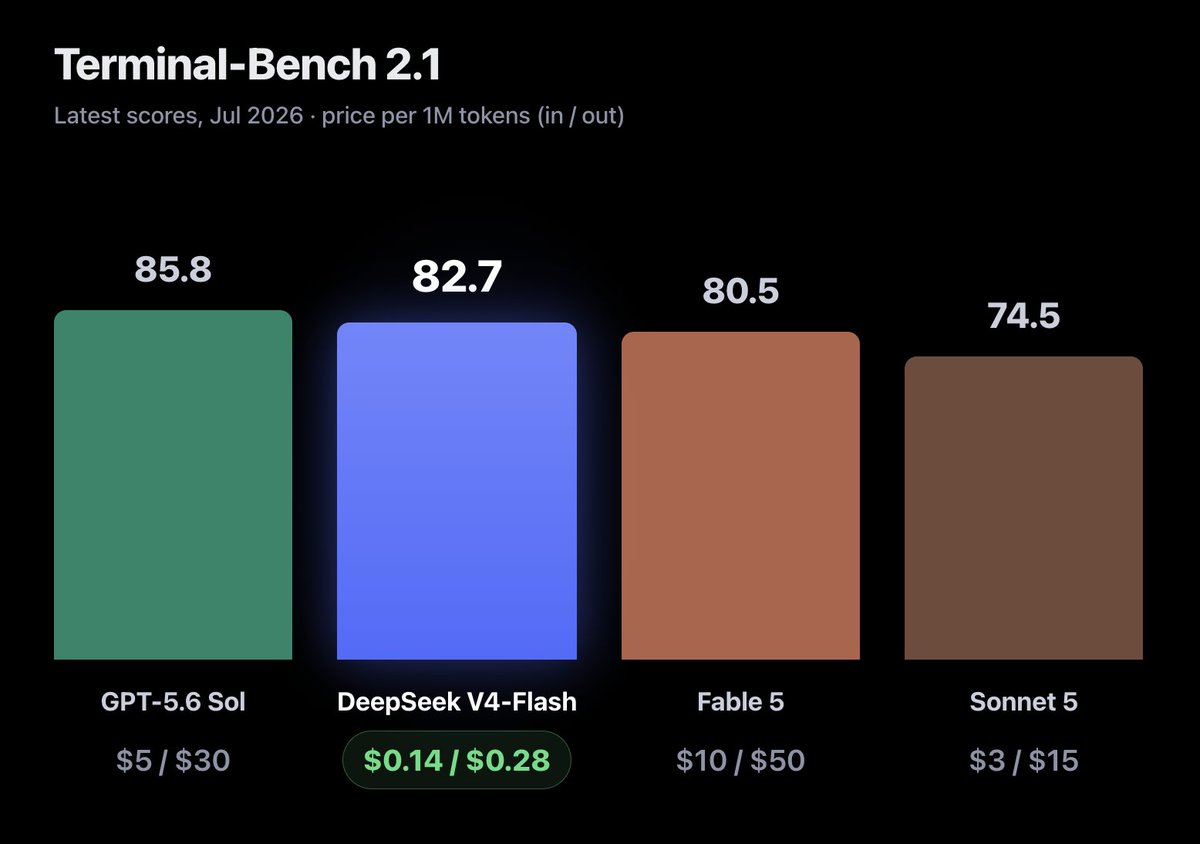
While DeepSeek V4-Flash is significantly cheaper on price per token, this can be misleading if the overall cost per task ends up being higher due to more turns being made.
However, @ArtificialAnlys reports DeepSeek completing the same benchmark tasks as Fable at 105x lower cost.
An internal version of Astra, @OpenAI’s next major model family, solved 10 major open problems in mathematics, quantum complexity, and theoretical computer science.
We believe it will be a major step for scientific reasoning. https://t.co/iP6cyheZ7i
Foreshadowing from yesterday. Open AI suddenly increasing their stack efficiency and slashing prices. The steadily increasing cadence in model releases. The sudden breakthroughs in math. It's all the same thing. Skeptics, it is time to bite the bullet. We are taking off.
let’s put this 80% price drop for 5.6🌙 in perspective
three weeks ago, gpt-5.5 xhigh was our frontier.
it completed 67% of tasks on DeepSWE.
today, luna max matches that score at about $0.12 per task instead of $7.23.
same score.
roughly 60x cheaper.
three weeks later
DeepSeek silently updated their changelog with a new V4-Flash upgrade 1 hour ago.
Their new Terminal-Bench score is 82.7, a massive +25.8 point leap from its initial April preview score of 56.9.
Currently only available via their API, open weights release will follow shortly.
This is a fascinating and important set of data which shows us where things are going, using OpenAI as a canary in the coal mine.
The chatbot era is over, and agentic systems are coming to tasks beyond engineering. And skills show promise as a way to standardize AI use in firms.
This is the most rigorous Bitcoin paper
I've read. I've been studying —
and testing — it for 20 days.
https://t.co/mCfJQpJTbE
Dr. Santostasi and Dr. Perrenod gave us the ruler —
and the imagination to see the oscillator.
Together: the most falsifiable framework
in crypto economics.
The Power Law isn't just a model —
it's the most precise ruler we have
for measuring where Bitcoin stands.
Most models describe the past.
The Power Law keeps passing tests
it was never designed for.
"Isn't β=5.69 just curve-fitting?"
Fair question.
So I ran a test the paper didn't.
━━━━━━━━━━━━━━━━━━━━━━
Materials & Methods
━━━━━━━━━━━━━━━━━━━━━━
Data: Daily closing price and non-zero balance
address count (BitcoinMagazinePro,
2010-08-17 to 2026-06-04, n=5,771).
Model: log₁₀P(t) = log₁₀A + β·log₁₀(t)
where t = days since Genesis Block (2009-01-03).
Out-of-sample design:
The power law was fitted exclusively on data
up to the freeze date, with zero observations
from the test period used in estimation.
Two freeze points were tested:
① Freeze at 2016-07-08 (2nd halving)
Training: n=2,153 | Test: n=3,617 (10 years)
② Freeze at 2020-05-10 (3rd halving)
Training: n=3,555 | Test: n=2,215 (6 years)
Residuals computed as:
ε = log₁₀(P_observed / P_predicted)
normalized by in-sample σ.
Mean residual and area integrals
(trapezoidal rule) applied to test period only.
The out-of-sample test was my idea.
Computation and analysis executed with
Claude Opus 4.8 (Anthropic).
━━━━━━━━━━━━━━━━━━━━━━
Froze the power law using data up to 2016 only (β=5.717).
Then measured the following 10 years it had never seen.
Result: mean residual −0.05σ. Effectively zero.
Frozen at 2020 instead → next 6 years, −0.13σ.
Same story.
The line drawn in 2016 ran straight through the next decade.
That's not fitting. That's forecasting.
The Power Law: powerful because it can be broken —
and hasn't been.
Knowing where we are won't tell us when things will happen — but it tells us exactly what to do now.
Buy Bitcoin Now.
@Giovann35084111@moneyordebt@ScientificBTC@saylor@natbrunell
#Bitcoin #PowerLaw
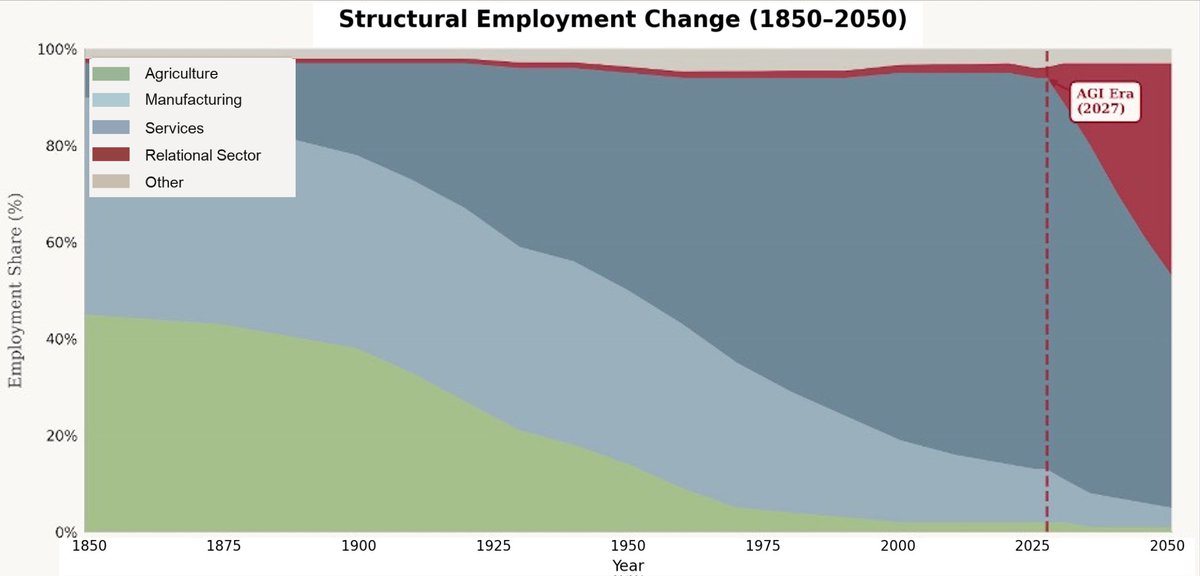
New essay on the economics of structural change and the post-commodity future of work.
1. Almost any question about the impact of advanced AI on the economy needs to start at the same place: what is still scarce? Answer that, and the analysis becomes pretty straightforward. This essay explores what becomes scarce if AI really can replicate most of what humans do in production, and what this mean for the future of jobs.
2. My conjecture, working through the economics: labor reallocates across sectors, and the sector it reallocates to has properties that keep labor a meaningful share of the economy. Ultimately this is about the structure of demand itself. For this, we have to go back to Girard, Augustine and Rousseau: once people's base needs are met, their preferences shift to comparative motives (e.g., status, exclusivity, social desirability). This motive is inherently non-satiated.
4. The key paper is Comin, Lashkari, and Mestieri (Econometrica 2021). As people get richer, they don't buy proportionally more of everything. They shift spending toward sectors with higher income elasticity. They estimate income effects account for 75%+ of observed structural change.
5. The ironic consequence: the sector that gets automated becomes a smaller share of the economy, not a larger one. Agriculture got massively more productive and its share of employment collapsed. Manufacturing too. The "stagnant" sectors absorb the spending and the jobs.
6. So the question is: which sectors have high income elasticity in a post-AGI world? I argue it's what I call the relational sector. Categories where the human isn't just an input into production, it is part of the value.
7. Why does the relational sector have high income elasticity? Because human desire has a mimetic, relational dimension. We don't just want things for their intrinsic properties. We want what others want, and we want it more when others can't have it. Girard, Rousseau, Augustine, and Hobbes all saw this.
8. In work with Kristóf Madarász, we showed this experimentally: WTP roughly doubles when a random subset of others is excluded from the good. And in new work with Graelin Mandel, AI involvement kills the premium. Human-made art gains 44% from exclusivity; AI-made art only 21%.
9. This all comes together for the core argument. The sector that absorbs spending as AI makes commodity production cheap is one where human provenance is part of the value, and demand for it grows faster than income. Exactly the profile that keeps labor meaningful.
10. To be clear about the claim: I'm NOT saying aggregate labor share must rise. It may fall. The claim is about sectoral composition, i.e., where expenditure and employment go once commodities get cheap, and the fact that the sector that will absorb reallocated labor maps to a substantial component of human preferences and desire.
11. If you're interested in the formal model, a linked companion technical note works out all the economics.
Read the essay here: https://t.co/NcjVgn2o8g
@tangotiger@mike_petriello Thanks. Is there a (public) way to identify what portion of the player’s xwOBA-derived batting run value is attributable to the player’s speed?
@mike_petriello do you find that fast players typically outperform their xwOBA? A batted ball might have the profile of a double 75% of the time and triple 20%. But Buxton is going to convert that hit into three bags everytime, while xwOBA only gives him 20% credit for a triple
@mike_petriello Any consideration of attributing this “speed value” of xwOBA to a player’s baserunning value as opposed to their batting value? Are we over/under valuing certain players bats by not isolating the contribution of their legs?@tangotiger