We were expecting major resistance at $80k, and the rejection came as expected. For those with a long-term vision, the most exciting part of the cycle is about to begin.
https://t.co/9NjzwyaU8N
Civilizations store value across time. Gold stored value across generations. Bitcoin may be the first asset designed to store value across a digital civilization.
What’s going on is your sensationalism by plotting on a linear axis and clipping into a small range. And typing in all caps.
Try plotting on a log price - log age scale.
This is a power law network asset in the long term.
Log-log plot regularly updated at https://t.co/nWmFA2thic
@Giovann35084111
People who panic at this should convert that emotion into a desire to buy at favorable prices. Stoicism.
Or leave Bitcoin to those with the emotional maturity to deal with the volatility.
Instead of “what is going on?” — “What, rationally, should I do here?”
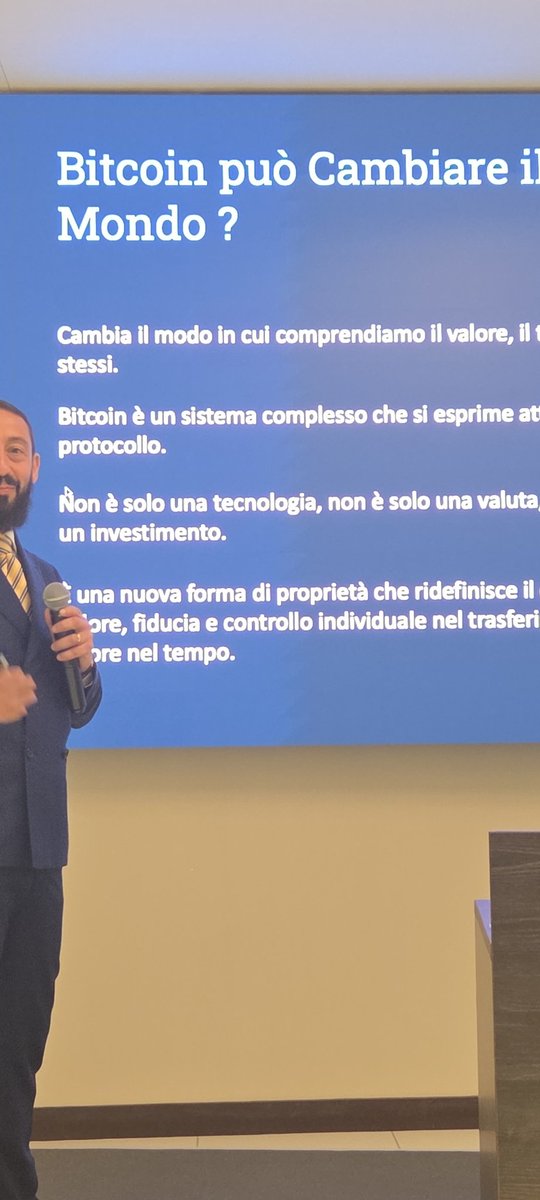
We are proud to announce @Giovann350841114111, Director of the @ScientificBTC, as a speaker at Bitcoin Corporate Day 2026.
Known for his work on the Bitcoin Power Law, Giovanni brings a rigorous research perspective to the institutional Bitcoin discussion, grounded in physics, data, and long-term empirical analysis.
We are pleased to have him join us in Prague.
https://t.co/uUK9R8maz4
A fascinating property of Bitcoin: the participants can disagree on politics, economics, and culture while still agreeing on the ledger. Bitcoin is inherently bipartisan but is not always treated as such.
Nice article and very good result on log-periodicity. It is refreshing to see the reproduction of our results on sigmoid stacking and rigorous testing of an alternative. Our paper was not set to propose any new model; the target was to follow the Clauset–Shalizi–Newman (CSN) protocol and do a more robust test of the Power Law. However, when we compared against other distributions, under AIC and BIC criteria, the single sigmoid (K=1) was noticed and we then proceeded to test the sigmoid stack (K=3) as a natural extension of that result.
Due to bias, I try to be very sceptical of my own results. So we did the wave-stability analysis to see if the stacks could occur by chance or were a rare event; it tested ok. But it still bothered me why K=3 and why not another K, like 2 or 4. Still, the stacks give an interpretation that price was driven by waves of adoption, with the caveat that since we can't predict new adoptions, it is a bad instrument for forecasting (as we pointed out).
Given all this, I am genuinely impressed by log-periodic being both better in-sample, with fewer parameters, and, more strikingly, retaining a very good forecasting behaviour. Taking into account our previous result on naive-power law blend, I am now thinking that a nice model for short (1 month) to medium range (2-3 years) would be a naive log-periodic power law blend.
Thank you for your much-needed contribution to rigorous testing, with in-sample testing (with AIC) and out-of-sample evaluation on different time horizons. It does help improve signal over noise, and we are seeing real progress in the understanding of this field.
I'm working with Claude on an amazing set of perks for the public members of the Scientific Bitcoin Institute.
It is an academic non-profit but we will accept memberships at different tiers with very nice perks like dashboards with Bitcoin news, power law charts and much more.
You can start signing up for our free newsletter and you will get an update when the membership feature are ready.
Chech us out at:
https://t.co/powveVXzGo
You who HODL are the bankers of your future and of The Future: be responsible.
“The 2008 crisis is the canonical demonstration: individuals acting rationally within the incentive structure produced a collectively catastrophic outcome. That’s less an ethics failure than a systems design failure — which is itself an ethical indictment of the architects of that system.”
Dai un'occhiata al nostro nuovo podcast SBI in italiano.
Check out our new SBI podcast in Italian. English speakers can turn on automated captions to follow along.
https://t.co/lpmqESAGQI
Bitcoin may ultimately force economists to adopt tools from statistical physics, network science, and nonlinear dynamics. The old models were built for equilibrium systems and the economists are falling behind.
Here is a great interactive chart of Bitcoin's power law. The website was created by an independent researcher and a member of our community. The current annual growth of the power law floor is 37%.
https://t.co/1nDbychKtR