🚨 10 Popular Mutual Funds With Strong 3-Year Returns 📊🔥
Some well-known funds that have delivered strong CAGR over the last 3 years 👀
1- HDFC Defence Fund — ~37.9%
2- Bandhan Small Cap Fund — ~26.1%
3- HSBC Midcap Fund — ~24.9%
4- Invesco India Large & Mid Cap Fund — ~23.4%
5- Invesco India Smallcap Fund — ~23.2%
6- SBI Healthcare Opportunities Fund — ~23.2%
7- SBI PSU Fund — ~22.5%
8- Motilal Oswal Large & Midcap Fund — ~22.3%
9- DSP India T.I.G.E.R. Fund — ~22.2%
10- Motilal Oswal Midcap Fund — ~19.4%
Bookmark It 🔖 Retweet ♻️
Goldmine for AI Engineers! 📌
If you're learning AI, ML, LLMs, or AI agents, don't waste hours jumping between random tutorials.
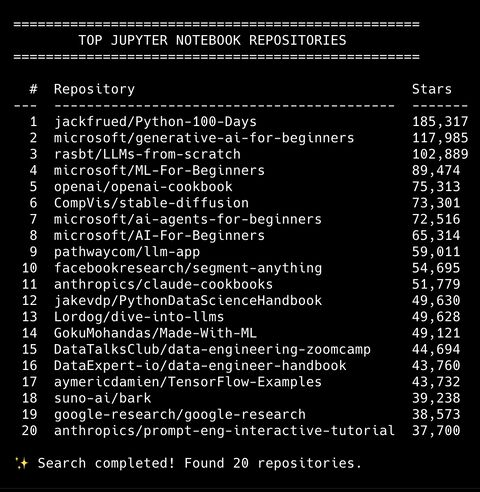
These are 10 repositories I'd actually keep bookmarked - from Python fundamentals to ML, LLMs, agents, and production AI.
1. Python - 100 Days
jackfrued/Python-100-Days
A 100-day Python learning path covering fundamentals, data analysis, web development, and more.
GitHub:
https://t.co/NMCNWjp4GT
2. Generative AI for Beginners
microsoft/generative-ai-for-beginners
A practical introduction to building Generative AI applications.
Covers:
• LLM fundamentals
• Prompt engineering
• RAG
• AI agents
• Fine-tuning
• AI application development
GitHub:
https://t.co/5QXAC1rsUZ
3. LLMs From Scratch
rasbt/LLMs-from-scratch
Want to understand what's actually happening inside an LLM?
Build one step by step.
Covers:
• Tokenization
• Embeddings
• Attention
• Transformers
• Training
• Fine-tuning
GitHub:
https://t.co/iEtPYVPpXV
4. Machine Learning for Beginners
microsoft/ML-For-Beginners
A structured 12-week, 26-lesson curriculum covering classical machine learning.
A good starting point if you want ML fundamentals before jumping into LLMs.
GitHub:
https://t.co/sLijf46NKB
5. OpenAI Cookbook
openai/openai-cookbook
A collection of practical examples and guides for building applications with OpenAI models.
Useful when you want to move from:
Learning → Building
GitHub:
https://t.co/H3ZiMmpMAq
6. Stable Diffusion
CompVis/stable-diffusion
Interested in generative image models?
This repository contains the original Stable Diffusion implementation and research code.
GitHub:
https://t.co/DFwSLqOlyn
7. AI Agents for Beginners
microsoft/ai-agents-for-beginners
A practical course for understanding and building AI agents.
Covers:
• Agentic AI
• RAG
• Agent frameworks
• Tool use
• Multi-agent systems
GitHub:
https://t.co/zNeYlZRQqa
8. AI for Beginners
microsoft/AI-For-Beginners
A structured 12-week, 24-lesson introduction to AI.
Covers:
• Neural networks
• Computer vision
• NLP
• Deep learning
• Classical AI
GitHub:
https://t.co/V7Oilwt7nA
9. LLM App
pathwaycom/llm-app
Focused on building practical LLM applications.
Explore:
• RAG
• AI pipelines
• Enterprise search
• Real-time data
• Vector search
GitHub:
https://t.co/2FdeXjZfQ8
10. Segment Anything
facebookresearch/segment-anything
A foundation model for promptable image segmentation.
Worth exploring if you're interested in computer vision and multimodal AI.
GitHub:
https://t.co/yCSrZH8b5w
Don't bookmark all 10 and forget about them.
Pick based on where you are:
Python → Python-100-Days
ML → ML-For-Beginners
AI Fundamentals → AI-For-Beginners
LLMs → LLMs-from-scratch
Generative AI → Generative-AI-for-Beginners
Agents → AI-Agents-for-Beginners
Building → OpenAI Cookbook / LLM App
Computer Vision → Segment Anything
Pick one.
Build something.
Then move to the next.
🔥 Key Takeaways From Ishmohit Arora’s Pune Session on New Age Manufacturing
🔥 Pune Event Takeaway
I recently watched Ishmohit Arora’s Pune session on New Age Manufacturing.
What stood out was not a stock idea. It was the way the entire manufacturing ecosystem was connected from raw materials and processes to precision engineering, electronics, aerospace, defence, robotics and advanced manufacturing.
Here are my key takeaways from the session.
1. 🔥 India’s Manufacturing Opportunity
The world is rethinking supply chains.
Cost is no longer the only factor. Geopolitics, tariffs, supply chain security and the China plus one strategy are pushing global companies to diversify manufacturing.
This creates a major opportunity for India.
2. 🔥 Assembly Is Only the Beginning
India has built strong assembly capabilities in many industries.
But the bigger opportunity is moving deeper into the value chain.
Raw materials to processes to components to precision components to sub assemblies to systems and eventually design led manufacturing.
The higher India moves in this chain, the more value it can capture.
3. 🔥 Processes Are the Foundation
Forging, casting, machining, sheet metal, fasteners and other manufacturing processes may look basic.
But these processes are the foundation of automotive, aerospace, defence, industrial equipment and many other industries.
The real advantage comes from consistently producing complex parts with high quality and tight tolerances.
4. 🔥 Precision Engineering
Precision manufacturing is not simply about buying an expensive machine.
It requires tooling, process knowledge, quality systems, skilled people, inspection and years of learning.
This accumulated manufacturing knowledge can become a strong competitive advantage.
5. 🔥 The Machine Layer
One of the interesting points from the Pune session was the importance of CNC machines and machine tools.
India is becoming a bigger producer of precision components, but it still imports a large part of the machines required to manufacture those components.
This shows that the opportunity exists both in making the components and in building the machines that make those components.
6. 🔥 Automation Does Not Remove the Human Moat
A CNC machine can repeat the same operation with extraordinary accuracy.
But manufacturing still needs people who understand tooling, fixturing, process changes, quality problems and real world production conditions.
This becomes even more important in aerospace and defence where production volumes can be smaller and specifications can be much more demanding.
7. 🔥 Aerospace Is a Capability Game
Aerospace manufacturing requires much more than producing a component.
Suppliers need precision, qualification, traceability, consistency and strict quality systems.
Once a supplier develops these capabilities and gets qualified, the relationship can become much harder to replace.
India is already becoming an important part of global aerospace supply chains.
8. 🔥 Defence Manufacturing Is Moving Deeper
India’s defence manufacturing ecosystem is expanding.
The important change is not only higher domestic production.
It is the development of a deeper supplier ecosystem involving components, systems, precision engineering and specialised manufacturing capabilities.
This can create capabilities that are useful across aerospace, defence and other advanced industries.
9. 🔥 Electronics Is Moving From Assembly To Integration
India has already built large electronics assembly capabilities.
The next step is much more important.
Can India manufacture more of the components that go inside those products?
PCBs, displays, electromechanical parts, power systems, semiconductor packaging and other components can help India capture more value from the electronics supply chain.
10. 🔥 PCB Backward Integration
The shift is visible across the electronics ecosystem.
Assembly can be followed by PCB fabrication, HDI and advanced PCB technologies, component integration and semiconductor packaging.
This is the difference between simply assembling a product and building a deeper electronics manufacturing ecosystem.
11. 🔥 The Bill of Materials Matters
The biggest opportunity may not always be the final product.
It can be hidden inside the product.
Every phone, vehicle, aircraft, machine and electronic system contains hundreds or thousands of components.
Capturing more of that Bill of Materials can gradually increase the value India captures from manufacturing.
12. 🔥 Physical AI Is a Manufacturing Opportunity
Humanoid robots make this even more interesting.
A humanoid requires actuators, reducers, sensors, motors, bearings, batteries, power electronics and computing.
This means the robotics opportunity is not only about the final robot.
It can create an entirely new ecosystem of precision component manufacturing.
13. 🔥 Advanced Manufacturing Needs Advanced Materials
New manufacturing industries also require better materials.
High performance alloys, speciality metals, engineered materials and specialised chemicals become increasingly important as applications become more demanding.
This creates opportunities further upstream in the manufacturing chain.
14. 🔥 Specialty Chemicals
The value in specialty chemicals is often not simply the volume produced.
It comes from formulation, process knowledge, purity, consistency, customer qualification and application expertise.
That creates a very different type of manufacturing business from commodity production.
15. 🔥 Pharma Is Also Moving Up the Value Chain
The interesting areas discussed in the session included CDMO, peptides, biosimilars, injectables, sterile manufacturing and specialty chemicals.
These areas require strong manufacturing processes, regulatory capabilities and customer trust.
Again, the theme is the same.
Move from basic capacity towards specialised capability.
16. 🔥 The Value Added Curve
One of the strongest ideas from the session was how manufacturers move up the value added curve.
First comes a product with better realisation.
Then products that are harder to manufacture.
Then increasingly difficult manufacturing processes.
Finally, capabilities that competitors cannot easily build themselves.
Each step requires capital, time and learning.
17. 🔥 Capability Creates the Moat
A strong manufacturing moat can come from many things.
A difficult process.
A qualified product.
A specialised workforce.
A long customer approval cycle.
A difficult manufacturing technology.
Or years of accumulated production knowledge.
These are much harder to replicate than simply adding factory capacity.
18. 🔥 Backward Integration
Backward integration is becoming one of the biggest themes across Indian manufacturing.
Companies are moving into components and processes that were previously sourced externally.
The objective is not only cost reduction.
It is greater control over quality, supply, technology and eventually a larger share of the value created.
19. 🔥 Scale Versus Localization
The session also showed an important strategic difference.
Some manufacturers focus on achieving massive scale through assembly.
Others focus on localisation and deeper manufacturing capability.
The strongest businesses may eventually combine both.
Scale provides operating leverage.
Localization provides control.
Capability provides the moat.
20. 🔥 India’s Manufacturing Map Is Much Bigger Than It Looks
The opportunity is not one single sector.
It is a connected ecosystem.
Materials
Processes
Machine tools
Precision engineering
Electronics
PCB and PCBA
Aerospace
Defence
Automotive
Specialty chemicals
Pharma
Robotics
Physical AI
Advanced industrial manufacturing
21. 🔥 The Biggest Takeaway From The Pune Event
The most important lesson I took from Ishmohit Arora’s session is that India’s manufacturing story should not be viewed sector by sector.
It should be viewed as a value chain.
The real question is not simply how much India can manufacture.
The bigger question is how much of the value chain India can own.
22. 🔥 From Make In India To Make More Of The Value
The next phase of Indian manufacturing could be about moving from assembly towards deeper capability.
More components.
More processes.
More engineering.
More localisation.
More design.
More specialised manufacturing.
More control over the supply chain.
That is where the real value creation can happen.
23. 🔥 Final Takeaway
The Pune session made one thing very clear.
India does not need to win every manufacturing category.
It needs to become exceptionally good at the parts of the value chain that are difficult to replicate.
That is where manufacturing capability becomes a moat.
And that is what makes India’s New Age Manufacturing story so interesting.
“Master, I’ve read so many books… but I’ve forgotten most of them. So what’s the point of reading?”
That was the question of a curious student to his Master. The Master didn’t answer. He just looked at him in silence.
A few days later, they were sitting by a river. Suddenly, the old man said:
“I’m thirsty. Bring me some water… but use that old strainer lying there on the ground.”
The student looked confused. It was a ridiculous request. How could anyone bring water in a strainer full of holes?
But he didn’t dare argue.
He picked up the strainer and tried.
Once. Twice. Over and over again…
He ran faster, angled it differently, even tried covering holes with his fingers. Nothing worked. He couldn’t hold a single drop.
Exhausted and frustrated, he dropped the strainer at the Master’s feet and said:
“I’m sorry. I failed. It was impossible.”
The Master looked at him kindly and said:
“You didn’t fail. Look at the strainer.”
The student glanced down… and noticed something.
The old, dark, dirty strainer was now shining clean. The water, though it never stayed, had washed it over and over until it gleamed.
💬 The Master continued:
“That’s what reading does. It doesn’t matter if you don’t remember every detail. It doesn’t matter if the knowledge seems to slip through, like water through a strainer…
Because while you read, your mind is refreshed.
Your spirit is renewed.
Your ideas are oxygenated.
And even if you don’t notice it right away, you’re being transformed from the inside out.”
📖 That’s the true purpose of reading.
Not to fill your memory…
but to cleanse and enrich your soul.
💡Takeaway:
Reading isn’t to store knowledge, but to purify your mind.
Every page renews your spirit, even if it seems forgotten.
True transformation happens quietly, from within.
@SomeshStock
Chandrayaan-3 Mission:
The Rover completed its assignments.
It is now safely parked and set into Sleep mode.
APXS and LIBS payloads are turned off.
Data from these payloads is transmitted to the Earth via the Lander.
Currently, the battery is fully charged.
The solar panel is oriented to receive the light at the next sunrise expected on September 22, 2023.
The receiver is kept on.
Hoping for a successful awakening for another set of assignments!
Else, it will forever stay there as India's lunar ambassador.
Chandrayaan-3 Mission:
Updates:
The communication link is established between the Ch-3 Lander and MOX-ISTRAC, Bengaluru.
Here are the images from the Lander Horizontal Velocity Camera taken during the descent.
#Chandrayaan_3#Ch3
Chandrayaan-3 Mission:
'India🇮🇳,
I reached my destination
and you too!'
: Chandrayaan-3
Chandrayaan-3 has successfully
soft-landed on the moon 🌖!.
Congratulations, India🇮🇳!
#Chandrayaan_3#Ch3
Still processing this feeling. To all of India and beyond, thank you so much for your support and blessings that have helped me reach this stage.
This moment will live with me forever 🙏🏽🇮🇳