#nifty told either it do not give dip will long at closing and if give dip till 23850 will be bullish
#nifty given dip 23859 and now 23940
Now will hold for tomorrow
When you have system with exact level than thing will work
‼️How MODI & BJP failed INDIA‼️
1. They said there were ₹1.25 lakh crore oil bonds (~₹3 lakh crore with interest), so excise duty had to be increased. They raised the duty from ₹9 to ₹33 within just a couple of years.
2. In the name of those bonds, they extracted nearly ₹42 lakh crores from the public.
3. When crude oil prices fell to $30 to $40, they did not pass the benefit to the common people. Instead, they increased various taxes to keep boosting revenue.
4. When they got the opportunity to buy cheap oil from Russia, they allowed one rich businessman to buy that oil, bring it to India, and then sell it to richer nations. He earned around ₹45,000 crores, while the common people got nothing.
5. Then a minister introduced ethanol blending. Without public consent, petrol was mixed with ethanol from sugarcane. His children allegedly made profits in billions, while the common public not only got no relief, but also faced reduced mileage and damage to many vehicles. 6. Now, when a crisis is looming because of failed government policies, instead of making excise duty zero, they still want to burden the same common people.
7. They know that this time the public may not spare them, so now they have started appealing, begging, and blaming international markets. For the last 12 years, it is the common public that has paid the heavy price for the sheer failures of this government. Now they say other countries also increased fuel prices. Yes, because those countries did not loot the public when crude prices were at rock bottom.
Minimum wages and salaries in those countries are many times higher than ours, and they provide world class education, healthcare, transport, and multiple other benefits.
What do we have in India?
My Dan Zanger deep dive is available for free, based on only free materials.
Several people DMed me, offering access to Dan’s old newsletters, but I declined. Copyright issues aside, I really wanted to prove just how much you can learn from what’s freely available online.
Individual sources are all linked in my write-up (https://t.co/UVtcDAVmsx), but for convenience, here’s a list of the key resources I used.
Dan’s own website, containing various written interviews (2000–2010)
https://t.co/upm796AY8D
Written interview with the CMT Association (2009)
https://t.co/M2mwPjqmLa
Probably Dan’s best interview, and certainly the highest WWR one (2005)
Part 1: https://t.co/Hy6DKfc7YT
Part 2: https://t.co/ZKgj9VAcQb
Very good longer spoken interview from 2016
https://t.co/f1IEFaJuaV
More recent spoken interviews on Spotify (2018 & 2020)
2018: https://t.co/6TLSONMl56
2020: https://t.co/YofXQWEQ2B
A few live broadcasts Dan did, with this being the most interesting IMO (because you can feel just how much he’d improved at environmental awareness/trading less; from 2015)
https://t.co/DDbZH5ZySM
The ‘catch’ is that going through this stuff takes a LOT of time and effort. But that’s also a good thing. The *intentionality* this type of exercise requires is what makes a study method effective.
Plus, an edge, by definition, involves doing things of value others can’t or won’t do. And when it comes to information in the public domain, the edge must come from what you do with it.
As Dan said: you can lead someone to water, but you can’t make them drink.
MOMENTUM VS THEME
In the last couple of days, @PradeepBonde shared many valuable insights around themes and momentum. Many people interpreted it as a “vs” debate and reduced it to sector vs setup.
But there are two key aspects from his tweets that I want to elaborate on:
1) Themes always have momentum, but momentum does not always need to have a thematic move behind it.
The real question is what you approach first. Since themes will always reflect in momentum, if you focus on momentum first, you will naturally find the leading themes. But if you go theme first, you may miss strong momentum stocks where there is no obvious thematic driver.
2) The second important factor is that Pradeep is not against themes, but against the quantitative formulas people use to identify leading themes.
Most traders identify themes based on net change over a period like one month, three months, or six months. By the time a sector or theme appears as a leader through those methods, a large part of the momentum is already gone, along with the easy money opportunities.
But if you identify them through your momentum scans, it won’t lag. Let me explain it with an example:
On Friday, around half an hour after market open, while looking at the top gainers of the day, I noticed two stocks trending together: #NAZARA and #DELTACORP. Both belonged to the gaming sector, which had been impacted by retrospective GST policy issues since last several quarters.
The first correlation that came to my mind was that this move might be driven by anticipation of a GST resolution, which is why both were moving together.
Now that is a thematic move based on distress resolution, and you immediately know something is happening there. More importantly, it was Day 1 of the momentum itself.
So if you see, I looked at momentum first, and through that I was able to identify the theme that was moving. It was not lagging because it was the first day of the move itself.
So themes are not lagging, the way most people measure them is.
And it is not theme vs momentum, but what you choose to look at first.
When I first discovered the CPR concept from Frank Ochoa and Mark Fisher — I was fascinated.
Early backtesting showed impressive accuracy.
But then I noticed something — sometimes it works like strong support/resistance, but simetimes price just pierces straight through CPR like it doesn't even exist.
Why?
It took deeper research and real market experience to find me the answer.
The key is always the higher timeframe trend first.
📈 Market in uptrend (higher timeframe)→ CPR is more likely to act as support and give bounces
📉 Market in downtrend (higher timeframe) → CPR is more likely to act as resistance
And also when both Nifty and Bank Nifty are at CPR support or resistance simultaneously and also at some important levels on daily chart — the probability increases significantly.
Confluence is everything.
Yesterday's example — 6th May, Nifty
✅ Daily timeframe — clear uptrend
✅ Nifty near CPR support
✅ Nifty at 20 EMA support on daily chart
✅ Bank Nifty near its CPR support also coinciding with PDC (Previous Day Close)
That is not just support. This is power of conflunce. That is a high probability long setup.
And look at what happened — massive move up in both Nifty and Bank Nifty.
💡 The lesson:
CPR alone is not enough.
CPR + Higher Timeframe Trend + Confluence = High Probability Trade.
Never trade CPR in isolation.
This exact concept is explained in detail in my book
"A Traders HandBook" (Page 85)
https://t.co/XFZbRJUFlR
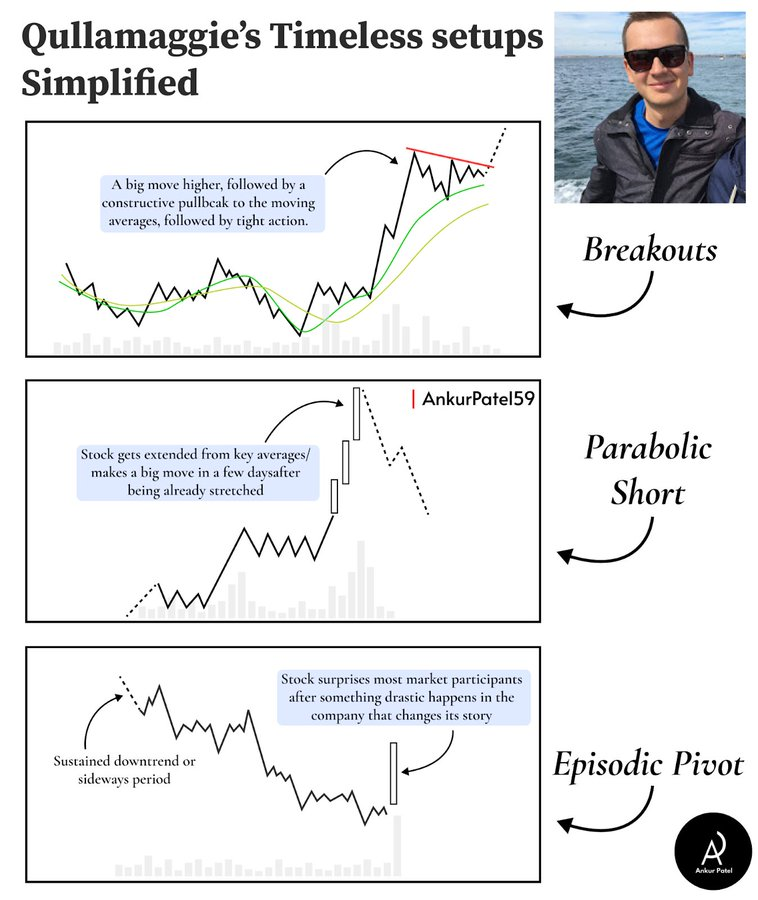
Qullamaggie's 3 Timeless Setups Simplified
Kristjan Qullamaggie has made tens of millions trading 3 simple setups. These setups occurred last year, 10 years ago, 50 years ago, and 100+ years ago. They occur over and over again.
1. Breakouts
Big move higher in the past 1-3 months. Orderly pullback with higher lows. Range expansion out of that consolidation.
How to trade it:
Enter on opening range highs when the stock breaks out
Stop at lows of the day (not wider than ATR/ADR)
Sell 1/3 to 1/2 after 3-5 days, move stop to breakeven
Trail the rest with 10-day or 20-day moving average
In bullish markets, these can give you 10-20x+ your initial risk if you're good at setup selection.
2. Parabolic Short (or Long)
Stocks are like rubber bands. When they get stretched short-term, they snap back hard.
How to trade it:
Stock up 50-100%+ in days/weeks (larger cap) or 300-1000%+ (smaller cap)
Up 3-5+ days in a row
Short on opening range lows or wait for first crack and fail at VWAP
Target is 10-day and 20-day moving averages
5-10x risk/reward, but higher win rate than other setups
3. Episodic Pivot (EP)
When unexpected good news hits a neglected stock, it can trigger multi-month or multi-year moves. Usually earnings or guidance that surprises the market.
How to trade it:
Big move (or gap up) in price 10%+
Big volume (preferably average daily volume traded in first 15-30 minutes)
Big growth numbers with significant beat to analyst expectations
Best if the stock hasn't rallied in the past 3-6 months
Enter on opening range highs. Stop at lows of the day. Trail with 10-day or 20-day moving average.
All of these setups are about finding low-risk entries on fast-moving stocks. Tight, high-probability areas to enter. High risk/reward on trades. You can be profitable with just a 25-30% win rate if you have small losses and big winners. Qullamaggie built an Evernote database over 7-8 years tracking thousands of these setups. He went back decades on thousands of stocks to find recurring patterns.
#Trading
🚨 Warren Buffett’s 4-hour masterclass can teach you more about investing than a $200,000 MBA.
Most people will still scroll past it.
It features Warren Buffett and Charlie Munger not teaching theory, but sharing how real wealth is actually built.
No hype. No shortcuts. Just timeless thinking.
They break down why patience beats activity, why most investors lose by overcomplicating things, and why discipline matters more than intelligence. It’s not about predicting the market it’s about understanding it and staying rational when others don’t.
You start to realize that great investing isn’t flashy.
It’s boring, consistent, and deeply logical.
And that’s exactly why most people fail at it.
This isn’t just content it’s perspective.
Bookmark it. Give it 4 hours this weekend.
Because while most people are chasing quick money…
Very few are learning how it actually works.
Today for next 45 mins to an hour or so, you may ask question by providing your Date, time and place of birth here.
Shall try my best to provide answer or give a one-liner prediction based on horoscope.
Kindly Comment and RT the quoted tweet using hashtag #astrosumitbajaj
#astrosumitbajaj #Astrology
Price action made me $1.7 million from trading in 2025.
But it took years to figure out—not because it's hard, but because nobody taught it in the right sequence.
Here's the 3-step framework that finally made it click:
I've seen traders with great setups blow up their accounts.
Every single time it came down to the same thing - no real risk management process.
Here are the rules I'd build that process around. 🧵
5 traders every serious student of the market should study.
I've spent years going through their books, interviews, and trades. The more you study them, the more you realise they're all saying the same thing.
A thread 🧵
5 traders who lost everything and came back.
I've read every account of what happened to these five. They all said the same thing “Losing everything teaches you things that winning never will.”
A thread 🧵