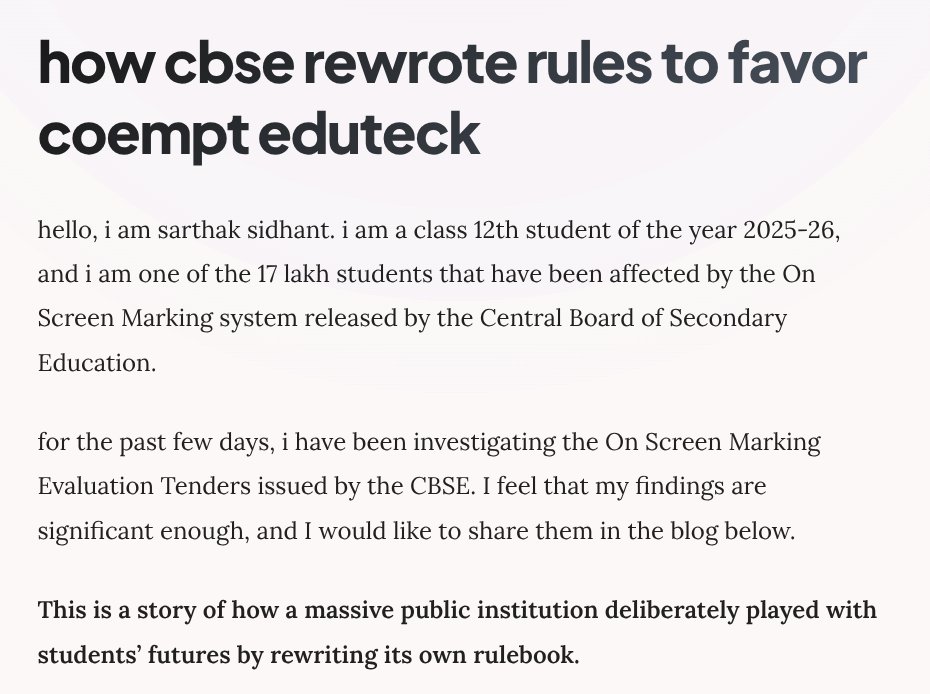
This is an unbelievable piece of work by Sarthak and something that requires amplification.
Let me explain what he found, in simple terms.
Sarthak is a Class 12 student from the 2025-26 batch, one of the 17 lakh students whose answer sheets went through CBSE's new On-Screen Marking system.
He spent days reading through CBSE's evaluation tenders, scraped all 576 tenders CBSE has issued, and tracked how the rules changed across three versions of the same tender.
The core finding is that the company that won the contract to scan and grade 17 lakh students' answer sheets is Coempt Eduteck.
Coempt used to be called Globarena Technologies. Globarena was the company behind the 2019 Telangana intermediate exam disaster, where software failures led to 3.8 lakh students getting wrong or missing marks, and 23 students died by suicide.
A government committee found systemic failure and negligence. Six months later, Globarena rebranded to Coempt Eduteck.
So a company with that track record won a contract to handle 17 lakh CBSE students. Sarthak's investigation is about how the rules were rewritten to let that happen.
The tender was issued three times.
> First tender, February 2025. It existed, then disappeared from the public GeM portal. Sarthak scraped all 576 CBSE tenders and this one was missing from the archive entirely.
> Second tender, May 2025. Four companies applied including TCS and Coempt. All four failed the technical evaluation. Cancelled.
> Third tender, August 2025. Coempt won. Between the second and third tender, a series of rule changes happened, and every single one made it easier for Coempt to qualify.
Here is what changed, one by one.
01. The old rules disqualified any company with a history of abandoning work, failing to complete contracts, or financial weakness. The new rules deleted this clause entirely. Coempt's Telangana history stopped being a barrier.
02. The old rules disqualified any company that was "blacklisted earlier." The new rules changed this to "currently blacklisted." Because Globarena rebranded after Telangana, removing the word "earlier" effectively erased their past.
03. The rules required Rs 50 crore average turnover over three years. Coempt's exact average came to Rs 50.86 crore. They cleared the bar by less than 1%. Earlier, a smaller company had asked CBSE to lower the bar to Rs 30 crore for fairer competition. CBSE refused. So the bar was kept high enough to block small players, but sat exactly low enough for Coempt to scrape through.
04. Software maturity is measured on the CMMI scale, 1 to 5. The old rules required Level 5. The new rules dropped it to Level 3. Coempt is a Level 3 company.
05. The cooling-off period for engaging retired CBSE officials was cut from two years to one. This makes it easier to use recently retired insiders to influence the process.
06. The old rules required experience with large projects of at least 5 lakh students each. The new rules removed the student count and counted cumulative answer-book volume across small projects instead. Coempt has many small fragmented university contracts. This helped Coempt and hurt TCS.
07. The old rules required bidders to own their own data centre and disaster recovery centre on Indian soil. The new rules allowed third-party MeitY-empanelled cloud hosting. Coempt runs on AWS and Azure. This helped Coempt and hurt TCS, which owns its own data centres. It also means student data is no longer on sovereign, Indian infrastructure.
08. The old rules required the bidder to own or control the complete source code of its software. The new rules deleted this. Coempt's platform runs on Microsoft's proprietary IIS, which they don't own.
09. A last-minute corrigendum, issued right before bid submission, removed CBSE's own power to blacklist the firm if its software failed catastrophically. So even a Telangana-scale failure couldn't get Coempt banned from future government tenders.
10. The penalty structure shifted from punishing mistakes to punishing delays. The old rules fined the vendor for wrong scanning, merged pages, and unscanned books. The new rules dropped those and instead levied Rs 50,000 per day for delays. This incentivises rushed scanning over accurate scanning.
11. The old rules had a hard accuracy threshold, error rate not to exceed 0.5%. The new rules removed this number entirely.
12. The old rules specified proper book and robotics scanners. The new rules just say "sufficient scanners." The definition was vague enough that, as Sarthak notes, the scanning could be done with a phone on a stand.
13. On the security side, the contract required a VAPT (vulnerability and penetration test) certified by CERT-In before go-live, and a restricted beta phase before launch. The system clearly wasn't restricted, because the other researcher, Nisarga, was able to access it and find vulnerabilities four days before go-live. So the mandatory security audit appears to have been bypassed.
These are more than a dozen rule changes, all between the failed tender and the winning tender, all pushing in the same direction, all benefiting the one company with the worst track record in the field.
The security holes Nisarga found last week now have an explanation. The system was built by a vendor that was specifically allowed to skip the security certification, the source code ownership, the data sovereignty, and the quality thresholds the original rules demanded.
Following things need to happen immediately;
1. An immediate CAG audit of the tender process.
2. A parliamentary debate on the topic.
3. An independent investigation into
> Why the first tender vanished?
> Why the disqualification clauses were deleted?
> Why the turnover bar was held exactly where it was?
> Why the security level was dropped?
> Why the blacklisting power was removed at the last moment?
Sarthak, this is genuinely exceptional investigative work. Far better than most journalists with full resources ever manage. Take a bow. :)
@Maruti_Corp@MSArenaOfficial while it’s a nice idea to extend the rear glass to give a mini Panoramic view to rear seat passengers of New Swift Dzire, this is not practical for hot cities. The glass extends well above seat, as a result half of the rear seat is exposed to sun
Wow delaying the government formation and using this opportunity to shutdown all state schemes? These authoritarians discover new ways to stoop to new lows everyday
@Ajaychairman@ChennaiIPL If they are going for both, then they should be releasing an overseas player to maintain the cap of 8. Who could get released?
@dominos_india@dominos once again they missed 2 cheese dips in my order. This is happening for the 3rd consecutive order at Nungambakkam branch. Delivery person mentioned they will refund immediately but nothing happened so far.
@dominos_india@dominos Worst service by Dominos Nungambakkam branch, Chennai. Last time they missed items worth Rs. 100, this time they again missed items worth Rs. 412 & not refunding/replacing. I am not able to reach the branch either. 0 responsibility. new business strategy?
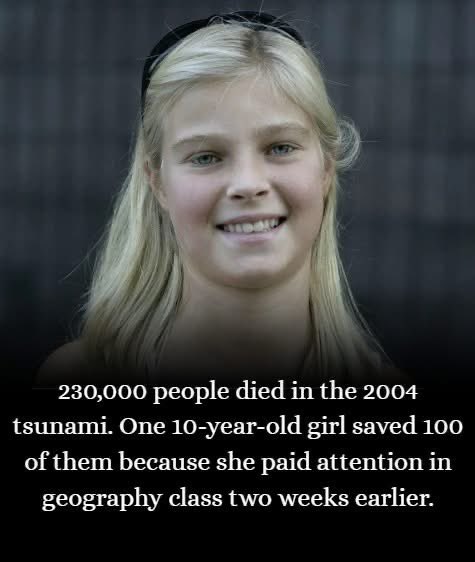
Her name was Tilly Smith. And she was about to prove that a single school lesson could mean the difference between life and death.
On the morning of December 26, 2004, Tilly was walking along Mai Khao Beach in Phuket, Thailand, with her family. They were on their first overseas holiday together—a Christmas treat.
The beach was beautiful. The weather was perfect. But something was wrong.
Tilly noticed the water wasn't behaving normally.
"It wasn't calm and it wasn't going in and then out," she later recalled. "It was just coming in and in and in."
The sea had turned frothy—"like you get on a beer," she said. "It was sort of sizzling."
Any other 10-year-old might have thought it was strange. Tilly knew exactly what it meant.
Just two weeks earlier, in her geography class at Danes Hill School in Surrey, her teacher Andrew Kearney had shown the class black-and-white footage of the 1946 tsunami that devastated Hawaii. He taught them the warning signs: the sea receding unusually far, frothy bubbling water, the ocean behaving in ways it shouldn't.
Tilly was watching those exact warning signs unfold in front of her.
She started screaming at her parents. "There's going to be a tsunami!"
They didn't believe her. They couldn't see any wave. The sky was clear. The beach was calm.
But Tilly wouldn't stop. She became more insistent, more frantic.
"I'm going," she finally said. "I'm definitely going. There is definitely going to be a tsunami."
Her father Colin heard the urgency in her voice. He decided to trust his daughter.
By coincidence, an English-speaking Japanese man nearby overheard Tilly use the word "tsunami." He'd just heard news of an earthquake in Sumatra. "I think your daughter's right," he said.
Colin alerted the hotel staff. They began evacuating the beach immediately.
Tilly's mother Penny was one of the last to leave. She had to sprint as the water began rushing in behind her.
"I ran," Penny recalled, "and then I thought I was going to die."
They made it to the second floor of the hotel with seconds to spare.
Then the wave hit.
It was 30 feet tall.
Everything on the beach—beds, palm trees, debris—was swept into the swimming pool and beyond. "Even if you hadn't drowned," Penny later said, "you would have been hit by something."
The 2004 Indian Ocean tsunami killed over 230,000 people across 14 countries. Entire beaches in Phuket were wiped out. Thousands died.
But at Mai Khao Beach, not a single person was killed.
Because a 10-year-old girl paid attention in geography class.
Tilly was hailed as the "Angel of the Beach." She received the Thomas Gray Special Award from the Marine Society. She was named "Child of the Year" by a French magazine. She appeared at the United Nations and met Bill Clinton.
Her story is now taught in schools around the world as an example of why disaster education matters.
Her father Colin still thinks about what could have happened.
"If she hadn't told us, we would have just kept on walking," he said. "I'm convinced we would have died."
Tilly is now 30 years old. She lives in London and works in yacht chartering.
She still credits her geography teacher, Andrew Kearney.
"If it wasn't for Mr. Kearney," she told the United Nations, "I'd probably be dead and so would my family."
Two weeks. One lesson. One hundred lives.
That's the power of education.
"Tilly Smith’s quick thinking saved her family during the 2004 tsunami. Click to read how one geography lesson made all the difference!"
@ChennaiTraffic Regular scenes at Gemini signal. Vehicles often jump the signals and block the traffic from GN Chetty Road
Today morning these 2 cars raced well after their signal turned red
TN06AE2727
TN12BK9015
Daily scenes at the Tidel park signal. Vehicles taking right towards Tiruvanmiyur blocking 3.5+ lanes out of the available 4 lanes, specially MTC buses. Vehicles going straight can’t use the green signal. Please take action
@ChennaiTraffic#TrafficViolation
When seen from space, city lights in long exposure create golden streaks across the Earth. Dark patches of water and wilderness can interrupt the pattern, creating jagged effects like these.