@TweetingPundit your book was my primary source in writing my first substack on defining what it means to be Kenyan. I also referenced Maisha Kazini @wmnjoya@m_ogada@WillieOeba https://t.co/YLSeFpjryW
A strike by nurses has paralysed health services in government hospitals across Kenya. Nurses are demanding better pay and improved working conditions.
Al Jazeera’s Malcolm Webb reports from Nairobi.
I'm shocked.
I think Kenyans have to conceptually understand that the current government has nothing to make money from, except from our enslavement. There's no plan for production. They are making a gamble that we want university education so badly that we are willing to go into a lifetime of debt for it. In other words, the product on sale is our aspiration and desperation, not our education. And if we can't afford an education, we're not worthy of it, anyway. I cannot explain the deep cynicism and madharau in that policy, especially because Kenyans don't get it. We're so used to analyzing Kenyan politics in terms of competence and corruption, that we don't understand contempt, racism and the belief of Kenyas political and bureaucratic elite that education should be for a few because it's not for knowledge but for access to power.
This principle was established with CBC. Nobody panicked because they were so focused on the frivolous promises which have no educational value.
It's really distressing to see this, but I'm not surprised.
I hope there's a political platform that will campaign on removing it post August 2027.
I've struggled with my health for a long time so in the last two years, I decided to see if dietary changes will make a difference. I cut wheat and milk (allergy reasons) then followed it with sugar. Increased my protein and fiber intake + started taking iron supplements...
This song in 1980 caused ripples in the Catholic Church to the extent that the Vatican asked the Bishops in DRC to intervene. Mobutu also stepped in to curb the spread of the song. Most of us black Africans who don’t speak Lingala did not know what the song was about until now that it is subtitled in English. This is a rendition of the original song, but the lyrics and music are unchanged. Happy Sunday Bazalwane
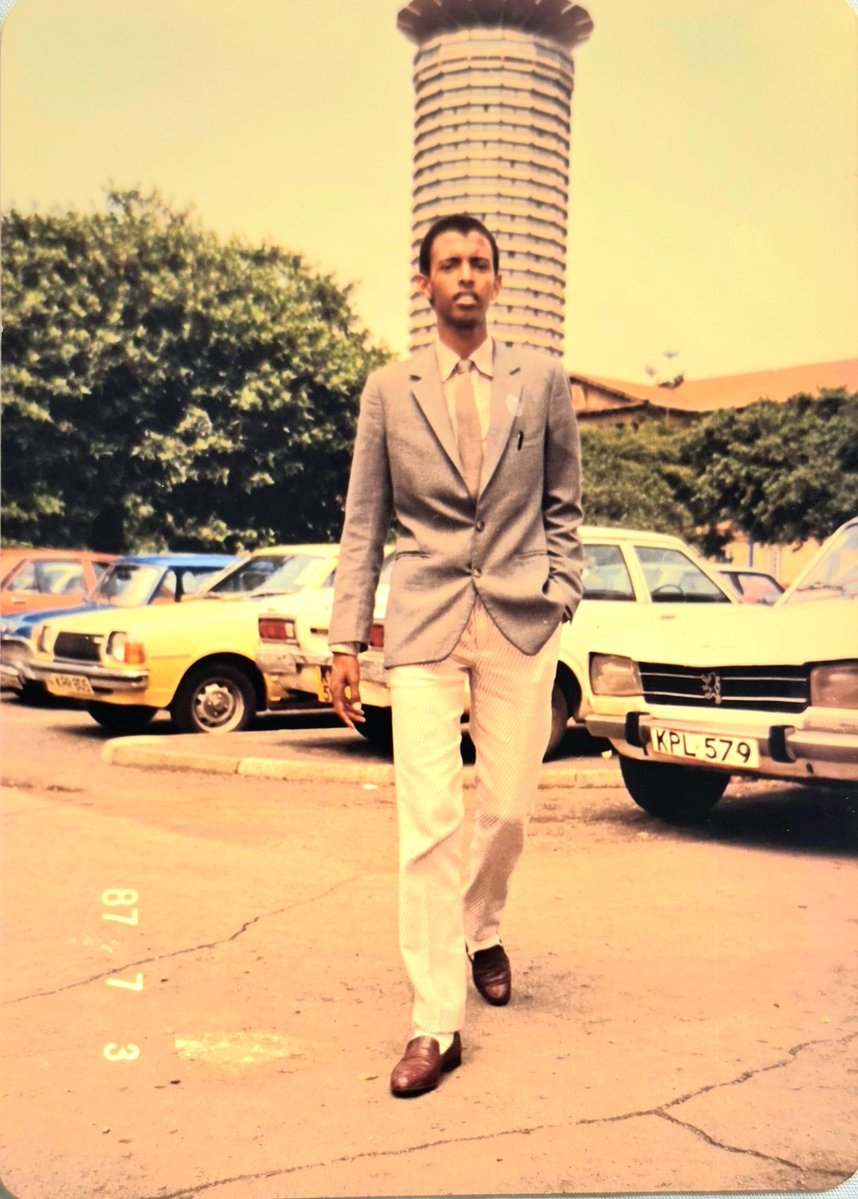
My 1987 Journey
In 1987, a year after finishing my A Levels, I did something many young Kenyans did back then almost casually. I applied for a bank clerk job at KCB Marsabit @KCBInKenya . I didn't think much of it. I certainly didn't expect that application to travel further than I did.
Those days, I can say it without any doubt, Kenya was an equal opportunity employer. There was a clear move to help and support any young man or woman from Northern Kenya who managed to study. I owe it all to my Dad, who insisted I focus on my studies since he never had that chance himself. May Allah grant him Jannatul Firdaus.
Well, my letter landed instead at KCB Nairobi, and before long I found myself walking into KCB Industrial Area for an interview, surrounded by a room full of other hopeful applicants, all of us in our best borrowed confidence. I still remember that day clearly, 3rd July 1987, because I have the photograph to prove it.
I didn't own a blazer then, so an older cousin lent me his. That photo has sat quietly in my archives for almost forty years, and finding it again recently felt like opening a small time capsule. A few days after the interview, I got the call. Not Marsabit. Mandera. I was to report as a bank clerk in a town I had never set foot in, in a region I had no connection to at all.
My name may sound like it belongs to North Eastern Kenya, but I had never lived there. My world until that point had been Eastern Province: Marsabit, Isiolo, and long stretches of schooling in Embu and Meru for O Levels, then Siakago and Meru School for A Levels. You see, I am also a cousin through education.
So I booked a bus ticket, spent the night at a lodging called Munawar in Eastleigh, and set off on a journey that took me through Garissa and Wajir before finally reaching Mandera. It took two full days, passing through Mwingi, Bangal (the largest livestock market in East Africa), Garissa, Mado Gashe, Habaswein, Wajir, Kutulo, Wargadud, Elwak, Rhamu, and finally Mandera.
Somewhere along those long, dusty stretches, it hit me properly for the first time just how vast Kenya really is. Growing up, my whole universe had been defined by a handful of schools and towns. This journey stretched that universe wide open.
Mandera, when I arrived, surprised me with its warmth. People were welcoming, and in a twist that feels almost unbelievable now, Somalia at the time was stable, peaceful enough that Mandera traders treated Bula Hawa as their own Dubai of shopping.
Kenya still had tight import restrictions in those days, so it was completely normal for someone back in Nairobi to ask a Mandera-bound friend to bring back a pair of jeans, a Seiko 5 watch, or a Sony double-cassette player. Cross-border trade was thriving, and Mandera sat right at the heart of it.
I spent 18 months there as a bank clerk, learning far more about Kenya, its people, and myself than any classroom could have taught me. Then I did something that, looking back, defined the rest of my career. I took a leap of faith, left the security of permanent employment and joined Utalii College. @KenyaUtalii
I only managed to get in on my second attempt. It was the most difficult decision of my life, leaving employment to go and study a field I knew nothing about. The only hotel I knew by name then was the Hilton Nairobi, not because I had ever set foot there but through its imposing structure in the heart of the city.
That decision set me on the path into hospitality and tourism, a path I have walked for over three decades since but it all started with a misdirected application, a borrowed blazer, and a long bus ride through a country I was only just beginning to understand.
As always, I choose to remain an optimist.
Alhamdulillah.
MH
Let me say this again: The problem starts with dividing children according to the subjects they are supposed to be good at. It's not which subject is better than the other. Children can be good at any and all. Knowledge is knowledge is knowledge.
The subjects overlap each other. Many mathematicians are philosophers because both deal with logical sequence; many musicians are engineers because both work with sound. So the problem wasn't the "better" pathway. It was the violent imposition of the pathways in the first place.
Someone help me with an analogy to explain the problem because I cant think of one now.
But this logic is not only dumb; it's racist. It will lead to stupidity like saying people from Rift Valley shouldn't be engineers because they are runners and people from northern Kenya shouldn't learn medicine because they are they're better with livestock, and people from the coast shouldn't learn any science because they're good with arts, or Africans are not good at thinking and should do TVET and leave academics to wazungu... etc
The British did this nonsense, and we're still doing it. And the media and academia keep repeating this nonsense.
@KICDKenya you adopted a racist, colonial education logic, and what is more shocking to me, is that you still dont gerrit.
#CBCisheretostay
Justice Mugure Thande of the High Court in Malindi finds that Kenya's next presidential elections ought to be held in August 2026 & not August 2027.
Justice Thande argues that holding the next Presidential election on any day other than within August 2026 amounts to violation of Articles 2,3,10,136(1), 142(1), 249 & 259(1) of the Constitution.
Many may recall that the financial year 2023/24 began on an interesting note when, on June 30th 2023 (the eve of the commencement date), Justice Thande issued conservatory orders temporarily suspending Finance Act 2023 (see quoted tweet).
The High Court in Malindi has ruled that Kenya's next General Election ought to be held in August 2026, not 2027.
The court based its decision on the Constitution, which says elections should be held on the second Tuesday in August in every fifth year.
According to the ruling, "every fifth year" means the election should take place during the fifth year after the last General Election, not after five full years have passed.
Since the last General Election was held on 9 August 2022, the court says the fifth year falls in August 2026, making that the correct election period.
The court also found that holding the election in August 2027 would not comply with this interpretation of the Constitution.
However, the court suspended the effect of its decision because organizing a nationwide election in August 2026 is no longer practical.
This means the ruling does not immediately change the current election timeline.
The decision is expected to be appealed, so higher courts could still determine whether Kenya's next General Election will be held in 2026 or 2027.