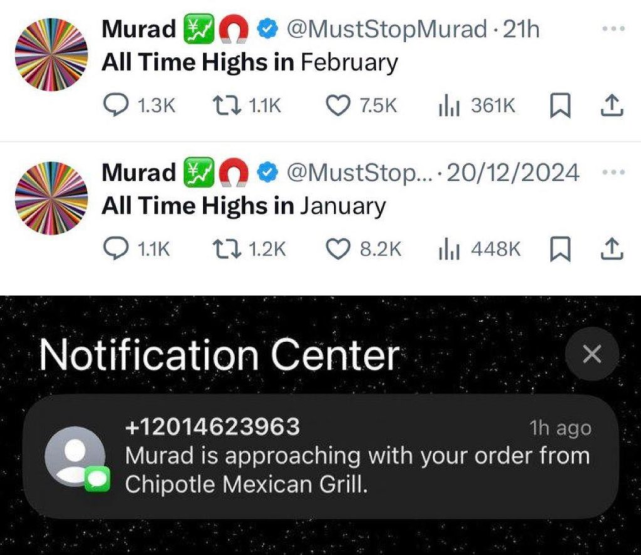
They accumulated 10.54% of the total supply and ETH couldn't even make a new all time high. Pathetic.
Send this fucking shitcoin to $1k where it belongs.
1/
I started tweeting this account about 2 years ago when SOL was at 30$ with less than 100 followers.
Now, 2 years in, I've crossed 32k followers.
after 2 years, around the same time, with potential UP-quarter
I figured it’s a good time to write this thread — about how my trading style evolved from scalping to MTF positioning, and why two principles changed everything:
Fold Pre & Pocket Ace. (feat. @thiccyth0t )
2/
The Fold Pre Principle is simple.
You shouldn’t have taken that trade in the first place.
Low conviction positions destroy more accounts than bad entries ever will.
The smartest move?
Don’t enter low-conviction setups at all.
3/
This applies to life too.
Jobs we hate but can’t quit.
Relationships we’ve outgrown but hold onto.
Dead trades we keep averaging down.
Ask yourself:
“If I could walk away today, free of cost, would I re-enter this position?”
If not — fold pre.
4/
Markets evolved.
Short-term trades are now mostly noise.
Charts alone won’t show you the real upside anymore.
Macro drives most of the flow now, and that’s what I began to focus on — ignoring the noise, and spending real time on research + positioning.
5/
I started just like many of you —
BitMEX scalps, leaderboard runs, dopamine loops.
But slowly, I changed.
Because true edge started to show only on higher timeframe setups with asymmetrical reward.
Scalping can’t give you life balance. Big trades can.
6/
There are many ways to make money.
Airdrops, farming, funding, degen longs, sniper entries.
But in the end —
It’s what you do when your Pocket Aces show up that defines you.
7/
And Pocket Aces don’t come often.
It’s your job to recognize them —
– When fundamentals + positioning + catalysts align.
– When you feel it in your gut and your spreadsheet.
– When the only thing left is to size in and execute.
8/
That’s how I treat my trading now.
Not as a trade.
But as an investment.
If the opportunity doesn’t align with a clear narrative or conviction — I skip it.
If it does, I size in.
Simple.
9/
Everyone has different edges.
Some people are great at scalping.
Some at hunting airdrops.
Some at L1 narratives, farming or option flow.
Don’t copy others.
Just know your Pocket Aces.
And when they come, bet like your life depends on it.
10/
Fold Pre is the art of restraint.
Pocket Ace is the art of commitment.
Both require experience.
Both require pain.
But if you can master just these two —
You’ll not only survive this market.
You’ll win.
11/
It looks like we’ll need to enter positions ourselves before mid-month.
Keep it simple:
→ Focus on a few key narratives
→ Don’t over-complicate
→ Don’t over-trade
→ Have conviction in the bet you chose, researched, and verified.
Believe in yourself.
Keep some cash on the side for new narratives.
Time to lock in.
S&P 500 - TAX DRAIN
In years following large bull market gains, the S&P 500 often suffers through an air pocket during tax season.
We saw this in 2022 (-12%) and 2024 (-5%).
Beware of those expecting positive April seasonality
@3F_Research
While the administration is clearly more focused on interest rates than anything else near term given the $10 trillion of debt that needs to be refinanced this year, intentionally causing a recession is dangerous as the deficit would blow out due to automatic stabilizers (plus lower tax receipts) and inflation *might* go up at the same time because of tariffs. The potential combination of these two factors means there would be a limited policy response.
This was the #1 topic in my discussions with peers this weekend. The fear is that if tariffs on April 2 are too harsh overnight vs. phased in slowly then they won’t be able to put the genie back into the bottle even if the market forces them to backtrack and we will have a potentially inflationary recession. Right or wrong, that was what most of my peers were worried about especially given that both the President and VP seem to be true believers in tariffs (and having read the VPs book, I am sympathetic to their views on the detrimental impact of globalization on blue collar workers even if the topic is super nuanced).
I understand all of these worries, but am also cognizant that an entirely self-inflicted, inflationary recession would mean a Blue wave during the mid-terms and an inability to accomplish any of their goals. 2024 election showed that voters hate inflation more than anything else, including illegal immigration.
So hard for me to believe the administration *want* a recession especially one that might be inflationary even if they are true believers in tariffs long-term. If tariffs are blamed for a recession, unlikely the tariffs will stand the test of time.
Reality is I think the American economy can afford higher tariffs. They can accomplish their policy goal - but the tariffs need to be phased in gradually to give industry time to reshore, accompanied by deregulation and clearly communicated so that businesses have policy certainty. Even CEOs who would benefit from tariffs are currently hesitant to invest in America right now given the level of policy uncertainty. Whatever CEOs are saying to the administration, this is what they are saying in private.
The news that China, South Korea and Japan will jointly respond to any American tariffs also undermines the administrations theory of the case, which is basically that the United States is the worlds largest economy and therefore has the leverage along with being “more flexible” per @SteveMiran Bloomberg interview; should note that Steve is quite smart. China, South Korea, Japan and the EU are collectively 1.5x the size of the United States economy and taken together are more “flexible” than the United States alone. Also wild to see China, South Korea and Japan agree on anything - might literally be the first time in over 1000 years.
And tariffs on semiconductors specifically would cut against the goal of America leading in AI. Easy to put the datacenters elsewhere.
So April 2 is an opportunity to either 1) reset, slowly phase in less extreme tariffs and stabilize policy such that reshoring will happen and tariffs will last (their policy goals) while letting DOGE do much of the near term deficit reduction or 2) destroy CEO confidence in such a damaging way that the economic recovery will be difficult, let alone the political impact of a potentially inflationary recession (no bueno for their policy goals).
Bessent and many others in the administration are super smart and for sure understand all of this. The American auto OEMs - who theoretically should be beneficiaries - imploding on the 25% overnight auto tariffs is a pretty strong signal. If the 25% auto tariffs had been phased in over the next two years (up 6.25% every 6 months), I think the American auto companies would’ve responded more positively.
Basically, lots of market participants are betting the administration will cut off its nose to spite its face and others are betting that they already have and there is no way back.
We shall see shortly.