I was struggling to create an infographic to show I see a 10x economic growth driven by mass adoption of advanced humanoid robots.
This video does it.
Imagine them creating economic value, not just being sold as consumer products. Tax that output and distribute income to human citizens.
Countries with heavy immigration system will suddenly find themselves at a huge disadvantage and unable to catch up.
Maybe it will take another year, or two until physical AI advances to the right level. But when it starts happening it will grow exponentially. Boom time.
Caveat: no one knows the impact on demographics: social relationships, marriages, reproduction, law and order.
Meta made a “deal” with Zuckerberg to issue non-voting shares that he can use to pay the 5% wealth tax.
Thus Zuckerberg spread his bets across the political divide. So machiavellian.
The fake threat “I will leave California if the wealth tax is enacted” gives away the cunning plan.
The most compelling argument for SpaceX and Tesla merger is that they share the same core focus: SI and energy.
Cars, robots, satellites, are products that sell to fund the advance of SI and product of energy at scale.
The ultimate goal: Kardashev Type 2 + Mars.
JENSEN HUANG SAYS CHINA HAS REPLACED THE U.S. AS ONE OF THE WORLD'S THREE INDUSTRIAL LEADERS
He explains how the computing revolution reshaped global manufacturing:
- Electrification created three major industrial powers: Germany, the United States, and Japan
- Over the past 50 years, the computing and digital revolution led the U.S. to shift much of its heavy manufacturing, building, and craftsmanship to China
- The world's three major industrial powers are now 🇩🇪 Germany, 🇯🇵 Japan, and 🇨🇳 China
Whenever I see a technological advance I wonder what it can do in a post-capitalist society in a 10x world.
A political power with superior SI can turn a small initial advantage into a crushing victory in a short time and hold that power over a long period.
The future of security in the AI age is "the constant pressure of models attacking you," says Kevin Mandia of @ArmadinSecurity. That means seeing your network the way a swarm of AI attackers would:
"We do a thing called a hyperattack. We throw a drone swarm of agents at you, and we map your network. Every service, every route, every system, all assets. We may end up with terabytes of metadata on your network."
"This is the attacker's view of your network. But with that metadata, we now just poll you almost like a heartbeat."
"What's changed?... Did a route change? Did a service get updated? Did a new machine get presented into the target area? We can poll cheaply for change and then attack the change."
"You can't [attack yourself] all the time because it's cost prohibitive, and it's unnecessary. You do it when either the threat changes, new models come out, new intelligence is available, or your network changes."
"Over the weekend, there was a zero-day in a popular product, and immediately we've already got the heartbeat. We just polled who's got the problem."
"Our goal at Armadin is to go from a known vulnerability to knowing whether it's actually exploitable before the bad guys can."
Absolutely incredible…
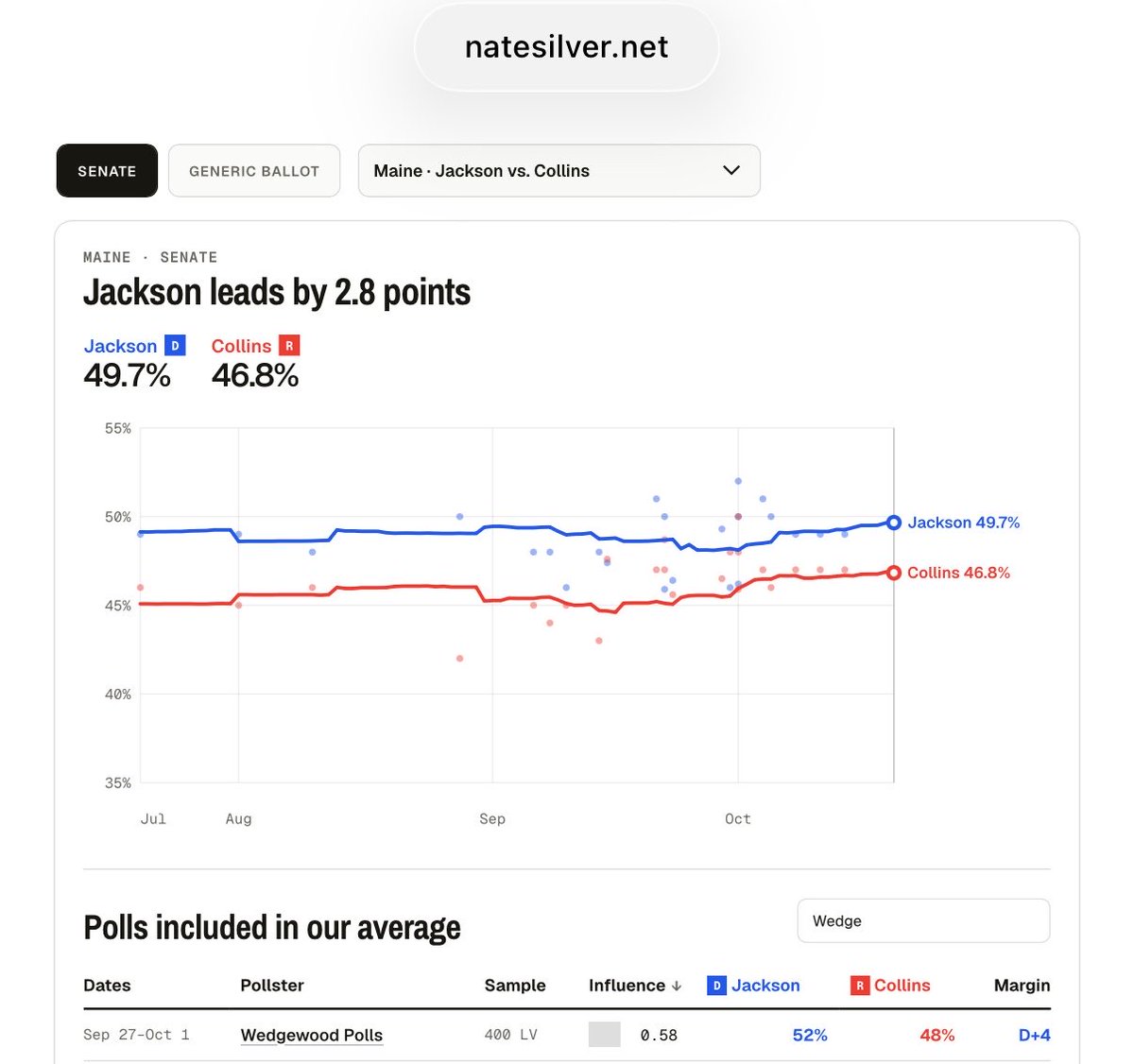
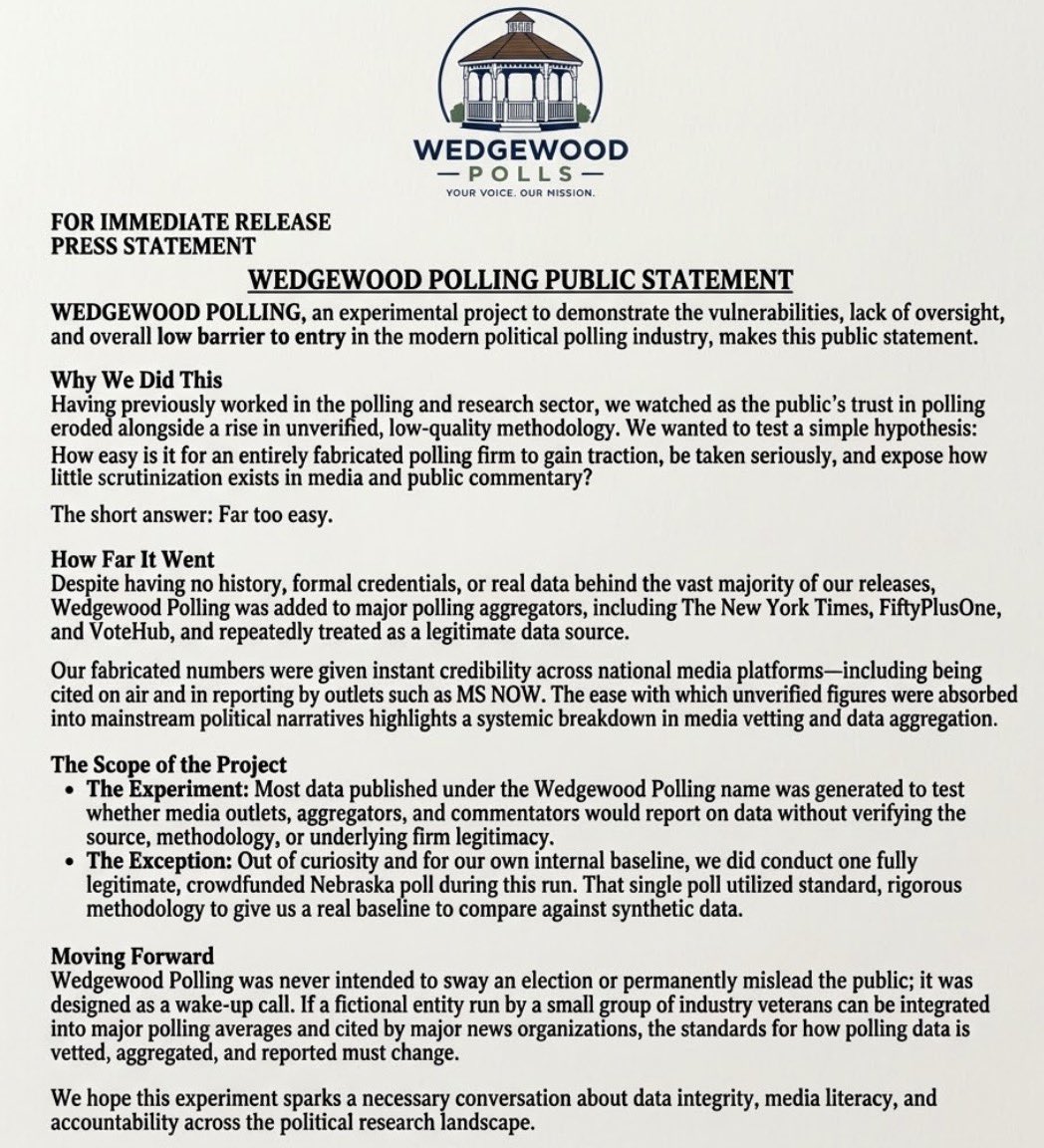
"Wedgewood Polls" just admitted they are a fake polling firm and made up their polls.
Their fake polls have been posted in both the NYT and Nate Silver’s averages.
@a16z this is a profound take
I always pay attention to the narrative. In that, small details in a narrative can pack a lot of information. It's like a super-compressed message.
Something doesn't add up. Total US AI investment: Goldman Sachs estimates around $581 billion (just under $600 billion) in the US for 2026, part of roughly $1 trillion globally. The Mag 7 spend about 70-80% of that total.
More likely the 99% who invest in the 10% come from unfounded VCs.