Finance Bill 2026 is asking for permission to kill local businesses.
Right now, if your company makes profits, you can choose to:
• Reinvest profits back to business
• Or distribute it as dividends to shareholders
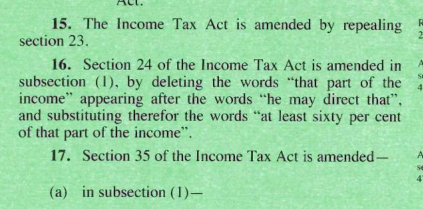
Finance Bill 2026 wants that removed. And be replaced by one hard rule. That,
• At least 60% of your profits can be treated as dividends by KRA. Even if you did NOT distribute anything.
“At least” means minimum.
KRA can push it to: 70%, 80% even 90% if they don't like you.
Read that again.
Meaning:
• If you reinvest all your profits in your business, KRA will says:
- Noo. At least 60% must be distributed to shareholders. And since you didn’t, we will assume you did, and demand dividend tax from you.
As a result:
• You are taxed on money you never paid out
• 5%–15% withholding tax on “deemed” dividends
Who is in cooked?
• SMEs reinvesting profits to expand
• Manufacturing businesses expanding
• Real estate firms with paper profits but no cash
Who is safe?
• SEZ companies
• NIFC companies
• REITs
Because their dividends are already exempt.
But for everyone else, this is a forced dividend rule.
The govt is no longer waiting for you to run your business. They want KRA to run it for you.
Is this fair taxation? Or forced extraction?
I’ve signed a petition calling for accountability over the humiliation of a Grade 10 student in the Kenyan Senate. No child should ever be degraded in public institutions. Join me in demanding action and stronger protections for children’s dignity: https://t.co/K7a8q1BgOf
Ruto’s Finance Bill 2026 gives KRA the power to freeze or take your money even if you have appealed a tax bill, until the dispute is fully resolved
For example Serikal sends you a tax bill of say kshs 5 million. As a business owner, you know the amount is not correct and you appeal it.
Under Ruto’s 2026 Finance Bill, KRA will simply tell your bank, SACCO, or M-Pesa to handover the kshs 5 million or freeze your accounts while the appeal case is still ongoing.
The pain this proposal will cause many business owners is unbearable.
That is why we are saying Reject Ruto’s 2026 Finance Bill.
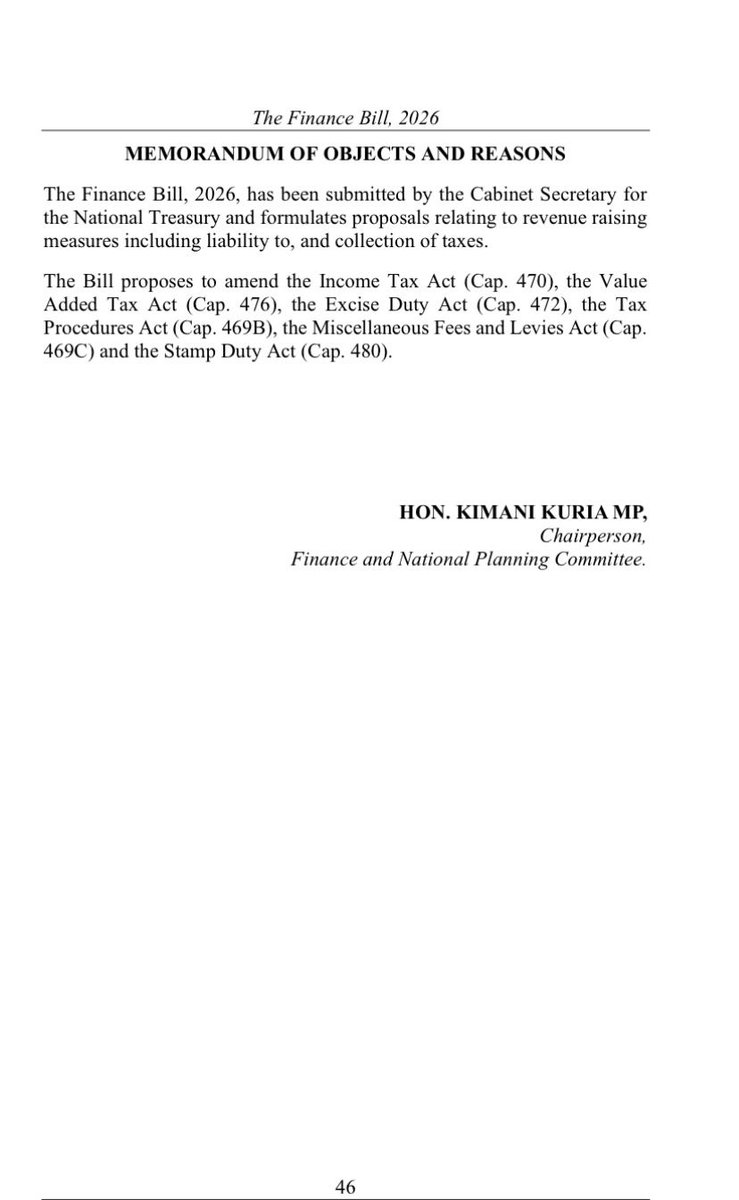
The Finance Bill, 2026 was published on 30th April and is now before Parliament and every Kenyan deserves to know what is in it.
The government targets Ksh3.63 trillion in revenue for 2026/27 and a wider budget deficit of 5.3% of GDP in the 2026/27 fiscal year (July-June) up from 4.7% in 2025/26. These are not unreasonable fiscal objectives but the manner in which the burden of achieving them is distributed is a cause for serious concern.
On tax filing timelines, the Bill moves the income tax return deadline to April 30th which is two months earlier than the current June 30th and compresses nil return filing to January 31st. This reduces the time available for audit completion, cash flow planning and compliance. For small businesses and individual traders, this is not administrative reform. It is an additional compliance cost they can ill afford.
On mitumba, the Bill inserts a new Section 12H into the Income Tax Act which deems profit at 5% of customs value payable upfront before goods are released by KRA as a final tax. A trader importing a bale worth Ksh1 million pays Ksh50,000 regardless of whether they make a profit or a loss. I cannot in good conscience describe this as equitable.
The Bill increases residential rental income tax from 7.5% to 10%. Absent a serious enforcement framework, this will drive non-compliance rather than revenue. The government must fix the enforcement gap before it increases the rate. One without the other is burden-shifting.
On digital financial services, the Bill removes existing VAT exemptions on money transfers and payment processing. These are the tools of financial inclusion that millions of Kenyans including the very people this government says it wants to reach rely on daily. Making them more expensive will not serve the objective of a broader tax base.
By including interchange and merchant service fees within the definition of management or professional fees for withholding tax purposes, the Bill introduces a compliance burden into automated banking processes. That burden will be passed on to businesses and ultimately to consumers.
The amendment to Section 24 of the Income Tax Act empowers KRA to deem at least 60% of a company's undistributed income as dividends for tax purposes. This fails to account for legitimate decisions on reinvestment, working capital and business growth. It is a retrogressive measure that sends the wrong signal to the investors Kenya needs.
A 25% excise duty on telephones for cellular and wireless networks is proposed. A phone is not a luxury. It is how Kenyans bank, communicate, conduct business and access government services. Parliament must interrogate this carefully.
On PAYE, Kenyans were led to expect relief and a restructuring of the tax bands to ease the burden on salaried workers. That proposal does not appear in this Bill. That is not a minor omission. An explanation is owed to every employed Kenyan who was waiting for it.
To be fair, the Bill is not without merit. The reduction of corporate tax for non-resident companies from 37.5% to 30% improves our investment climate. The extension of the tax amnesty to cover liabilities up to 31st December 2025 provides a genuine and welcome pathway to compliance. VAT exemptions on electric buses, bicycles, dialysers, animal feed raw materials and PPP infrastructure are sensible measures. The clarity introduced on trust taxation ensuring beneficiaries are not taxed on income already taxed at the trust level and the recognition of gratuity contributions as exempt income are also steps in the right direction.
Be that as it may, we cannot afford a repeat of June 2024. Parliament must discharge its oversight role with the seriousness this moment demands. They should not merely rubber-stamp what the Treasury has placed before it. Every clause must be scrutinised. Every punitive or ambiguous provision must be rejected or amended.
#FinanceBill2026 #PublicParticipation
Day 06 and this con pastor is still walking around intimidating the family...keep pushing hadi aifeel kabisa..day 06 of @ntsa_kenya not doing anything at all..SHAME ON THEM..One way or another we will get justice!
Kenya’s imported cars face total taxes of about 70%–100% of their value, pushing prices higher.
Here is the explanation of how the taxes are structured.
Save the thread below:
Watched an Alex Mwakideu interview the other day he was talking to the legendary judge from Vioja Mahakamani. Millennials, you know her ~That no-nonsense mama who took zero nonsense in that courtroom.
Now here’s the wild part they never had scripts. Not a single one. They’d just show up, pick roles, agree on the case, and go. Cameras rolling, take one, done.
So every punchline Alphonse Makacha and Dot Makokha ever dropped? Pure improvisation. No rehearsal. Nothing prepared. Just talent doing its thing in real time.
Kenya really had something special with that crew.
And here’s the part that gets me AG Amos Wako was fully behind the show. He’d supply them with real court cases and actual judgments from Kenyan courts. So when the judge passed her verdict on screen, it wasn’t made up. It was legally accurate, straight from the constitution.
Comedy on the surface. Civic education underneath.
That’s a level of craft most productions today can’t touch.
Golden era. Salute to those legends. 🫡
Joel Jirani apewe his flowers for exposing the rot in our public hospitals. Ukienda hosi huwa unapata na hawa doctors wakiwa unmotivated na kazi unadhani wao hukuwa roho chafu kumbe behind the scenes wanashangaa waanzie their day wapi from the mess created by governors.
The doctors and health professionals are speaking up on the health related matters in Kenya and it’s nothing short of an apocalypse.
The health sector needs to be reigned in and rogue players ostracized. Health is a basic need and must be addressed as such
I’ve worked in public hospitals since 2016 and I can tell you for free. Hizo Mmeona Leo ni za level 5 and 6. Huko Dispensaries and health centres are struggling.
Mngejua how far these medics go for poor systems to save lives? We literally buy meds for patients. We buy Nan for mothers without breast milk. We even help clear bills. You go home defeated.
Hospitali haina hata thermometer. Glucose strips ni gold
Eeei