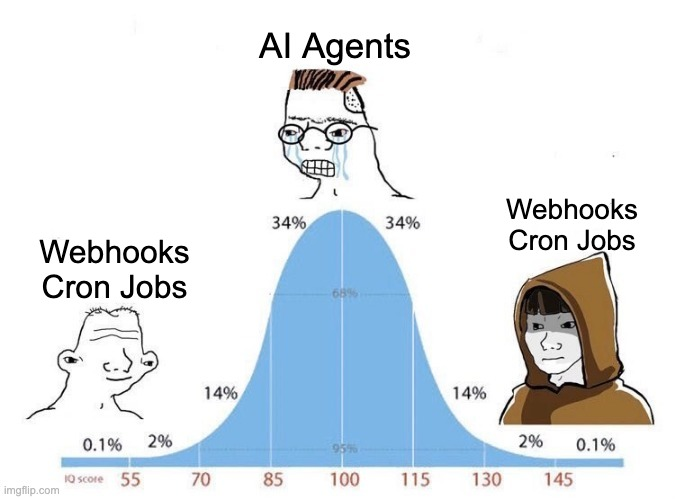
the AI debate is split into camps:
doomers, ethicists, builders, pragmatists, and skeptics
some want to slow everything down, some think LLMs are all just fancy autocomplete, others are convinced AGI is basically tomorrow
but the weird part is we're all watching the same progress, we interpret it in totally different ways
that's why every AI discussion turns into a messy, polarized fight so fast
A common mistake that AI companies make nowadays is to not give their engineers enough time and mental calm to do their best work. Constant deadlines, pressure and distractions from daily AI news are poison for writing good code and systems that scale well. That’s why most AI APIs and products have reliability issues.
A good company culture that mixes excellence with focus and enough rest leads to faster and better results. The best example of how to do it well is the early Google culture from 1998 which resulted in one of the largest scale and most reliable services on the web in just a few short years. Founders should copy some of the strategies that Larry and Sergey used. They are still underrated IMO despite their huge reputation.
@JacksonAtkinsX ARC-AGI-1 consists of 800 puzzle-like tasks, designed as grid-based visual reasoning problems. These tasks, trivial for humans but challenging for machines, typically provide only a small number of example input-output pairs (usually around three).
My brain broke when I read this paper.
A tiny 7 Million parameter model just beat DeepSeek-R1, Gemini 2.5 pro, and o3-mini at reasoning on both ARG-AGI 1 and ARC-AGI 2.
It's called Tiny Recursive Model (TRM) from Samsung.
How can a model 10,000x smaller be smarter?
Here's how it works:
1. Draft an Initial Answer: Unlike an LLM that writes word-by-word, TRM first generates a quick, complete "draft" of the solution. Think of this as its first rough guess.
2. Create a "Scratchpad": It then creates a separate space for its internal thoughts, a latent reasoning "scratchpad." This is where the real magic happens.
3. Intensely Self-Critique: The model enters an intense inner loop. It compares its draft answer to the original problem and refines its reasoning on the scratchpad over and over (6 times in a row), asking itself, "Does my logic hold up? Where are the errors?"
4. Revise the Answer: After this focused "thinking," it uses the improved logic from its scratchpad to create a brand new, much better draft of the final answer.
5. Repeat until Confident: The entire process, draft, think, revise, is repeated up to 16 times. Each cycle pushes the model closer to a correct, logically sound solution.
Why this matters:
Business Leaders: This is what algorithmic advantage looks like. While competitors are paying massive inference costs for brute-force scale, a smarter, more efficient model can deliver superior performance for a tiny fraction of the cost.
Researchers: This is a major validation for neuro-symbolic ideas. The model's ability to recursively "think" before "acting" demonstrates that architecture, not just scale, can be a primary driver of reasoning ability.
Practitioners: SOTA reasoning is no longer gated behind billion-dollar GPU clusters. This paper provides a highly efficient, parameter-light blueprint for building specialized reasoners that can run anywhere.
This isn't just scaling down; it's a completely different, more deliberate way of solving problems.