Check out our recent work accepted to #RSS2026! We enable a robot to learn a flying knot from a single human demonstration and less than 10 trials using Task-Level Iterative Learning Control:
https://t.co/8ZAi3PIbzY
Check out our recent work accepted to #RSS2026! We enable a robot to learn a flying knot from a single human demonstration and less than 10 trials using Task-Level Iterative Learning Control:
https://t.co/8ZAi3PIbzY
@Scav Haha yes there are some really fun rope magic tricks! Many of them are a bit more complex and we're still working toward doing some more multi-phase tasks: https://t.co/W8xdusVgD5
Everyone asks if Atlas can bring them a drink, but this robot can bring you the whole fridge. Using AI-driven behaviors, Atlas is doing hard work and coordinating its whole body to manage heavy objects, balancing complex contact points with accuracy and reliability.
GR00T-VisualSim2Real is now open source!
VIRAL and DoorMan are now available with training code, simulation assets, and the full recipe for bringing visual sim-to-real loco-manipulation skills to your own humanoids.
Repo: https://t.co/vgRsCeRG8w
Watch AthenaZero juggle barehanded using on-board sensory feedback only. No motion capture. No funnels. No help adding the third ball. The robot learns to adapt to the uncertainties from contact and the appropriate hand-eye coordination.
Learn more: https://t.co/L5p2wD9nAd
@fdellaert But as the task evolves we may want to shift our representation of the state. As the robot perceives more and accomplishes more, it may require a change in reasoning about different levels of the abstraction hierarchy.
@fdellaert Very cool framing with factor graphs. One challenge I’m curious if you have any thoughts on is that once an abstraction choice is made for any part of the system, such as the state representation, it becomes fixed for all estimation and planning. (1/2)
When roboticists think about where robots can best fit into our daily lives, there is often a focus on "Dull, Dirty, and Dangerous" (DDD) jobs. But what if those terms aren't as straightforward as they sound?
Before we automate, we need to understand the whole picture for this type of work.
We explore the social science behind DDD work and offer a framework to better understand the context of DDD jobs: https://t.co/lRfTFnZgol
Let your robots hear slips with A-SLIP! 🤖🎧
How can a robot detect in-hand slip and estimate its direction and magnitude without cameras or fragile tactile skins?
A-SLIP uses piezoelectric microphones embedded in grippers to hear it.
https://t.co/VZWCZ7XaPe
🧵1/7
Excited to share SoftAct, a framework for retargeting human manipulation demos to soft robot hands using explicit contact force reasoning! How do you transfer human skill to a hand that looks and moves nothing like yours🐙🖐️? It turns out VR environments can let us capture privileged force interaction demonstrations to help. 🧵1/7
Learning from human videos often requires restrictive, carefully choreographed human motions.
We propose ✨3PoinTr✨: a scalable way to pretrain from casual human videos. It bridges the embodiment gap by learning 3D scene evolution, enabling learning from natural human motions.
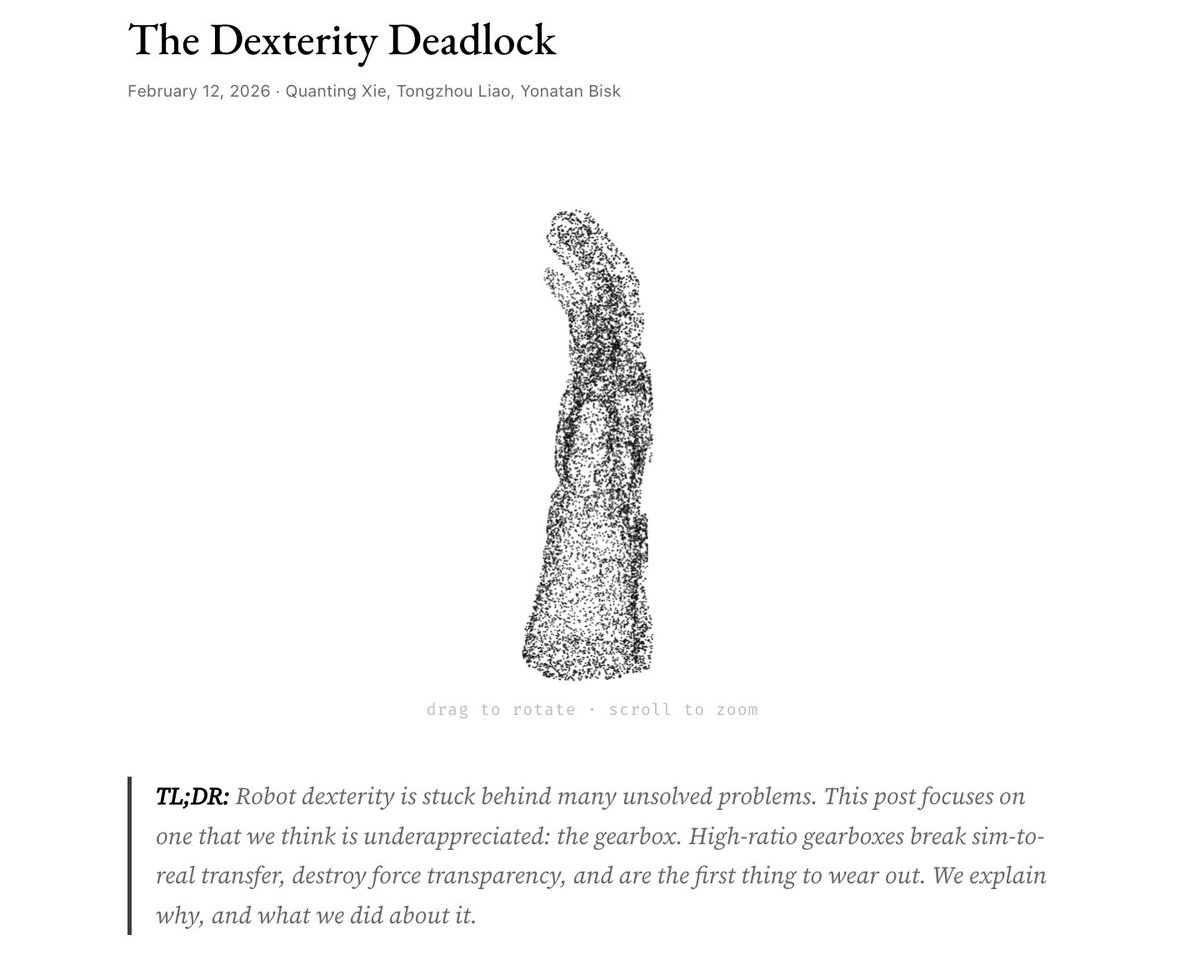
Why does manipulation lag so far behind locomotion? New post on one piece we don't talk about enough: The gearbox. The Gap You've probably seen those dancing humanoid robots from Chinese New Year. Locomotion isn't entirely solved; but clearly it's on a trajectory. But we haven't seen anything close for manipulation. 𝗪𝗵𝘆? When sim-to-real transfer fails, the instinct is to blame the algorithm. Train bigger networks. Crank up domain randomization. Those approaches have made real progress; we don't deny that. But we started wondering: are we treating the symptom or the disease? The Hardware Bottleneck: Fingers are too small for powerful motors. So most hands use massive gearboxes (200:1, 288:1) to get enough torque. But those gearboxes break everything manipulation needs:
• Stiction and backlash are complex to simulate. Policies trained on smooth physics hallucinate when they hit that reality.
• Reflected inertia scales as N². At large gear ratio, the finger hits with sledgehammer momentum.
• Friction blocks force information. The hand becomes blind.
And they're the first thing to break. What we are trying to build at Origami, we cut the gear ratio from 288:1 to 15:1 using axial flux motors and thermal optimization. The transmission becomes more transparent: backdrivable, low friction, forces propagate to motor current. Early signs are encouraging. Still running quantitative benchmarks. Why Interactive? I love how Science Center uses interactive devices to explain complex ideas. I want to borrow this concept and help people understand the hard problems in robotics better visually. The post has demos where you can toggle friction, slide gear ratios, watch the sim-to-real gap widen in real-time. What's inside:
• Interactive demos (friction curves, N² scaling, contact patterns)
• Comparison table: 14 robot hands by sim-to-real gap and force transparency
• The math behind why low-ratio matters
Read it here: https://t.co/imHPaCqNfS We're not claiming we've solved dexterity. The deadlock has many pieces. But we think this one's foundational. Curious what you think.
Robust humanoid perceptive locomotion is still underexplored. Especially when different cameras see different terrains, paths get narrow, and payloads disturb balance...
Introduce RPL, tackling this with one unified policy:
• Challenging terrains (slopes, stairs and stepping stones);
• Multiple directions;
• Payloads;
Trained in sim. Validated long-horizon in the real world.
Watch the robot walk it all🦿
Details below👇
CogNVS was accepted to @NeurIPSConf 2025! 🎉We are releasing the code today for you all to try:
🆕Code: https://t.co/keRWoQMNH5
Paper: https://t.co/dV0Q2FYW3i
With CogNVS, we reformulate dynamic novel-view synthesis as a structured inpainting task: (1) we reconstruct input views with off-the-shelf SLAM systems, (2) create self-supervised training pairs for learning to inpaint, and (3) test-time finetune to the input at inference.
with @kaihuac5 and @RamananDeva