🚨 THE 99% DESERVE EARLY ACCESS
“You can blow your savings in Vegas… but you can’t invest early in AI, robotics, or nuclear? Absurd.”
We’re pushing to tokenize private markets so everyday Americans can invest before valuations hit billions.
🚨 THE 99% DESERVE EARLY ACCESS
“You can blow your savings in Vegas… but you can’t invest early in AI, robotics, or nuclear? Absurd.”
We’re pushing to tokenize private markets so everyday Americans can invest before valuations hit billions.
There could be a lot more institutional money waiting on the sidelines than people realize.
And the problem may come down to something that sounds incredibly basic.
What exactly is the asset?
Is it a security?
Is it a commodity?
For a bank, credit union, insurance company or asset manager, that classification affects almost everything.
Tyler Williams explained that institutions have a hard time going to an investment committee and proposing a crypto strategy when they can't clearly explain the legal classification, tax implications or regulatory requirements around the asset.
It also makes it harder for traditional financial institutions to connect with permissionless blockchain technology.
That's why regulatory clarity matters so much.
They don't necessarily need every single rule figured out immediately. They need enough certainty to know which direction they're allowed to move.
Tyler believes there is a significant amount of capital sitting on the sidelines waiting for exactly that kind of directional certainty.
And that's one of the bigger potential implications of the CLARITY Act.
Full conversation below 👇
There could be a lot more institutional money waiting on the sidelines than people realize.
And the problem may come down to something that sounds incredibly basic.
What exactly is the asset?
Is it a security?
Is it a commodity?
For a bank, credit union, insurance company or asset manager, that classification affects almost everything.
Tyler Williams explained that institutions have a hard time going to an investment committee and proposing a crypto strategy when they can't clearly explain the legal classification, tax implications or regulatory requirements around the asset.
It also makes it harder for traditional financial institutions to connect with permissionless blockchain technology.
That's why regulatory clarity matters so much.
They don't necessarily need every single rule figured out immediately. They need enough certainty to know which direction they're allowed to move.
Tyler believes there is a significant amount of capital sitting on the sidelines waiting for exactly that kind of directional certainty.
And that's one of the bigger potential implications of the CLARITY Act.
Full conversation below 👇
A lot of people are going to watch Tuesday's CLARITY Act vote without understanding what they're actually watching.
That's because Tuesday isn't simply a vote on whether the Senate likes or dislikes the bill.
Tyler Williams, a crypto policy insider who has worked at the Treasury and advised Secretary Bessent on crypto, explained the entire process to me.
Before the Senate can debate the substance of the legislation, it has to vote for cloture.
That requires 60 senators to vote in favor of proceeding.
If that happens, the Senate can actually start debating the bill, consider amendments and move toward substantive votes.
If it doesn't, the process can't move forward in the same way.
He also made an important point: even if you're skeptical of crypto or don't like parts of the bill, you still have to vote to proceed if you want those issues debated and changed.
So the 60 votes on Tuesday are a much bigger deal than they might look on the surface.
Full conversation below 👇
A lot of people are going to watch Tuesday's CLARITY Act vote without understanding what they're actually watching.
That's because Tuesday isn't simply a vote on whether the Senate likes or dislikes the bill.
Tyler Williams, a crypto policy insider who has worked at the Treasury and advised Secretary Bessent on crypto, explained the entire process to me.
Before the Senate can debate the substance of the legislation, it has to vote for cloture.
That requires 60 senators to vote in favor of proceeding.
If that happens, the Senate can actually start debating the bill, consider amendments and move toward substantive votes.
If it doesn't, the process can't move forward in the same way.
He also made an important point: even if you're skeptical of crypto or don't like parts of the bill, you still have to vote to proceed if you want those issues debated and changed.
So the 60 votes on Tuesday are a much bigger deal than they might look on the surface.
Full conversation below 👇
Next week is going to be INSANE.
FOMC and CLARITY Act.
Crypto doesn't NEED these events, but that doesn't mean the market won't move based on the decisions.
Just yesterday saw almost $1B liquidated on stable inflation rates.
So what do you think will happen next week?
Next week is going to be INSANE.
FOMC and CLARITY Act.
Crypto doesn't NEED these events, but that doesn't mean the market won't move based on the decisions.
Just yesterday saw almost $1B liquidated on stable inflation rates.
So what do you think will happen next week?
The CLARITY Act may be closer to becoming law than most people realize.
I just spoke with Tyler Williams, a crypto policy insider who has done two stints at the Treasury, advised Secretary Bessent on crypto, and was one of the people involved in writing the bill.
His view is pretty interesting.
The CLARITY Act has already made it through the House with significant bipartisan support, and the Senate Banking and Agriculture Committees have both moved their respective pieces of the legislation forward.
Now it comes down to the Senate floor.
The immediate hurdle is Tuesday's cloture vote. If they can get the 60 votes needed to proceed, Tyler believes the finish line could be much closer than people think.
And considering how much time has already gone into getting this legislation to this point, there's a lot riding on what happens next.
I wanted to get Tyler's read because he has actually been in the room for this process.
Full conversation below 👇
The CLARITY Act may be closer to becoming law than most people realize.
I just spoke with Tyler Williams, a crypto policy insider who has done two stints at the Treasury, advised Secretary Bessent on crypto, and was one of the people involved in writing the bill.
His view is pretty interesting.
The CLARITY Act has already made it through the House with significant bipartisan support, and the Senate Banking and Agriculture Committees have both moved their respective pieces of the legislation forward.
Now it comes down to the Senate floor.
The immediate hurdle is Tuesday's cloture vote. If they can get the 60 votes needed to proceed, Tyler believes the finish line could be much closer than people think.
And considering how much time has already gone into getting this legislation to this point, there's a lot riding on what happens next.
I wanted to get Tyler's read because he has actually been in the room for this process.
Full conversation below 👇
SpaceX going public doesn't necessarily mean the investment journey ends.
WLTH has now taken its SpaceX setup from private equity all the way through the public-market transition.
When the time comes, you can move your Slice into USDC, swap into the public token, and keep it in the same wallet.
Pretty interesting way to handle the jump from private to public, right?
SpaceX going public doesn't necessarily mean the investment journey ends.
WLTH has now taken its SpaceX setup from private equity all the way through the public-market transition.
When the time comes, you can move your Slice into USDC, swap into the public token, and keep it in the same wallet.
Pretty interesting way to handle the jump from private to public, right?
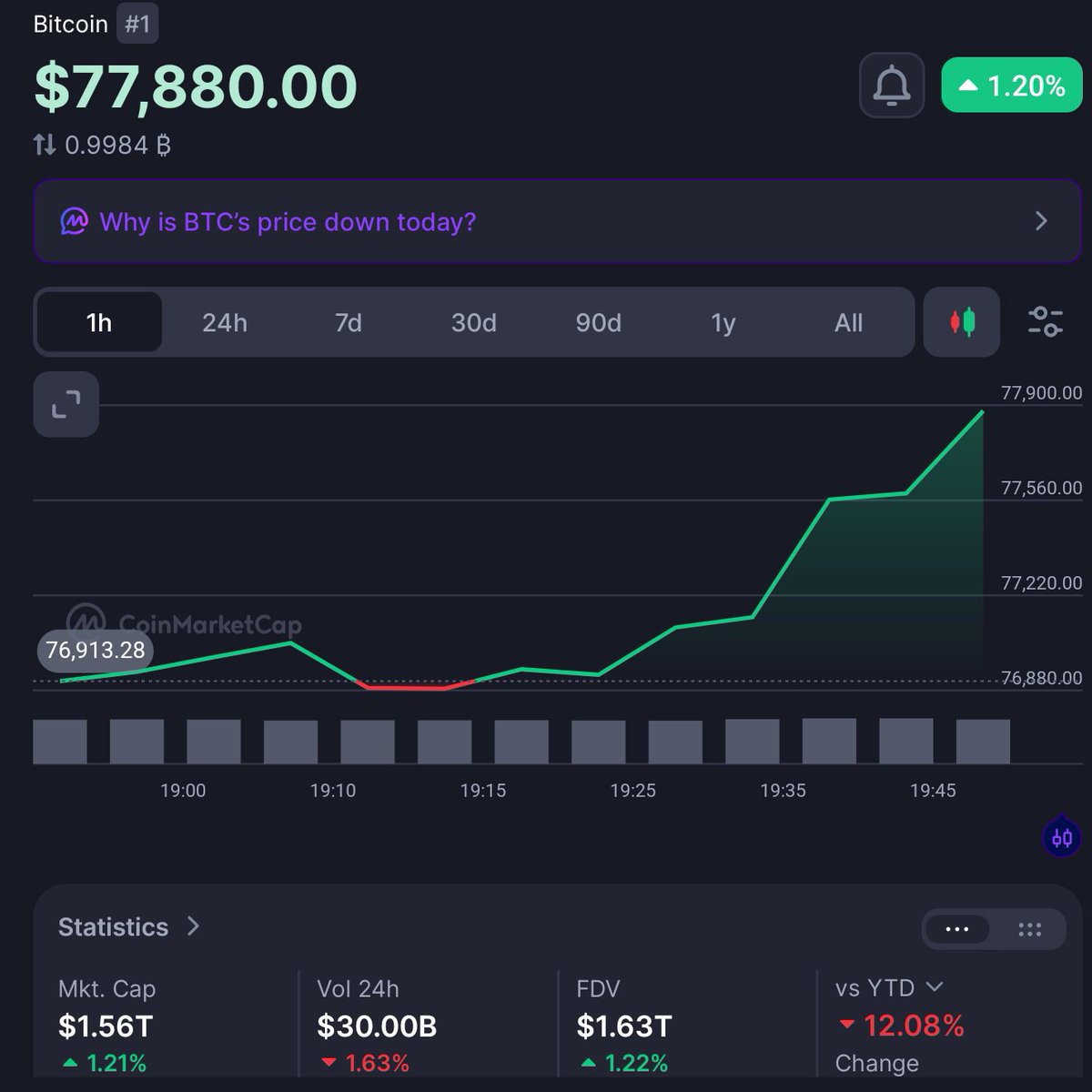
US inflation held steady at 3.4%, while rate hike odds jumped and Bitcoin pushed toward $78K.
That reaction makes no sense on paper. Higher hike odds should pressure risk assets, yet BTC is moving higher.
Either the hike was already priced in, or downside positioning got so crowded that the market is squeezing shorts.
Price is telling us more about positioning than the headline right now, guys.
Priced in or squeeze?
US inflation held steady at 3.4%, while rate hike odds jumped and Bitcoin pushed toward $78K.
That reaction makes no sense on paper. Higher hike odds should pressure risk assets, yet BTC is moving higher.
Either the hike was already priced in, or downside positioning got so crowded that the market is squeezing shorts.
Price is telling us more about positioning than the headline right now, guys.
Priced in or squeeze?