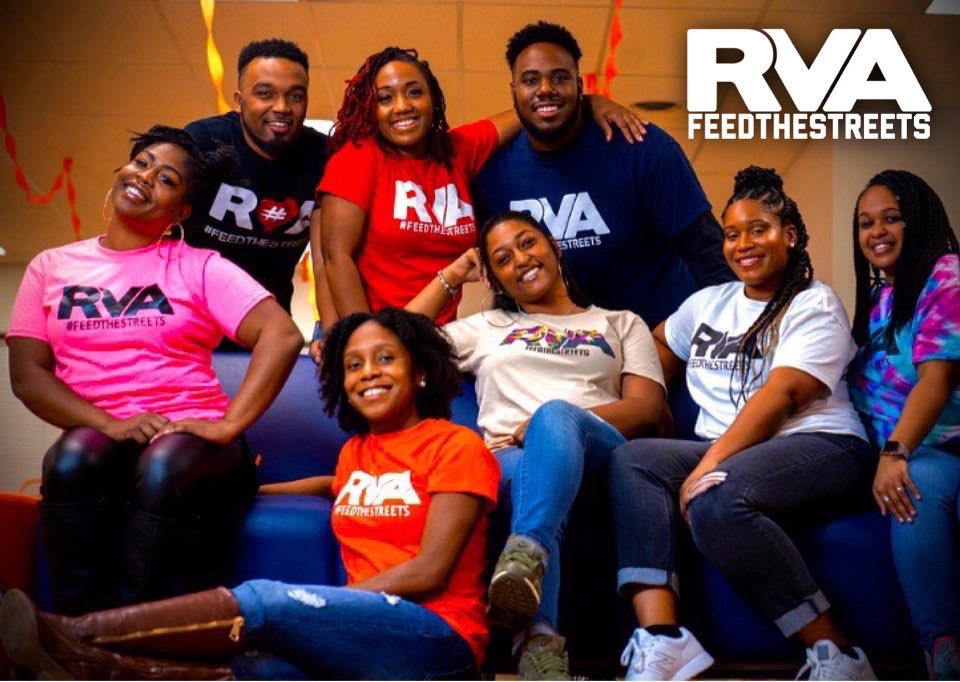
Three years of serving our home town. Three years of hard work. Three years of dedication to the city of Richmond. Crazy enough, this really is just the beginning.
A Gen Z joined the team.
Week one.
During onboarding, the manager said,
“We sometimes stay late during peak periods.”
Gen Z nodded.
Then asked,
“Is that paid… or just expected?”
The room went quiet.
- No attitude.
- No rebellion.
- Just a question.
Later that day, HR mentioned “growth opportunities.”
Gen Z replied,
“Does growth include raises, or just more responsibility?”
Again, silence.
- No laziness.
- No entitlement.
- Just clarity.
That’s when the team realized something.
When people say
“Gen Z is lazy,”
what they really mean is:
Gen Z watched old generation
- skip meals,
- miss birthdays,
- work weekends,
- and burn out
only to be told
“budgets are tight”
and “be grateful you have a job.”
So Gen Z chose differently.
- They don’t romanticize overwork.
- They don’t confuse suffering with ambition.
- They don’t trade health for praise.
They still work hard.
They just refuse to work for nothing.
It’s not laziness.
It’s pattern recognition.
And honestly,
after everything old generation went through…
Can you really blame them?
I live in an apartment complex. The guy above me stomps around at 2 AM every night. I was fed up. I marched upstairs to bang on his door and give him a piece of my mind. The door opened before I could knock. He was holding a crying baby. The apartment was bare. No furniture. Just a mattress on the floor and boxes. He looked exhausted. "I'm so sorry," he whispered. "I'm trying to walk him to sleep. The floor is creaky. I know we're loud." I looked past him. "Where's your furniture?" "Bed bugs in the last place," he said. "Had to toss everything. We just moved in. I’m saving up for a crib." My anger evaporated. "Hold on," I said. I went downstairs. I dragged my spare rocking chair up the stairs. "Sit," I told him. "Rocking is quieter than walking." He sat. The baby settled instantly. The next day, I posted on our building’s group chat: "New neighbor in 4B needs a restart. Who has spare stuff?" By noon, he had a crib, a sofa, a table, and three casseroles. He knocked on my door tonight. No stomping. just a quiet knock. "Thank you," he said. "We slept for six hours." Judge less. Ask more.
Anonymous
My stepdad, Greg, never said 'I love you.' He was a hard man. Worked construction. Came home, ate, slept. He paid for my college. He paid for my car. But he never hugged me. I always thought he resented me. I wasn't his real son. Greg died of a heart attack last week. I was cleaning out his truck. In the glove box, I found a worn-out notebook. It was a diary. Entry 1: Met a woman with a boy today. The boy looks sad. I want to make him smile. Entry 50: The boy needs braces. Picking up extra shifts. Entry 200: He graduated today. I stayed in the back so I wouldn't embarrass him with my dirty work clothes. I've never been prouder. Entry 500: I wish I knew how to talk to him. I just hope he knows I’d die for him. I sat in the driver's seat of his dusty truck and cried until I couldn't breathe. He didn't say it. He did it. Every single day. Love isn't always words. Sometimes, it’s calloused hands and a tired back.
Anonymous
“I own a small bakery. Business has been slow. Rent is up. I was thinking about closing. Last Friday, a teenager came in. He looked nervous. He counted out change for a cookie. He was short 50 cents. ‘It’s okay,’ I said. ‘Take it.’ He ate it at a table, looking at his math homework. He looked stuck. I used to be a math tutor. I walked over. ‘Quadratic equations?’ He nodded. ‘I don’t get it.’ I sat down and helped him for 20 minutes. He got it. He left smiling. The next day, he came back with two friends. They bought cookies. The day after that, five kids came. Apparently, he told the school: ‘The lady at the bakery helps with homework.’ Now, my bakery is the after-school hang-out spot. It’s loud. It’s messy. There are backpacks everywhere. But yesterday, I found a note in the tip jar. It was wrapped around a $20 bill. ‘Thanks for helping my son pass math. - A Mom.’ I’m not closing the bakery. I think I finally found my purpose. It’s not cookies. It’s community.”
Anonymous participants / Facebook
"Remember when we used to own things?"
"Now, you don't own. You access, you subscribe, stream, rent."
"They call it the convenience era. But let's be real, it's the control era."
"Miss a payment, it's gone. Change the terms, too bad. Your tools freeze, your files vanish, your account resets."
"You think you're the user? No, you're the product."
“A text message arrived from my daughter’s friend at 1 AM: ‘Your daughter is really drunk at this party. She needs help but won’t call you. Can you come?’ I was terrified and furious but grateful. I got there in twelve minutes. My seventeen-year-old daughter was barely conscious, surrounded by drunk teenagers who’d been taking videos. The friend who texted me, a girl named Aisha, had stayed sober and chased everyone away. ‘I’m sorry to snitch, but she’s really bad. She needs a hospital.’ Aisha helped me get my daughter into the car, came to the ER with us, and stayed until 4 AM when my daughter was stable. She held my hand while I cried. ‘Thank you for calling me. You probably saved her life.’ Aisha shook her head. ‘My cousin died at a party like this. Everyone was too scared to call for help. I promised myself I’d never let that happen to someone else.’ My daughter was humiliated and angry at first, but she eventually understood that Aisha’s call had prevented alcohol poisoning or worse. Aisha remained her friend through the fallout. Thirteen years later, my daughter is a pediatric nurse, and Aisha is an EMT. They’re still best friends. Together, they run a program teaching teenagers about party safety and bystander intervention—they’ve presented to 4,200 high school students across our state. Last month, a student who attended their presentation called 911 for an overdosing friend. That friend survived. When the student thanked them, Aisha hugged her. ‘You did exactly what you were supposed to do. You saved a life.’ My daughter credits Aisha with saving her that night and inspiring her career. I keep Aisha’s original text saved on my phone: ‘The message that changed everything.’”
—Deborah Sinclair, Boise, ID
I have an employee, Sarah, who has been my right hand for 6 years. She opens the shop, closes the shop, and treats the business like it's her own. Yesterday, she came into my office shaking, handing me a resignation letter. She said her mom was diagnosed with dementia and she needs to become a full-time caregiver because she can't afford a nurse. I tore up the letter. I told her, 'You are not quitting. You are on paid leave until you figure this out. Your job will be here, and your paycheck will hit your account every two weeks.' I’d rather take a hit to my profits than lose a loyal human being to a tragedy she didn't ask for.
Good people are hard to find, we have to protect them
let’s talk about how women get
OVERSTIMULATED, and it's mistaken for
ANGER? no, she's not angry, the TV is way too loud, the dryer's running, her shirt feels too tight, her messy bun isn't sitting right, and there are crumbs on the floor that she can feel under her feet. she's NOT maď, she's overstimulated and just needs a MINUTE to pull herself together
I don’t think it’s controversial to say that anyone who works 40 hours a week should have enough money to buy a house, go on a holiday each year, afford Christmas presents and be able to turn the heating on.
The fact that there’s a cap on how much money disabled people can make but not a cap on how much billionaires can make is part of what’s wrong with this country.
"My name's Raymond. I'm 73. I work the parking lot at St. Joseph's Hospital. Minimum wage, orange vest, a whistle I barely use. Most people don't even look at me. I'm just the old man waving cars into spaces.
But I see everything.
Like the black sedan that circled the lot every morning at 6 a.m. for three weeks. Young man driving, grandmother in the passenger seat. Chemotherapy, I figured. He'd drop her at the entrance, then spend 20 minutes hunting for parking, missing her appointments.
One morning, I stopped him. "What time tomorrow?"
"6:15," he said, confused.
"Space A-7 will be empty. I'll save it."
He blinked. "You... you can do that?"
"I can now," I said.
Next morning, I stood in A-7, holding my ground as cars circled angrily. When his sedan pulled up, I moved. He rolled down his window, speechless. "Why?"
"Because she needs you in there with her," I said. "Not out here stressing."
He cried. Right there in the parking lot.
Word spread quietly. A father with a sick baby asked if I could help. A woman visiting her dying husband. I started arriving at 5 a.m., notebook in hand, tracking who needed what. Saved spots became sacred. People stopped honking. They waited. Because they knew someone else was fighting something bigger than traffic.
But here's what changed everything, A businessman in a Mercedes screamed at me one morning. "I'm not sick! I need that spot for a meeting!"
"Then walk," I said calmly. "That space is for someone whose hands are shaking too hard to grip a steering wheel."
He sped off, furious. But a woman behind him got out of her car and hugged me. "My son has leukemia," she sobbed. "Thank you for seeing us."
The hospital tried to stop me. "Liability issues," they said. But then families started writing letters. Dozens. "Raymond made the worst days bearable." "He gave us one less thing to break over."
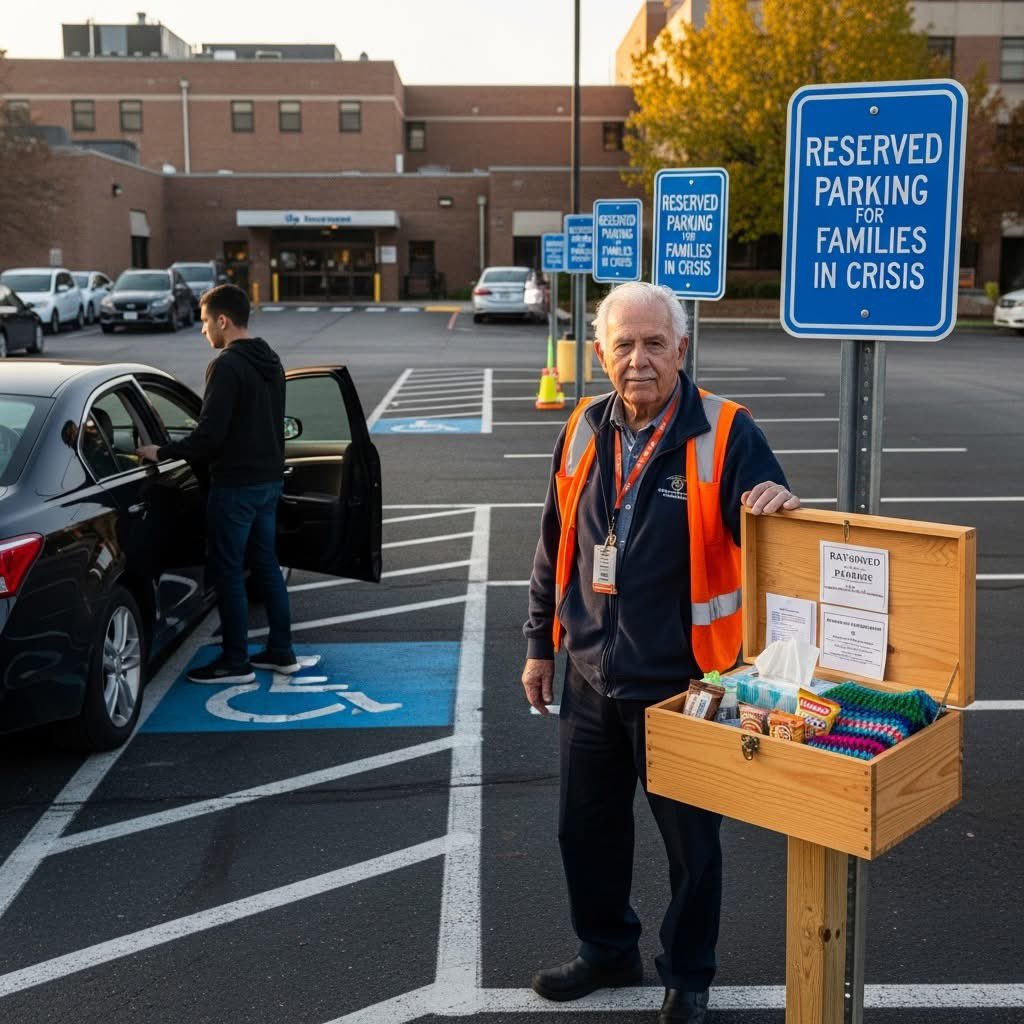
Last month, they made it official. "Reserved Parking for Families in Crisis." Ten spots, marked with blue signs. And they asked me to manage it.
But the best part? A man I'd helped two years ago, his mother survived, came back. He's a carpenter. Built a small wooden box, mounted it by the reserved spaces. Inside? Prayer cards, tissues, breath mints, and a note,
"Take what you need. You're not alone. -Raymond & Friends"
People leave things now. Granola bars. Phone chargers. Yesterday, someone left a hand-knitted blanket.
I'm 73. I direct traffic in a hospital parking lot. But I've learned this: Healing doesn't just happen in operating rooms. Sometimes it starts in a parking space. When someone says, "I see your crisis. Let me carry this one small piece."
So pay attention. At the grocery checkout, the coffee line, wherever you are. Someone's drowning in the little things while fighting the big ones.
Hold a door. Save a spot. Carry the weight no one else sees.
It's not glamorous. But it's everything."
Let this story reach more hearts....
Credit: Mary Nelson
Marriage, divorce, adoption, and changing jobs are considered qualifying life events that trigger a special enrollment period for your health care.
Becoming pregnant is not considered a qualifying event.
The Healthy MOM Act - which I just introduced today - would change that.