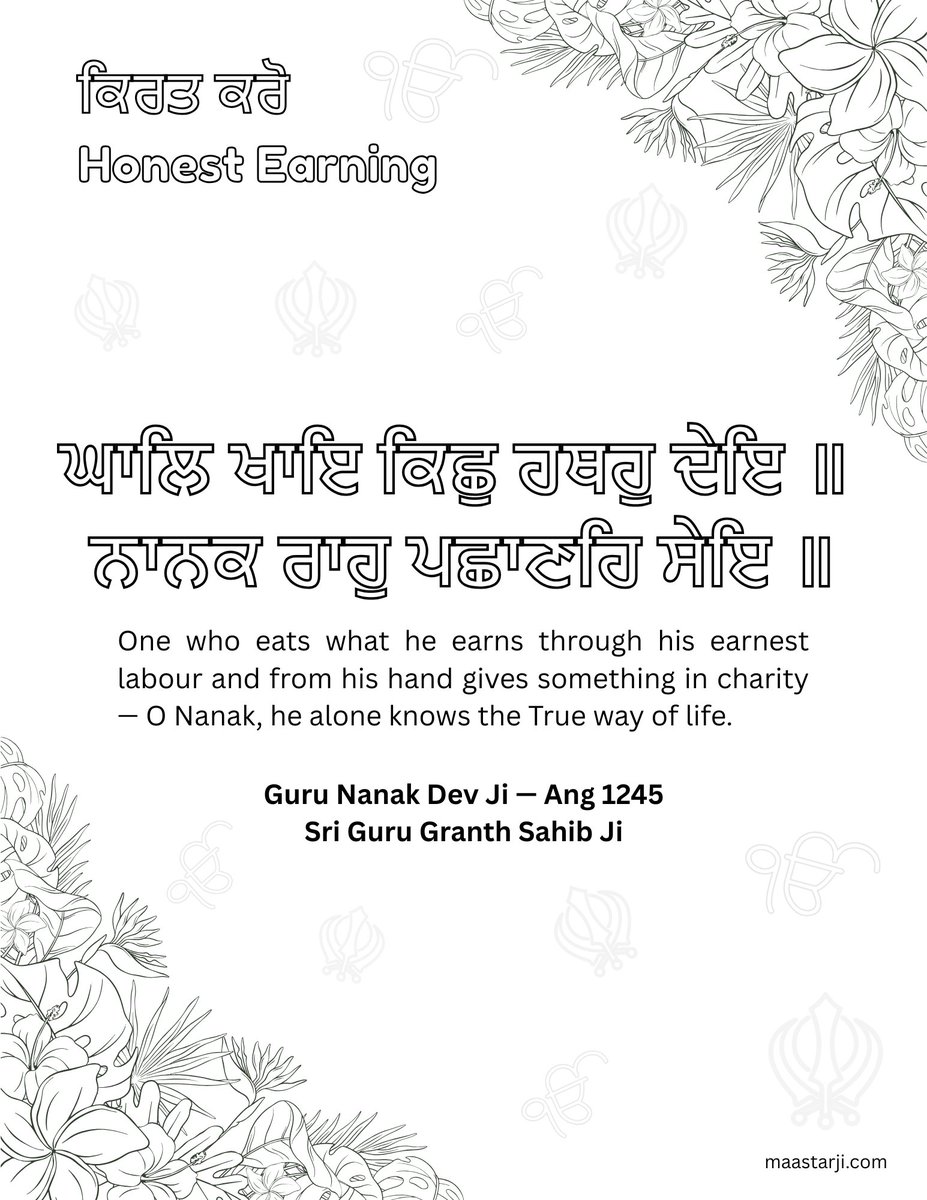
Fateh Singh's team found the perfect wind turbine design on YouTube. Four blades. Thirty degrees. It spun without a wobble.
Then the teacher asked: "Why did you choose this angle?"
Silence.
"Fateh Singh and the Shortcut" — a story about Kirat Karni. Now on @_maastarji
https://t.co/XvSAJEco4f
Looking for a simple, barrier-free way to introduce your little ones to the beautiful Gurmukhi script? We’ve got you covered! https://t.co/HBetvOZajh
Why families love our resources:✅ Clean, simple, and intentional layouts ✅ Clear stroke guidance for building confidence ✅ Completely free and accessible educational resources!
Let’s keep our roots strong and our language alive in the next generation. ❤️
He lost an eye to smallpox as a baby. At 10 he inherited a misal. At 19 he took Lahore. For 40 years he ruled Punjab without ever wearing a crown — and turned 700 years of foreign invasions back at the Khyber Pass. A new book for kids on Maharaja Ranjit Singh. Read Now: https://t.co/cTmLeXaa2B
Note for Parents:
The shabad paints a picture of God's infinite generosity: "His storehouses are brimful in every age, and never is there a deficiency in them." Gratitude in Sikhi isn't just good manners — it's a recognition of reality. We are constantly receiving from the Creator: breath, health, relationships, the natural world. The practice of gratitude shifts a child's focus from "what I don't have" to "what I've been given." Start a simple practice: at bedtime, name three things you're grateful for. Over time, this rewires the child's default lens from scarcity to abundance — which is exactly the lens Gurbani offers.
Note for Parents:
This shabad builds to a powerful conclusion: "Says Nanak, I have become fearless. He, the Lord, has become my shelter." The progression is important — first comes the admission of weakness ("I am nothing, Thou art the only One"), then the decision to draw strength from God ("Thou alone art my strength"), and finally the result ("I have become fearless"). Courage in Sikhi isn't the absence of fear — it's drawing on a source of strength beyond yourself. The kirpan teaches us "we don't walk past" — courage as duty, not recklessness. Help your child name their fears, then practice facing small ones together, with Waheguru as the source of strength.
Note for Parents:
This verse links four qualities: dharam (faith/righteousness), dheeraj (patience), sahaj (poise/equipoise), and sukh (peace/happiness). They are presented as fruits of spiritual practice in sangat. Patience isn't isolated — it's part of a package that includes faith, balance, and joy. When your child struggles with waiting, acknowledge the difficulty while pointing to the reward: "I know waiting is hard. But look — you did it! And doesn't it feel good?" Build patience through small practices: waiting for langar to be served, taking turns in kirtan class, growing a plant from seed.
Note for Parents:
This verse from Sukhmani Sahib frames the healthy body as a divine gift ("prasad" — grace). The shabad continues: "By whose grace your honour is preserved... by whose goodness you attained the scarcely procurable human body." The human body is described as precious and hard to obtain — caring for it is an act of gratitude to God. Frame food choices not as restrictions but as stewardship: "Waheguru gave you this amazing body — let's fuel it with amazing food!" Connect this to langar at the Gurdwara, where simple, nourishing food is served.