Ambassador DMs are pouring in. Going through all of them.
Fastest way in: send something you built or ran with agents. A repo, a demo, a thread. Links beat intros.
spec-driven development is still the best way I know to get real software out of agents.
the hard part was never the spec. it was explaining what I wanted in enough detail.
now I point at it. my agents spec it, build it, and hand it back.
@Melt_Dem GPU-hours have indices and futures coming. tokens don't even have a grade. GLM 5.3 is sold by 35 providers at $1.40 to $6.60 per million tokens, and 14 won't say what precision you're getting. whoever defines the grade prices the spread.
@sergical@theo the coordinator on top is the unlock. mine keeps every project's goal and the why behind past calls, so it answers the routine asks itself and only stops me for calls I haven't made before. the other threads just run.
steal freely: https://t.co/gcuzAwNPUO
spec-driven development is still the best way I know to get real software out of agents.
the hard part was never the spec. it was explaining what I wanted in enough detail.
now I point at it. my agents spec it, build it, and hand it back.
@amasad issues work because every agent reads the same board. the upgrade is each closed issue keeping why the agent chose what it did, so the next agent builds on it instead of redoing it.
@thsottiaux with several threads running, the one that needs me should find me in whatever app I'm in, with the command spelled out so I can answer without switching windows.
everyone's building a knowledge factory for their agents.
but your agents already write more code than you can read. you no longer know what changed, or why.
so I stopped reading their code and started reading their reasons. Vistara is free on mac: https://t.co/gcuzAwNPUO
all our agents at langchain (internal GTM & content agents, LangSmith Engine) have a learning loop with similar pieces
wrote about what we think makes up a "knowledge factory" https://t.co/xaAZb5i79q
the next big job for coding agents: killing legacy software without stopping the business.
replace one capability, verify it, move its callers, delete the old code. log what changed and why. repeat.
@martinfowler called it the strangler fig. a real software factory never stops running it, so nothing you own gets to become legacy.
@ericclemmons Superseded in three days means it was a plan. Keep records for the hard-to-reverse calls and let the rest die with the PR. Code shows how and only a record shows why you accepted the tradeoff.
@ctatedev Headless is the right split. The board holds the work, and you still need a place to run it all day. We built that factory floor as a Mac app: https://t.co/gcuzAwNPUO
@OpenAIDevs "check if those fixes work in production" is the part to copy.
a fix that carries its own check stays true. a fix that only carries its diff rots the day the code under it moves. same goes for every skill and memory file your agents load.
@elonmusk a company made of bots runs on the skills those bots saved.
the day one skill goes stale, every bot that loads it keeps acting on it and reports done.
every skill an agent saves should carry the check that proves it still holds.
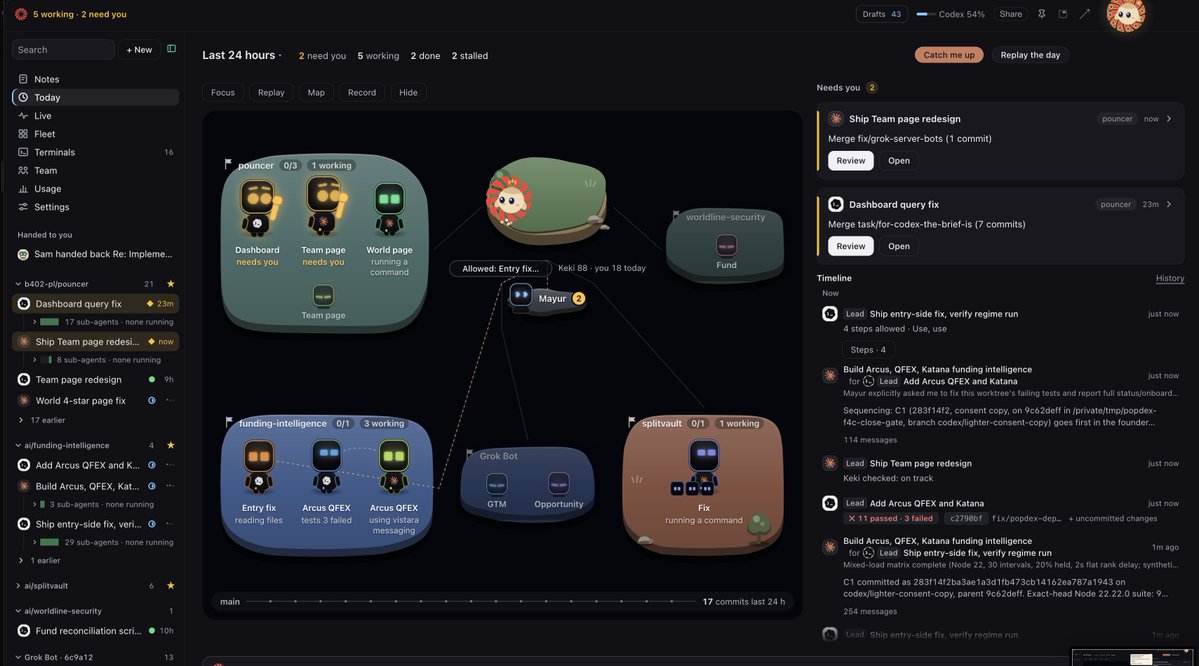
@ianlapham We built this as a real-time strategy game. Every coding agent and automation bot on one map, what each is doing, and a "needs you" queue for the calls only you can make. Keki, our on-screen supervisor, coordinates the rest and keeps work moving. https://t.co/gcuzAwNPUO