@WorldCupMedia We are but disappointed so far. I was expecting a solid performance but Cape Verde is playing really well, especially the goalie Vozinha.
@sanchezcastejon Te adoramos. Nosotros, los inmigrantes, podemos vivir con dignidad en esta hermosa tierra y con personas increíbles. Seguiremos trabajando duro y contribuyendo a este hermoso país que ahora llamamos hogar.
Hoy se cumplen ocho años desde que fui investido presidente del Gobierno.
Ocho años en los que hemos transformando profundamente la realidad y mejorado la vida de las personas.
Desde 2018 hasta ahora, nuestro PIB ha crecido un 12,3%, tres puntos más que el promedio de la UE, casi el doble que el de países como Italia o Francia y 10 veces más que el de Alemania.
Hemos creado tres millones y medio de empleos.
Hemos cruzado por primera vez la cifra histórica de los 22 millones de afiliados a la Seguridad Social y la tasa de paro es la más baja de los últimos 18 años.
Hemos subido el salario mínimo un 66%. Dando a empresas y trabajadores herramientas como los ERTE para evitar que los despidos sean la respuesta natural a las crisis.
Hemos aprobado una reforma laboral que ha reducido la temporalidad en 12 puntos y ha hecho que el salario medio crezca un 23%, cuatro puntos por encima de la inflación.
Hemos impulsado una profunda transformación estructural de nuestro tejido productivo de la mano de los Fondos del Plan de Recuperación que negociamos en Bruselas. Ya hemos desplegado 67.000 M€ para la modernización de nuestra economía, que han permitido impulsar la digitalización y la transición verde.
Nuestra apuesta por la energía limpia y barata nos ha permitido más que duplicar la potencia instalada de renovables desde 2018. Las energías renovables han pasado de generar el 39% de nuestra electricidad en 2018 al 56% en 2025. Y seguimos.
Hemos redoblado nuestra apuesta por la educación y la innovación. Hemos superado por primera vez los más 2.500 millones al año dedicado a becas y ayudas al estudio. Y hemos culminado la reforma de la Formación Profesional, financiando la creación de 400.000 nuevas plazas, lo que ha permitido que hoy tengamos casi un 50% más de alumnos que en 2018.
Hemos expandido los derechos sociales. Cuando llegué al Gobierno, los padres tenían un permiso de poco más de un mes cuando nacía su hijo. Hoy tenemos un sistema de permisos igualitarios e intransferibles para padres y madres de 19 semanas.
Hemos aprobado una reforma de pensiones destinada a dar certidumbre a los pensionistas presentes y futuros, mejorar las pensiones mínimas y fortalecer su sostenibilidad. Hoy los pensionistas tienen garantizado su poder adquisitivo, lo que ha permitido que la pensión media haya pasado de 950€ al mes en 2018 a 1.400€ hoy.
Hemos creado un Ingreso Mínimo Vital que ha servido para proteger las rentas de más un millón de hogares vulnerables, y que ha permitido que la desigualdad y la pobreza estén hoy en los mínimos de las últimas dos décadas.
Y hemos fortalecido el Estado del bienestar: incrementando un 174% la financiación a la dependencia, aumentado un 54% las plazas de Formación Sanitaria (MIR), y multiplicado por ocho la inversión estatal en vivienda.
Queda muchísimo por hacer. Pero estos ocho años demuestran lo mucho que podemos hacer juntos y juntas. Seguimos.
We become irrelevant when we grow old. That's how it is, that's how it will be.
And this is when we realise that nothing matters, no one cares.
So why not live the life you always wanted. This is the ultimate revelation.
None of us humans are actually special. We are just a very small part of the game called "World". We are only valuable if we are beneficial to someone - person orsociety. When we go old as a regular person, no one sees value in us.
@thevirdas Every protest has a foreign link. What an angle? Can it just not be people standing for their rights. I mean these are the citizens of the country, aren't they?
@BBCWorld Another rhetoric of fake account hate spreaders will start in this thread. I don't even understand why this two month old news posted by @BBCWorld now?
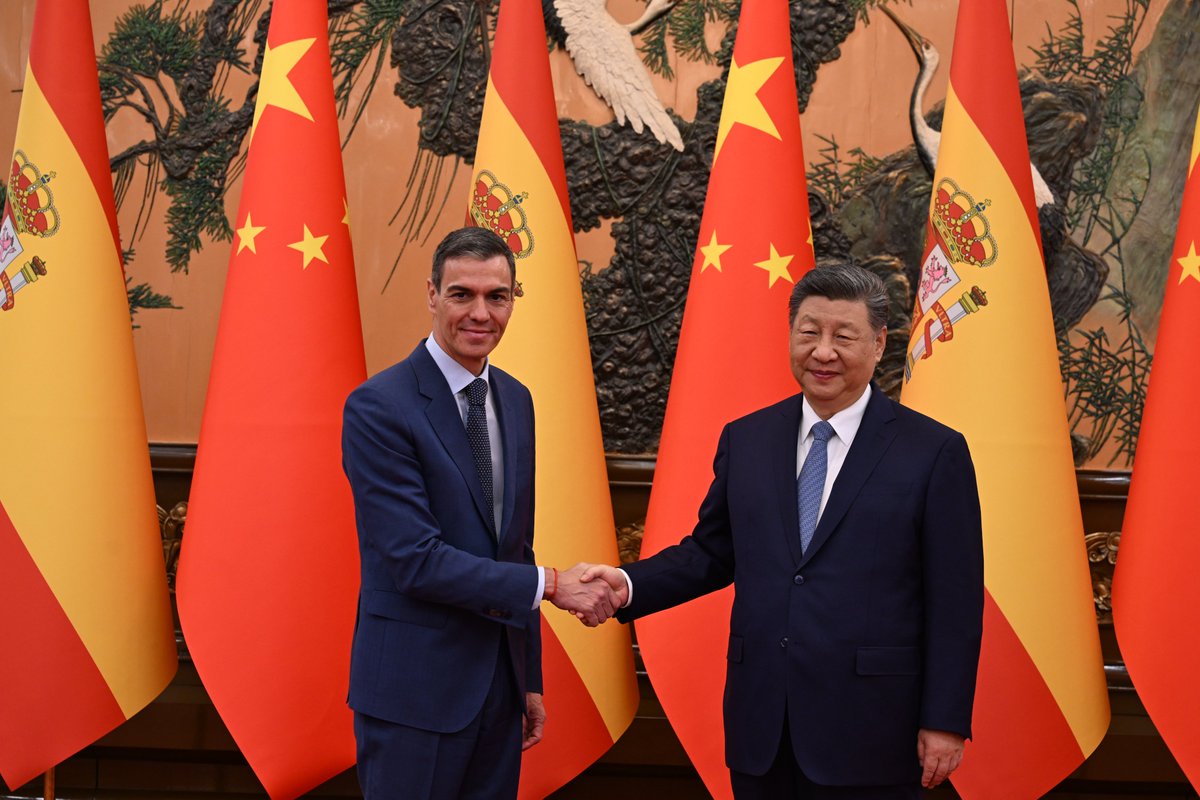
Hoy, con el presidente Xi Jinping he constatado que el vínculo entre España y China sale reforzado tras este viaje oficial.
En un mundo cada vez más incierto, España apuesta por una relación UE-China basada en la confianza, el diálogo y la estabilidad.
Debemos seguir avanzando hacia un orden multipolar construido desde el respeto y el pragmatismo.
Asked someone from the industry whether foreign investors are still interested in allocating to India. The TLDR:
Interest has pretty much died out. India is seen as geopolitically exposed, especially to an oil shock. There are no real AI plays. Valuations are rich. And the rupee situation doesn't help.
On top of that, investors who were sitting on gains have taken money off the table and are now looking at markets like Japan, Taiwan, Korea, Europe etc instead.
He also pointed out that our LTCG/STCG structure and the increase in STT have made India less attractive compared to other markets that are seeing inflows.
If we need to attract FPIs back, and we do, fixing this feels like pretty low-hanging fruit.
Tech seems to be getting effectively nationalized. Starting from around 2020, we've seen an increase in export controls on things like chips, critical minerals, restrictions on advanced manufacturing equipment and various other trade restrictions. Supply chains have become a security issue for countries.
We're no longer in a world where India can be okay with just exporting IT services. If we don't build domestic deep tech capabilities, we'll be locked out when it matters most. Self-sufficiency has become necessary insurance.
India's startup ecosystem has come a long way. We have genuine local talent that can build a lot of what we currently import. They just need the right support. The recent government push for deep tech is a step in the right direction.
The timing also matters. If AI can pretty much produce all of the software, asset-light models will get hit. The next decade belongs to atoms, not just bits. You're already seeing this with money flowing into data centers, defense systems, batteries, semiconductors, advanced manufacturing.
You can also see this in VC investment flows. In the last decade most of VC investments went into eCommerce, lending, and payments. Those segments have now matured and the easy opportunities are gone. For deep tech, it's still day one.
We have the talent but what we don't have is the ecosystem around them.
Comparisons with China are cliched, but they didn't become an industrial superpower by accident. There are lessons we can learn.
China's internal market is brutally competitive. Hundreds of startups compete in a given sector and this forces them to innovate and be efficient. Indian states used to do this for software parks. Why not for deep tech? Tamil Nadu, Gujarat, and Maharashtra are success stories but we need more states in the race.
Companies choose to manufacture in China because everything they need to manufacture is within a few miles. This industrial clustering creates genuine competitive advantages. You can create a design in the morning and have a prototype by evening. This density took decades to build, but we can do it if we invest with a long-term mindset.
China also built real bridges between universities and companies. In India most ideas die in the minds of students. Brilliant PhDs can't find the capital or institutional support to build a prototype, let alone turn them into businesses. We need government procurement guarantees. Patient capital that understands hardware burns cash for years before revenue. Pathways from idea to commercialization.
The government backing deep tech is a good move. But support can't just mean funding. We need R&D tax credits, subsidies, first-purchase guarantees, streamlined approvals and other incentives. All of this has to be sustained across decades, not election cycles.
Without domestic deep tech capability, we stay dependent on others for critical infrastructure. That dependence is vulnerability.
If we build the clusters, invest in education, fund the R&D, bridge academia to industry, and let states compete to create ecosystems, we get more than self-sufficiency. We become a deep tech exporter.
The bulk of our recent investments through @rainmatterin have been to support homegrown deep tech startups.
España no reconoció al régimen de Maduro. Pero tampoco reconocerá una intervención que viola el derecho internacional y empuja a la región a un horizonte de incertidumbre y belicismo.
Pedimos a todos los actores que piensen en la población civil, que respeten la Carta de Naciones Unidas y que articulen una transición justa y dialogada.
I am a supporter of gig workers demanding doing away with 10 minute delivery as it clearly jeopardizes their safety, as well as the safety of others on the road.
It is a classic case of negative externalities where the actions of a company create profits for itself while creating negative consequences for the society at large which they do not pay for
Similarly there is a concept of tragedy of the commons where a business or individual disproportionately uses or degrades common resources without compensating the society for it
(Text book definition of both given below)
And no we cannot reply on capitalism alone to provide adequate working conditions for the workers.
If that were the case we would never have to legislate on things like minimum wages or safety in factories. In all such cases the laws had to be made to force business owners to meet certain minimum conditions for the workers.
For context, I am a heavy user of online shopping but have never used 10 minute delivery. I simply do not see a use case for this beyond emergency medicines and the like. There is almost nothing in the world where you cannot plan 30 or 60 minutes in advance.
Given that Indian vehicle owners refuse to stop at zebra crossing and since I like to walk to places I have seen the increase in two wheeler traffic (often driven by distracted riders who are trying to follow a map on their phone) making road crossing more dangerous than before.
I hope sensible laws are made which remove excessive stress and physical hazards from the already hard lives of delivery workers.
Negative Externalities: This occurs when an individual or firm's actions impose costs on others that are not borne by the actor. For example, a factory polluting a river does not pay for the harm caused to downstream communities; this is a negative externality. Damaging public property imposes a cost (for repair) on society (taxpayers) that the perpetrator is not paying for at the time of the act.
Tragedy of the Commons: This concept applies to common resources, which are non-excludable but rivalrous (use by one person reduces the amount available for others, such as fish stocks in the ocean). Overuse and damage occur when individuals act in self-interest, leading to the depletion or degradation of the shared resource.