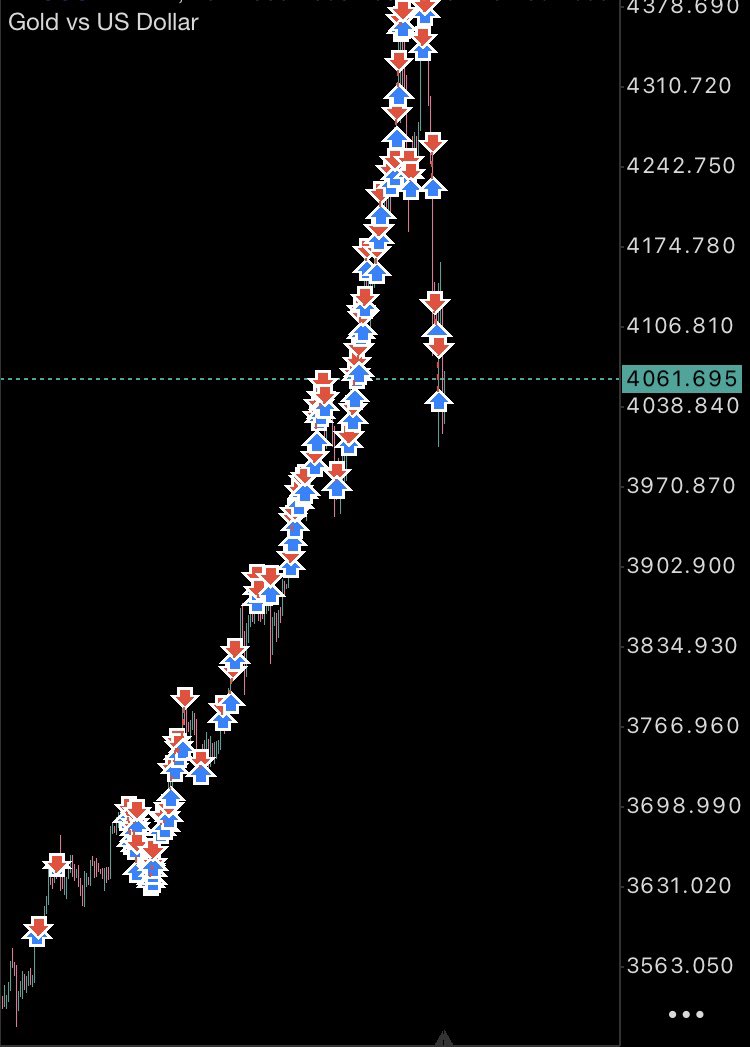
Imagine waking up, opening your phone, and your system already executed 3 trades while you slept. You check the results and see that the rules ran perfectly. No emotion involved.
Now, compare that to your current reality:
You’re checking the charts every 15 minutes, afraid to miss an entry, closing a trade early because you 'had a bad feeling', holding a losing trade overnight, you can't sleep so you’re up by 2am refreshing MT5 and even revenge trading after a red day just to end up in a bigger drawdown.
That's not a strategy problem. That's a YOU-in-the-trade problem.
When you have a fully automated, validated system running for you, you get your life back. You can travel, spend time with family, focus on building while your system keeps working.
No babysitting. No emotional spirals. No more wondering 'what if I'd held longer.'
I'll show you exactly how to build your very own trading bot with A.I. from scratch, in our FREE Masterclass.
The good thing about it is that don’t need to be a tech bro to do this and just for attending this online training, you’ll be getting a working Larry Williams strategy trading bot I created, + 23 years of backtest data to prove this works.
Click the link to register now!
@NewMoonAlgos You’re spot on. Cant have a complete system without that. Thanks for pointing that out but this is just a bird’s eye view of the whole process.
A beginner asked me how people are building trading bots without knowing how to code.
The software stack I’d recommend:
- Python 3.11
- VS Code
- GitHub Copilot or Claude
- Pandas + NumPy
- MetaTrader 5
That stack is enough to build and deploy trading bots today.
The traders who learn how to turn strategy ideas into systems early are going to have a huge edge.
Inside my free masterclass, I walk through this entire workflow step-by-step.
How to turn trading strategy ideas into working automated systems using AI — even if you don’t know how to code.
Link in comments.
Most traders completely underestimate how much work goes into building a REAL trading system.
Here’s the actual sequence:
Step 1: Understand the game first.
Learn market structure, liquidity, order flow, and the difference between manual and systematic trading.
If you don’t understand how markets move, you’ll just automate the same emotional mistakes.
Step 2: Learn the language of data.
Python. Pandas. NumPy.
Use them for reading price CSVs, calculating returns, building DataFrames, and analyzing time-series data.
This is where raw numbers become information.
Step 3: Learn the math of survival.
Sharpe ratios. Drawdowns. Expectancy. Risk of ruin.
Most traders avoid this. Professionals use it as armor.
Step 4: Learn design thinking for systems.
Every algorithm follows the same flow:
Data → Logic → Decision → Execution → Feedback.
The faster you iterate, the faster you improve.
Step 5: Build and backtest your first strategy.
Test both ways — vectorized (fast) and event-driven (realistic).
Many “good” strategies fall apart when realistic fills are added.
Step 6: Validate robustness.
Walk-forward analysis. Train/test splits. Parameter sensitivity. Monte Carlo simulations.
Your job isn’t to prove a strategy perfect — it’s to find out if it’s durable.
Step 7: Get position sizing right.
90% of traders who blow up do so because of excessive position sizing. Not bad ideas.
Step 8: Build your execution layer.
Broker API connectors. Order lifecycle management. Rate limits. Safe execution patterns.
Sloppy execution turns good backtests into bad live results.
Step 9: Build logging, monitoring, and kill-switches.
Most live losses come from operational failures — not edge failure.
Step 10: Paper trade. Then deploy small.
Compare live results to your backtest. Investigate every deviation before touching real capital.
Professional systematic trading is really about:
•infrastructure
•testing
•execution
•risk management
•repeatable processes
That’s the real game.
If you want to shortcut this entire process using AI + pre-built trading system templates, indicator libraries, backtesting frameworks, and plug-and-play prompts that turn strategy ideas into working code…
Register for the free masterclass.
I break down the entire workflow step-by-step.
Link in comments.
If I had to learn trading automation from scratch today, this is exactly what I’d do:
Step 1: Write your strategy rules in plain English.
Step 2: Open VS Code and install GitHub Copilot or Claude.
Step 3: Ask AI to generate python code based on your entry and exit logic.
Step 4: Backtest the strategy using Pandas.
Step 5: Connect it to MT5 for live execution.
The traders who learn how to turn strategy ideas into systems early are going to have a huge edge.
Inside my free masterclass, I walk through this entire workflow step-by-step.
How to turn trading strategy ideas into working automated systems using AI, even if you don’t know how to code.
Link in comments.
Building trading bots no longer requires becoming a professional software engineer.
Here is how to turn your strategy ideas into an automated trading system with AI:
Step 1: Write the strategy rules in plain English.
Step 2: Open VS Code and install GitHub Copilot or Claude.
Step 3: Feed the strategy rules into AI and ask it to generate entry/exit logic.
Step 4: Use Python + Pandas to backtest the strategy on historical data.
Step 5: Add stop loss, take profit, and position sizing rules.
Step 6: Connect the strategy to MT5 for live execution.
Recommended software stack:
- Python 3.11
- VS Code
- GitHub Copilot
- MetaTrader 5
The biggest advantage of this workflow is speed.
Instead of manually testing ideas emotionally, traders can now:
- validate ideas with data
- remove emotional execution
- backtest years of historical performance
- automate trade execution
- iterate much faster
That’s the future of trading.
Inside my free masterclass, I walk through this process step-by-step:
- how to turn strategy ideas into bots
- the exact software to use
- how to backtest properly
- how to deploy automated systems using AI
Link in comments.
The biggest misconception about algorithmic trading is that you need to be a genius programmer.
You don’t.
What you ACTUALLY need is:
- clear strategy rules
- structured logic
- historical data
- AI assistance
- a framework
That’s it.
Most traders already have strategy ideas.
The problem is they never test them properly.
So they spend years:
- guessing
- overtrading
- changing systems emotionally
- blowing accounts
Instead of validating ideas with data.
This is why AI-assisted trading automation is such a massive opportunity right now.
You can take a strategy idea like:
'Buy when volatility expands after consolidation'
And turn it into:
- code
- backtests
- performance reports
- live execution systems
Far faster than before.
That changes everything.
Because once you can test ideas quickly…
your learning speed explodes.
That’s how systematic traders improve faster than emotional traders.
I explain the entire workflow in my free masterclass.
How to convert trading strategies into working bots using AI, even if you don’t know how to code.
Link in comments.
Most retail traders completely misunderstand this:
Most blown accounts are risk management failures disguised as strategy failures.
Most traders approach the market emotionally.
They:
- hesitate on valid setups
- panic during drawdowns
- revenge trade after losses
- move stop losses emotionally
- abandon systems after short losing streaks
That’s the core problem.
Because trading success does not come from predicting every move correctly.
It comes from executing a repeatable edge consistently over large sample sizes.
This is why professional traders obsess over:
- data
- probabilities
- volatility
- drawdowns
- expectancy
- Sharpe ratio
- position sizing
- system architecture
They understand something most retail traders never fully grasp:
Trading is less about prediction…
and more about process.
This is where automation becomes incredibly powerful.
An automated system:
- does not panic
- does not FOMO
- does not get greedy
- does not skip trades emotionally
- does not suddenly change rules after 2 losses
It simply follows logic.
And now AI has changed the game completely.
You can literally:
- describe your strategy in plain English
- structure your rules clearly
- use AI to help convert those ideas into code
- backtest them across historical data
- optimize parameters
- deploy systems far faster than before
That creates an enormous advantage for traders who learn this skill early.
Because once you can test ideas quickly…
your learning speed compounds.
You stop gambling emotionally.
You start engineering systems.
The traders who understand this shift early are going to dominate the next decade of trading.
I break this entire process down step-by-step in my free masterclass:
- how to turn trading strategies into automated systems
- how to backtest ideas properly
- how to use AI-assisted workflows
- how to think like a systematic trader instead of an emotional trader
Link in comments.
You don’t need to become a software engineer to build trading systems anymore.
AI lowered the barrier completely.
Here’s what most people still don’t understand:
You no longer need to:
- learn programming for years
- become a quant developer
- study computer science
- memorize complex syntax
AI changed the game.
Today, if you can clearly explain:
- your entry rules
- your exit rules
- your stop loss logic
- your take profit logic
- your confirmations
- your risk management
…you can use AI to help convert that strategy into a working automated trading system.
That changes EVERYTHING.
Because now traders can:
- test strategy ideas faster
- validate systems with historical data
- remove emotional execution
- automate decision making
- optimize parameters
- deploy systems to live/demo accounts
Without writing everything manually from scratch.
This is the exact shift most traders are missing right now.
They’re still:
- manually checking charts
- second-guessing entries
- revenge trading
- skipping setups emotionally
- blowing accounts from inconsistency
Meanwhile systematic traders are building repeatable execution engines.
And honestly…
This is where the industry is heading.
The future trader will not just understand charts.
They’ll understand:
- systems
- automation
- AI-assisted workflows
- backtesting
- strategy architecture
- probabilistic thinking
And the traders who learn this early will have a massive advantage.
That’s exactly why I created my free masterclass.
Inside it, I break down:
- how to convert trading strategy ideas into working bots
- how to use AI to generate the framework
- how to backtest systems properly
- how to deploy automated trading systems
- how non-coders can do all this without traditional programming experience
If you can explain a strategy clearly…
you are already much closer than you think.
Link in comments.