FALSO
Petro deja el mayor ENDEUDAMIENTO en la historia de Colombia, 1220 BILLONES de deuda
62% del PIB en deuda a las tasas mas altas en mas de 20 años
Cambio deuda externa barata por deuda interna mas cara y deja LA MAYOR DEUDA HISTÓRICA
Salieron los datos de deuda pública de abril.
Les dejo está gráfica.
La línea roja muestra la deuda inicial en este gobierno en agosto de 2022: $183 mil millones de dólares. La línea verde es la deuda a abril de 2026: $326 mil millones de dólares.
Saquen sus conclusiones
Petro y Avila Nos acaban de CLAVAR otros 6 billones de DEUDA a tasas incluso cercanas al 15% 🤮
6 billones casi al 15%
El gobierno de Petro nos está endeudando a tasas se un gota a gota
QUEBRARON a Colombia
Variación deuda pública a 44 meses inicio gobierno
(millones de USD)
Uribe 1: 24.849
Uribe 2: 35.100
Santos 1: 27.177
Santos 2: 12.163
Duque: 43.897
Petro: 148.523
Deuda pública tomada durante presente gobierno, supera suma de los 5 anteriores.
No han entendído q una cosa es el DÓLAR con Petro con un BANREP independiente q defendió la moneda
Y otra el DÓLAR con Cepeda cuando tome control del BANREP y empiece a imprimir billeticos para la falta de caja, déficit y deuda y te LICUEN el peso Colombiano y sirva pa origami
ESTO NO LO VAMOS A PERMITIR.
Por: Carolina Restrepo Cañavera
Si el gobierno firma un decreto para obligar a los fondos privados de pensiones a repatriar $250 billones invertidos en el exterior, tenemos que meterle el diente completo. Y lo vamos a hacer.
Porque esto no es una medida fiscal.
Esto no es una estrategia económica.
Esto es una expropiación encubierta. Un abuso de poder. Un asalto normativo.
¿Y saben qué es lo más grave? Que ni siquiera lo están haciendo con una reforma de ley, con trámite legislativo, con discusión pública. No. Lo quieren hacer por decreto.
En silencio.
A las patadas.
Con hambre.
La plata no es del gobierno.
No es del Ministerio de Hacienda.
No es del presidente.
Es de millones de colombianos que ahorran toda su vida para tener una vejez digna.
Quieren tocar ese ahorro para solucionar su desgreño fiscal, su incapacidad de ejecución, su falta de caja. Quieren obligar a los fondos a traer la plata para que el gobierno pueda mostrar liquidez a costa del ahorro de todos.
Es una jugada burda, ilegal y peligrosa.
¿La respuesta? Jurídica. Inmediata. Sin pestañear.
En cuanto salga el decreto, hay que demandarlo por inconstitucionalidad.
Hay que pedir medidas cautelares urgentes para frenar sus efectos antes de que se cause un daño irreversible.
Hay que ganar esto en la Corte. Porque esto no es un desacuerdo político: es una línea roja jurídica.
El artículo 58 de la Constitución protege el derecho a la propiedad.
El 48 protege el régimen pensional y su sostenibilidad.
Y ningún decreto puede pasar por encima de esos principios.
Esto es serio. Esto es estructural. Esto es peligroso.
Así que sí: a esto sí hay que meterle el diente. Completo.
Y lo vamos a hacer.
Con fuerza.
Con ley.
Y si toca, con una defensa técnica que pare en seco esta barbaridad.
Porque el ahorro pensional no es caja menor del Estado.
Y Colombia no se deja expropiar por decreto.
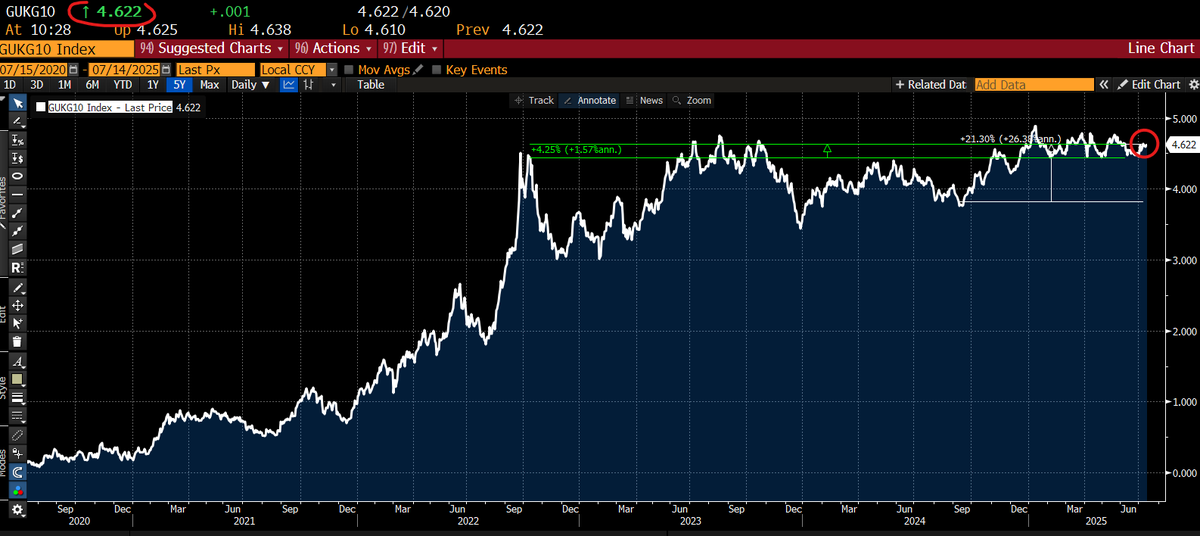
No, it's not Bitcoin. It's the UK sovereign bond yield.
New highs, worse than Greece or France.
The government budget massively increases spending and destroys the economy with more taxes.
No one resigns. Socialism always destroys what it pretends to defend.
via Bloomberg
🛢️ | URGENTE: El crudo Brent subió a 80 dólares por barril, y los analistas advirtieron que los precios podrían llegar a 100 dólares si Irán toma represalias atacando la infraestructura petrolera del Golfo o el Estrecho de Ormuz.
BREAKING: Oil prices rise+2% at the open in the market's initial response to US strikes on Iranian nuclear facilities.
Once again, this is not a market that is pricing-in a long-term conflict.
BREAKING: Russia's Chairman of the Security Council says "a number of countries are ready to directly supply Iran with nuclear warheads" after US strikes on Iran.
He also says Iran's enrichment of nuclear material and future production of nuclear weapons will continue.
A historic picture:
Ships set to cross the Strait of Hormuz make a 180 degree U-Turn at ~9:15 AM ET this morning.
This was just minutes after Iran's parliament approved closing the Strait.
Wild times.
MAJOR news from Iran:
Iran's parliament officially approves CLOSING the Strait of Hormuz for the first time since 1972.
If approved by Iran's top security body, shipments of 20+ MILLION barrels of oil PER DAY will be impacted.
What's next? Let us explain.
(a thread)
🇯🇵 Japan’s Bond Market: The Global Sovereign Debt Bubble Is Fracturing
Post:
Japan’s 30-year government bond yield just hit 3.13% the highest level in history. But this isn’t just a local market move. It’s a global alarm bell.
Here’s why it matters:
⸻
1. This Isn’t a Japan Story. It’s a Global Stress Signal.
For decades, Japan’s long-term bond yields were suppressed under Yield Curve Control (YCC) a pillar of the deflationary, low-rate world. That pillar is now cracking. The Bank of Japan is either losing control of the long end or choosing to exit slowly. Either outcome breaks the global feedback loop.
When JGB yields rise:
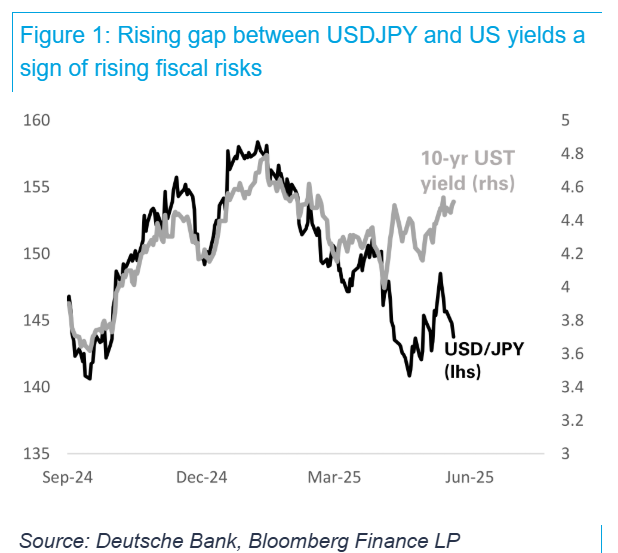
•Japanese investors start repatriating capital selling U.S. Treasuries and foreign debt.
•Demand for U.S. Treasuries collapses at a time when U.S. issuance is surging.
•Dollar funding markets tighten, and the cost of hedging foreign bonds explodes.
⸻
2. The U.S. Is Already Feeling the Blowback.
Look at U.S. Treasury yields across the curve:
•The 2Y sits around 3.97%, barely moving.
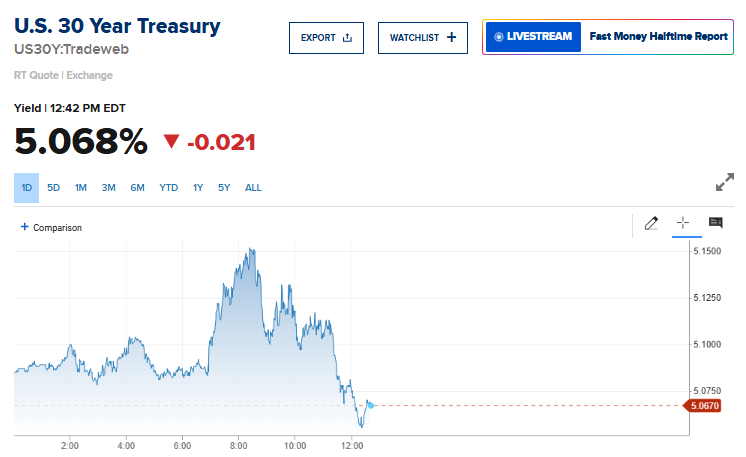
•But the 10Y and 30Y are climbing 4.49% and 4.98% respectively.
This steepening of the yield curve isn’t a growth signal. It’s a scarcity of long-end buyers.
Foreign institutions (especially Japan) historically anchored U.S. debt markets. That bid is vanishing. The Fed is being forced into stealth support operations swap lines, backdoor QE, buyback programs to keep auctions from failing.
⸻
3. This Is the Quiet Unwinding of the Global Carry Trade.
Japan was the low-yield funding base for global risk appetite. Now it’s repricing:
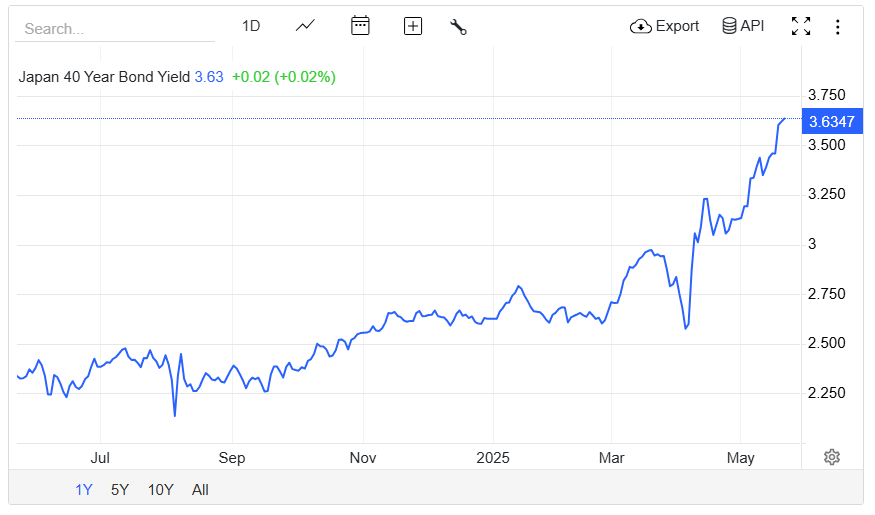
•The 40Y JGB just hit 3.62%.
•FX-hedged returns on U.S. Treasuries are collapsing.
•Liquidity stress is bleeding across borders from Tokyo to Frankfurt to New York.
⸻
4. This Signals a Regime Shift.
We’re not in a normal cycle. We’re in the early stages of a sovereign debt repricing cascade:
•Japan’s long end breaks first.
•Europe follows (see German and French spreads widening).
•The U.S. gets squeezed last but hardest.
Every uptick in JGB yields now functions as a volatility accelerant across FX, rates, and credit.
⸻
Bottom Line:
The sovereign debt bubble isn’t bursting at the center it’s unraveling from the outer shell. Japan is the test case. The BoJ’s ability (or willingness) to suppress long rates is evaporating.
If Japan can’t suppress its curve, what central bank can?
Watch the swap lines. Watch the Fed’s stealth interventions. This is how monetary architecture fractures quietly, then suddenly.
‼️This is absolutely INSANE:
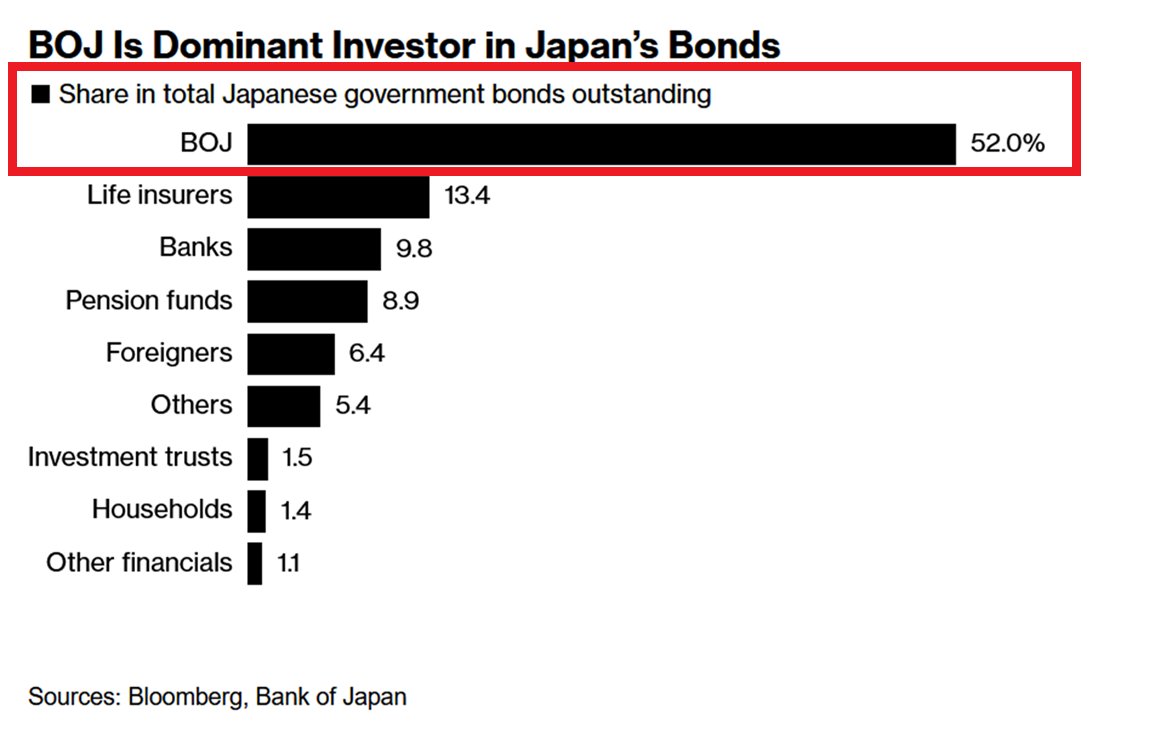
The Bank of Japan owns a whopping 52% of its domestic government bond market.
Since July, the BoJ has been gradually reducing the size of its holdings.
The estimated value of Japan's government debt market is $7.8 TRILLION, world's 3rd largest.