One of the exciting things about neuroscience is finding common principles in complex disorders. This new UCLA study shows that different genetic risks for autism can produce shared changes in specific brain cell types.
At the same time, the fact that “interfaces aim to monitor or alter internal states such as attention, memory, emotion, and decision-making” seem naive, exciting and terrifying. However, closed-loop systems may really be the most rewarding approach to advance in this regard.
Adaptive, closed-loop systems may be the future of the BCIs that will restore or improve function.
The emerging field of cognitive brain–computer interfaces
https://t.co/vaWxtEho0X
#neuroscience
I went in skeptical & came out cautiously impressed. Claude Science found a real insight in our data that we hadn't thought to look for. Still fact-checking carefully, but the analysis it proposed is clever & genuinely illuminating. Honest take in the video. 🧠 @AnthropicAI
@MillerLabMIT Naive questions: the given EM field intensity boundary threshold is such that one cannot but wonder why
1. a smartphone in the ear would not disrupt consciousness
2. patients can be awake during cortical stimulation
3. thermal noise does not knock out people during fever
That’s me & my dad many years ago. Father’s Day has a way of bringing old memories to the surface. Feeling especially grateful today for the love, guidance, and moments that stay with us long after childhood. #FathersDay
@AnnaCiaunica -> through the work of Humberto Maturana, expanding it and further developing it into something that could really take into account the phenomenology of embodiment when studying the mind. Do your work has had any influence from Maturana’s?
@AnnaCiaunica It is a rare opinion dismissing the cliché idea of “brain in a vat” that silently dominates neuroscience. It is very obvious that brains cannot function without bodies but few takes it really seriously when studying neural activity. One of us is trying to look at this… ->
A compelling reminder that cognition is cumulative, not episodic. Emerging neuroscience suggests every decision carries residual traces of prior choices and outcomes. The brain does not reset between moments. It continuously integrates lived history into what comes next.
“That framing changes everything.” Is this AI generated or people are truly sounding like LLMs? Both things are happening faster and faster, it is truly difficult to avoid or by pass all this noise. @JoaoCalangro
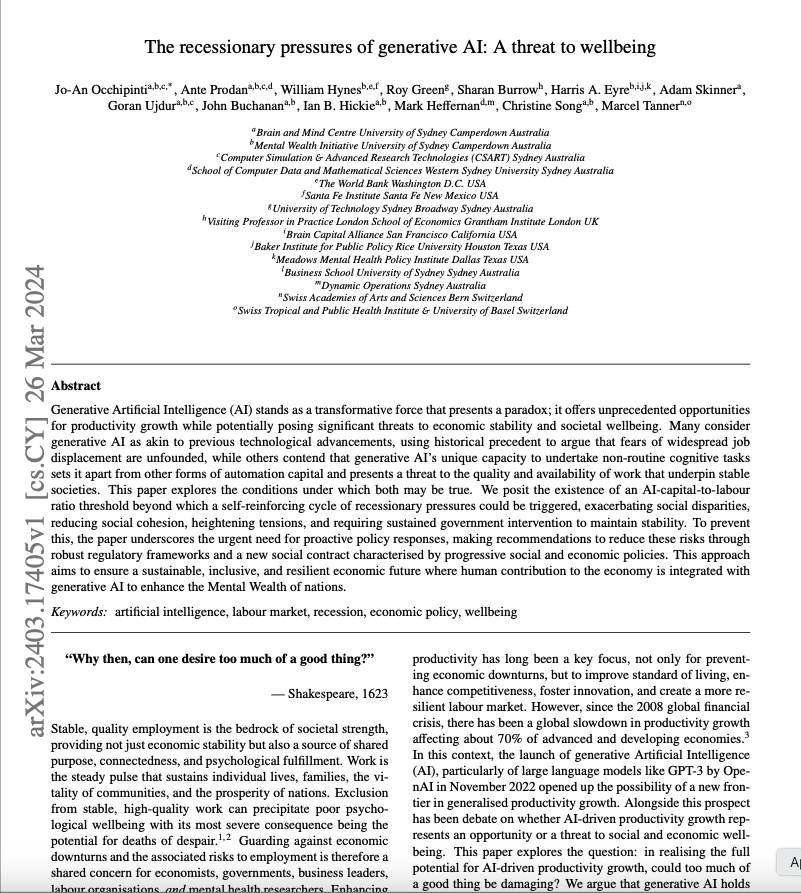
A public health paper just described how AI-driven unemployment could trigger the same economic collapse that caused the 2008 financial crisis.
Except this time, there is no housing bubble to blame. The bubble is the workforce itself.
The paper is called "The Recessionary Pressures of Generative AI: A Threat to Wellbeing." Published in 2024 on arXiv, later peer-reviewed and cited in public health literature through the National Institutes of Health. It is not written by economists. It is written by public health researchers, people who study what economic collapses do to human bodies and minds.
That framing changes everything.
Generative AI holds the capacity to profoundly reshape labour market dynamics and paradoxically, if left to market dynamics, undermine the very economic growth it aims to achieve.
The researchers start with a historical observation. Since the 2008 global financial crisis, there has been a global slowdown in productivity growth affecting 70% of advanced and developing economies. AI arrived as the promised solution, the technology that would finally break through the stagnation and deliver the productivity surge that had been missing for 15 years.
But the researchers identified a paradox built into the promise.
The pioneers of this technology are now openly acknowledging that generative AI is fundamentally a labour-replacing tool. Experts who understand the capability and trajectory of generative AI recognize that the current surge in AI-specialized jobs may ironically promote their own obsolescence.
Here is the doom loop they describe.
AI replaces workers. Displaced workers lose income. They reduce spending. Consumer demand falls. Companies see falling demand and cut costs by automating more. More workers displaced. Less spending. Less demand. More automation.
The productivity gains flow entirely to capital owners, the shareholders and executives whose wealth grows as the workforce shrinks. Workers receive none of the gains. They absorb all of the losses.
The researchers then apply the public health lens that makes this paper unlike anything economists have published.
They document what happens to human health during economic contractions driven by unemployment. Suicide rates rise. Substance abuse rises. Chronic disease rates rise. Mental illness rates rise. Life expectancy falls. The 2008 financial crisis generated measurable spikes in all of these across every country it touched.
Brookings Institution estimates that within the next decade, around 60% of job tasks in the United States alone are at medium to high risk of being replaced by AI.
If 60% of tasks are automated and the productivity gains go entirely to capital, the researchers argue the result is not just economic instability. It is a public health crisis at a scale that has no modern precedent.
The paper does not say this is inevitable. It says: without deliberate policy intervention, the market will not self-correct. The forces driving automation are too strong and the benefits too concentrated. And the people who will absorb the consequences, the workers have no seat at the table where the decisions are being made.
The conclusion is worth reading in full: a technology designed to produce abundance, left to market forces, risks producing the conditions for a recession that damages human wellbeing on a generational scale.
This paper was written in 2024. It was citing warning signs that were already visible then.
In 2026, those warning signs are now data points.
Source: "The Recessionary Pressures of Generative AI: A Threat to Wellbeing" · arXiv:2403.17405 · https://t.co/w1oIEexpSf · NIH/PMC: https://t.co/YaUg3XfuDR
@namcios Garbage written by AI. For LLMs, it doesn’t matter if one mix YAML, jason, html, CSS, markdown, liquid, or whatever markup or templating language you want, even LaTeX or R. It will take whatever one throws into it. One proof is the pseudo-JSON it blurts out ocasionally.
Interestingly, I have a feeling that this opinion was AI generated. At least, inspired by LLM output standard text structure and format. I will read this paper, let’s see what is the substance behind it. Thoughts, @JoaoCalangro?
A researcher spent two years documenting what AI is doing to the way humans think.
His conclusion fits in one sentence.
AI is standardizing human thought. Across societies. Across cultures. Across generations. Simultaneously. At a scale no technology in history has ever achieved.
The paper is called "The Impact of Artificial Intelligence on Human Thought." Published July 2025 on arXiv. Written by independent researcher Rénald Gesnot, categorized under Computers & Society and Human-Computer Interaction.
It is not a benchmark paper. It is not a capability paper. It is something rarer — a systematic analysis of what happens to human cognition, creativity, and intellectual diversity when billions of people outsource their thinking to the same machine.
Here is the mechanism the researcher describes.
When you ask an AI a question, you get an answer shaped by the model's training data, its fine-tuning, its alignment process, and the preferences of the company that built it. That answer is not neutral. It reflects a specific set of values, framings, and assumptions. Usually Western. Usually English-dominant. Usually optimized for engagement and approval.
When 500 million people ask the same AI similar questions and receive similar answers, those answers become reference points. People quote them. Build on them. Argue from them. The diversity of starting points — different cultures, different intellectual traditions, different ways of framing problems — begins to compress.
The researcher describes this as cognitive standardization.
Not censorship. Not propaganda. Something subtler and harder to reverse. A gravitational pull toward the outputs of a small number of models, trained by a small number of companies, reflecting a small number of worldviews.
The paper also documents algorithmic manipulation — AI systems that exploit cognitive biases to influence behavior. The way recommendation algorithms produce filter bubbles. The way AI-generated content exploits confirmation bias. The way personalization systems learn what you already believe and feed it back to you amplified.
And then the creativity question — the one nobody wants to answer directly.
When AI can produce a poem, an essay, a business plan, or a research summary in seconds — and when that output is often indistinguishable from or preferred over human-generated content — what happens to the human practice of creating those things? Not the output. The practice. The struggle. The failure. The slow development of a personal voice through years of imperfect attempts.
The researcher argues that cognitive offloading — delegating thinking tasks to AI — does not merely save time. It atrophies the mental capacity that the offloaded task was building.
Microsoft and Carnegie Mellon found this empirically in 2025: higher AI trust correlates directly with measurably lower critical thinking. The researcher provides the theoretical framework for why.
The paper ends with a question the researcher admits he cannot answer.
Once a generation grows up with AI as the default thinking partner — once the habit of outsourcing cognition is formed before the habit of independent thought is developed — what does intellectual autonomy even mean?
And is it already too late to find out?
Source: Gesnot, R. · "The Impact of Artificial Intelligence on Human Thought" · arXiv:2508.16628 · https://t.co/qoQR2Ow4YI · July 2025
Have I mentioned that cognition is rhythmic?
Planar, spiral, and concentric traveling waves distinguish behavioral states in human memory
https://t.co/CFuGPUugGs
#neuroscience
Integrated information theory - the good, the bad, and the misunderstood. New preprint, a long time in the making, led by Adam Barrett alongside a terrific crew: @MilinkovBorjan@PedroMediano@_fernando_rosas@DanielBor Lionel Barnett, & me. https://t.co/p2HuhDOqQ8
At that time we will not disclose the models (easy to guess, though). We will prepare a preprint about this. Personally, it was really disturbing, and it included heavy sexual objetification and high potential for addiction. You and your kids are not safe playing with that.
A colleague and I just finished jailbreaking two major LLM models that claim not to generate sexualized images or text, and both were tricked into displaying suggestive images and generating text with graphic sexual descriptions. We only used text prompts, nothing special.
OpenAI is shelving development for their erotic "adult mode" chatbot
The company faced pushback from investors due to problems sexualized AI content could have on society
via FT
@anilkseth It seems pretty clear that this is a marketing stunt in a hostile business environment for AI techs. Stocks are stumbling and the market is anxious, so they have to be creative. Someone should write something in the line of “The AI Delusion”.
And so this icy ball may hide the secrets from the dawn of the solar system, maybe even some clue about why we happen to have here this weird quirky phenomenon we call life.
Today is the 96th anniversary of Pluto's discovery in 1930. And it still hasn't even made half an orbit around the Sun since!
It'll take another 152 years to complete its first full orbit since its discovery. That'll happen on March 23, 2178. Maybe your great-grandchildren will get to see that day.