@authordlewis He appears on casrep as that bn. 46 men KIA or DOW on 8&9/7/44. Two who DOW-Concar and Tipper-are buried at Ranville. I'd bet that marker is relatively modern and in error.
@Tunisia_1943@paul_bamford35 Cols and Brigs had (have) a crown surmounted by a lion (commonly known as the General Staff badge). Gen officers have the same (smaller) surmounted on a crossed sword and baton with a laurel wreath.
@LordRickettsP There they took on the provision of communications. The status of the det was disputed by the Japanese after its declaration of war in Dec 1941; they were eventually accepted as being diplomatic staff. All 6 (and the wives of Morgan & Welchman) were evacuated from Shanghai.
@LordRickettsP Amongst those onboard the Tatsuta Maru were Royal Signals soldiers Sgt W. G. Melly, L/Cpl A. F. Morgan and Signalmen A. Binningsley, E. E. Godwin, T. R. Marshall, G. L. Summers & G. C. Welchman of the Tientsin, China det who had been transferred the Peking Legation in Aug 1940.
On October 19, 1973, four men, two of them armed with sawn-off shotguns, robbed a sub-post office in Bermondsey, south London, before escaping in a stolen Ford Corsair.
They were spotted by a police patrol car whose occupants were unaware of the robbery but decided to stop the Corsair because it was being driven erratically. They pursued the car north for more than four miles, giving a running commentary on their radio, before losing sight of it.
PC Ryan David was in another patrol car in Hornsey, north London, listening to the commentary with a colleague, when he recognised the stolen vehicle coming towards them. He quickly drove his car across the road to block it but the driver managed to get past. Immediately reversing, David continued the pursuit. As he did so, a passenger in the stolen car fired his weapon, hitting David’s windscreen. Undeterred, he continued to give chase.
Meanwhile, another police car had been placed across the road ahead, forming a roadblock. As the robbers approached, they turned sharply into a cul-de-sac with David and his colleague still in pursuit. Coming to a halt they fired two shots at the officers manning the block, though neither was hit.
David leapt out of his car and began grappling with one of the gunmen to try to take his weapon. Meanwhile, the other gunman began loading his shotgun. David was forced to release his grip on the first gunman but managed to pull one of the unarmed men from the car and arrest him, in the process suffering injuries to his arm that later required hospital treatment. More officers arrived and ran towards the stolen car, arresting another man, but the armed gunmen continued to point their weapons.
When one of them fired, the unarmed officers rushed the car. After a violent struggle, they subdued the two gunmen.
Harold Styling, 58, a member of the public, witnessed the arrests, which took place outside an off-licence. “A police car swung in front of the Corsair,” he told journalists. “Police rushed the car and, using truncheons to smash the windows, managed to get two men out of the back and get handcuffs on them. Suddenly the police shouted, ‘Get back, they’ve got guns.’ The police took cover and two shots were fired. I saw the robbers holding the shotguns.”
Five months later at the Old Bailey the incident was described as “a Chicago-style shoot-out”. Jailing four men for between eight and 14 years, the judge said that all 17 officers involved “had been incredibly brave and had behaved with the utmost heroism”.
In March 1975, David was one of three officers awarded the Queen’s Gallantry Medal for their role in apprehending the robbers. The citation read: “All the officers involved in the events leading to the arrest of these armed and dangerous men, who did not hesitate to use their weapons, displayed devotion to duty, great courage and a complete disregard for their own safety.”
It would not be David’s only appointment at Buckingham Palace. In the early hours of December 6, 1975, he was called to Archway Bridge, north London. A suicidal young man had climbed over the railings and was standing on a 2ft-wide unprotected ledge, threatening to leap 57ft into the road below.
Several officers had tried to talk him back, but to no avail. David climbed over the railings on to the ledge, but the man moved away. Meanwhile, the fire brigade had prepared a noose, intending to drop it over the man.
Noticing their intentions, he made to jump. David released his hold on the bridge, moved forward quickly and grabbed the man, forcing him back against the railings. The man began struggling violently, such that at times his legs were off the ledge.
Another officer clambered over the railings and positioned himself behind David, holding on to his clothing. To onlookers, it appeared that all three could fall to their deaths. Finally, with the help of a fireman who had also climbed over, the young man was manhandled back to the safety of the bridge.
Continued…
@agbdrilling 2363707 Driver John Brady, aged 26, who drowned on 10 August 1945. Originally buried at Schleswig Military Cemetery, his remains were reinterred on 22 May 1947 at Kiel War Cemetery.
American far-right, assisted by the British far-right, spent the last week asserting three young women were "murdered" in Brighton.
Many of the posts suggested an "illegal immigrant" did the murders.
I'll go through how they exploited the information deficit to sew division. /1
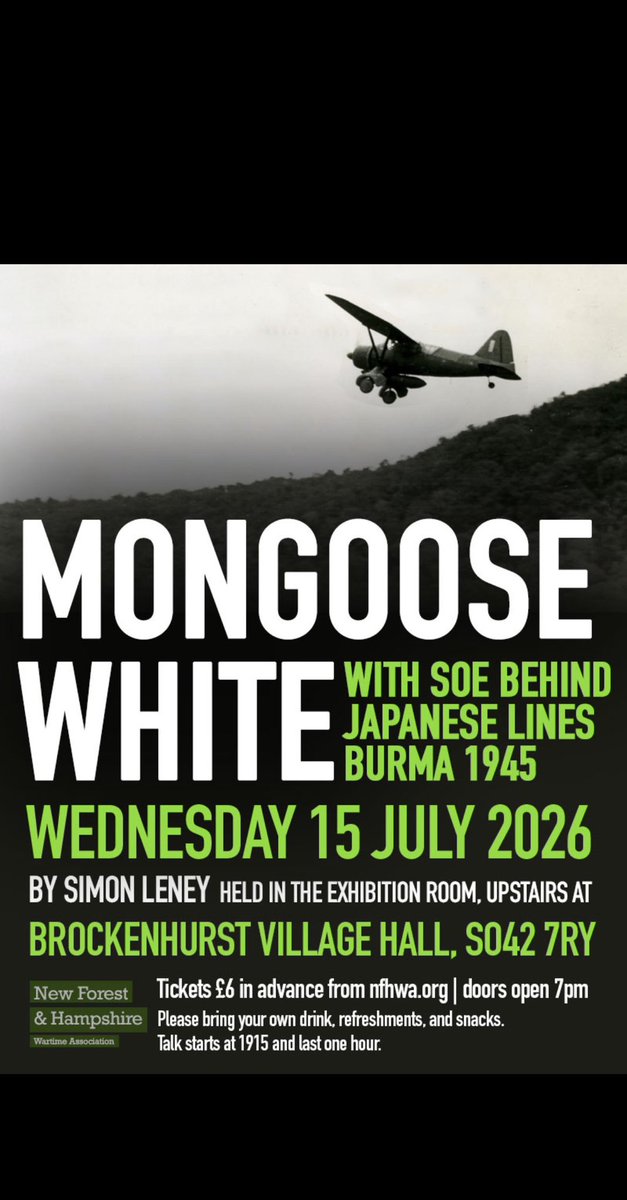
And in Burma where 357 SD sqn supported #Force136, especially during #OperationCharacter. In the final months of the war the Lysanders were their lifeline. To hear more of that story, come along to my talk in July 🙏
Op Varsity—The Royal Signals Air Support Signal Unit teams attached to US 17th Airborne Division. #Varsity
Two Air Liaison Officers and nine Royal Signals: Six killed in action, one wounded. One Military Medal, one Bronze Star.
https://t.co/z83RXscUQk
@R_Signals@signalsmuseum
Joe Beecroft, one of Australia’s Greatest Generation who served in Navy in WWII and survived Japanese captivity. Joe had a “second act” in NSW police rescue. Aged 59, Joe was a hero of the 1977 Granville Rail disaster, leading the rescue effort. 83 were killed that tragic day.
I've used em-dashes my whole life — they add rhythm and grace to writing. But now they're an AI tell.
Can we get a grandfather clause for those of us who were fluent in em-dashes before ChatGPT launched in November 2022?
In 2021, after 6 years of shopping at my local Sainsbury’s and tracking where I parked each time on a spreadsheet, I completed all 211 parking spots the store had to offer. In 2024 I moved to a new town - and guess what I’ve been busy doing since :) A thread 🧵