Software is like aluminum.
Aluminum used to be a rare luxury metal. Kings were served their meals on it.
Then someone discovered that aluminium could be extracted from bauxite.
Now we wrap our sandwiches in it.
The aluminum industry is way bigger than it was back then, but the aluminum artisans who made plates for kings went out of business.
Today, the only way to make money in the aluminum industry is using cheap electricity at massive scale.
Nobody has a moat just because they can make aluminum anymore.
AI is doing this to software.
There will be more software than ever, but the ability to make it (including taste) will no longer be valuable.
Software isn't going away—it's margins and the artisans who make it are.
This Dhanteras, ₹2,000 for a movie ticket or 10 gm of silver?
Am I too middle class to even think like this, or is this just financial wisdom? 😂
#Dhanteras#Priorities#diwali
Do you feel India should depend on other countries for processing the critical minerals that power our future?
I certainly don’t!
Lithium, nickel, cobalt…these are essential for EVs, batteries, electronics and defence. Yet, we remain heavily dependent on imports of refined materials.
To address this, the Cabinet has approved a scheme to change this.
Key highlights:
New critical mineral processing plants.
Capital subsidy to boost investment.
Greater domestic value addition.
Stronger supply chains.
The principle is clear...India must have capabilities to build technologies of the future!
https://t.co/deencvjivt
Trump can veto legislation passed by Congress, but he can't make laws on his own.
With Democrats winning control of Congress in the 2026 midterms, how can Trump get his legislative agenda passed without bipartisan support? @grok#Trump#Election2026#BlueWave#Midterms2026
Proud moment! 🙏
Those are the very lanes I grew up in Bada Bazaar.
Legends like Ghanshyam Das Birla and L.N. Mittal walked these same lanes, and so many of India’s great business journeys began right here. a spirit of enterprise that stays with you for life.❤️
कागज़ की पुड़िया वाली streetside झालमुड़ी का स्वाद कुछ अलग ही होता है। इस बार कोलकाता में झालमुड़ी खाई, तो लगा जैसे पूरा बचपन लौट आया।
कोलकाता से तीन पीढ़ियों का रिश्ता है हमारा। बाऊजी ने late 1950s में पटना जाने का फ़ैसला किया था। उससे पहले मेरे बचपन के शुरुआती लगभग पाँच साल, बड़ा बाज़ार के घर में joint family के बीच ही गुज़रे।
सालों बाद इस हफ़्ते कोलकाता गया, तो बहुत सी पुरानी यादें ताज़ा हो गईं। यहाँ की गलियाँ, यहाँ के लोग और सबसे बढ़कर, यहाँ का खाना!
जिस भावुकता से कोलकाता के लोग मिलते हैं, अपनेपन के साथ खाना खिलाते हैं, वो दिल को छू जाता है।
मैं ख़ासतौर पर यहाँ के youngsters से मिला और उनके चेहरों पर उत्साह भरी जो चमक देखी, आगे बढ़ने की जो चाह देखी, वो देखकर बहुत positive महसूस हुआ।
और बंगाल की महिलाओं के बारे में क्या कहूँ? उनकी सोच, उनके opinions और हर क्षेत्र का उनका ज्ञान, हमेशा बंगाल की पहचान रहा है और रहेगा।
कोलकाता से जाते-जाते, यादों के साथ-साथ, झालमुड़ी का एक छोटा सा पैकेट भी लंदन ले आया।
Just learnt about the incredible bravery of Captain Smit Machchhar. To show such courage in the face of a terrifying and unprecedented challenge is truly extraordinary. A real-life hero in every sense. The entire nation—and the world—is proud of you. 🇮🇳👏🏻
I was standing at a metro station in kolkata today.
The train hadn’t even stopped properly, but people had already formed a tight cluster near the gate. One station before their destination, they had moved early… afraid they might not get space to step out.
And suddenly I realized—
This is not just metro behavior.
This is the psychology of scarcity.
I see it everywhere.
At public events, the moment a chair becomes vacant, someone rushes to occupy it.
At food stalls during professional gatherings, people hurry to grab the first plate — not because the food will run out, but because somewhere inside, there is a fear:
“If I don’t move first, I may miss out.”
Even in traffic, the signal turns green and vehicles behind start honking within one second — as if waiting patiently means losing something.
We have unknowingly become a society trained in insecurity.
Scarcity of space.
Scarcity of opportunity.
Scarcity of trust.
Scarcity of time.
And when scarcity becomes cultural, people stop contributing.
They start competing for survival in every small moment.
But the India I dream of is different.
An India where people don’t rush because they trust there is enough.
An India where people don’t grab first — they offer first.
Where confidence replaces insecurity.
Where fulfillment replaces fear.
Real development is not just GDP, infrastructure, or technology.
Real development is when a nation’s people stop behaving like they are deprived… even when they finally have enough.
The day we move from
“What if I don’t get it?”
to
“How can I help someone else get it too?”
— that day India will truly evolve.
And maybe change does not begin with policy.
Maybe it begins in ordinary moments:
Waiting calmly.
Letting someone else go first.
Trusting there will still be enough left for us.
Nations are built by collective psychology.
And I genuinely believe India’s next transformation is not only economic.
It is emotional.
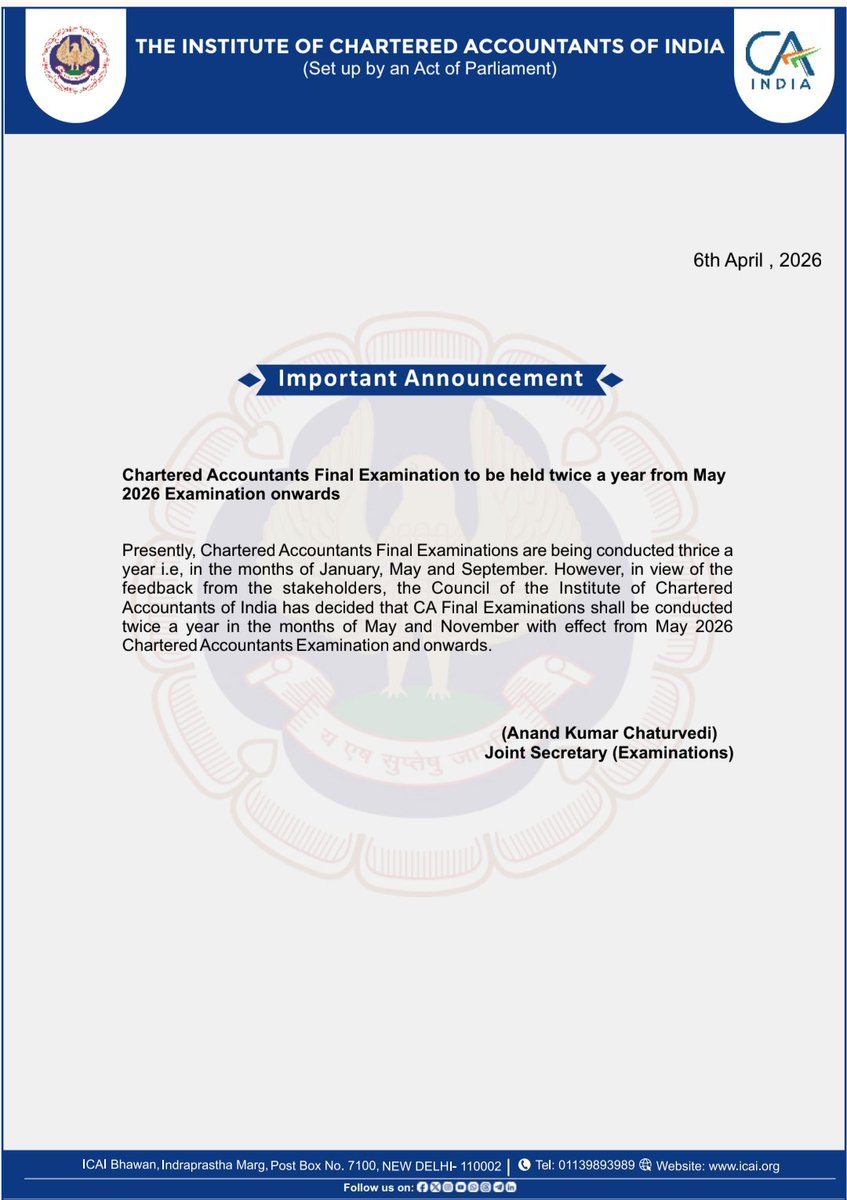
ICAI’s decision is welcome. Inter and Foundation should also be held only twice a year, because conducting them three times a year creates unnecessary disruption in students’ preparation. From a preparation standpoint, the issue is the same for CA Inter and Foundation. The only distinction is that CA Final acts as a feeder for industry and practice.
@theicai
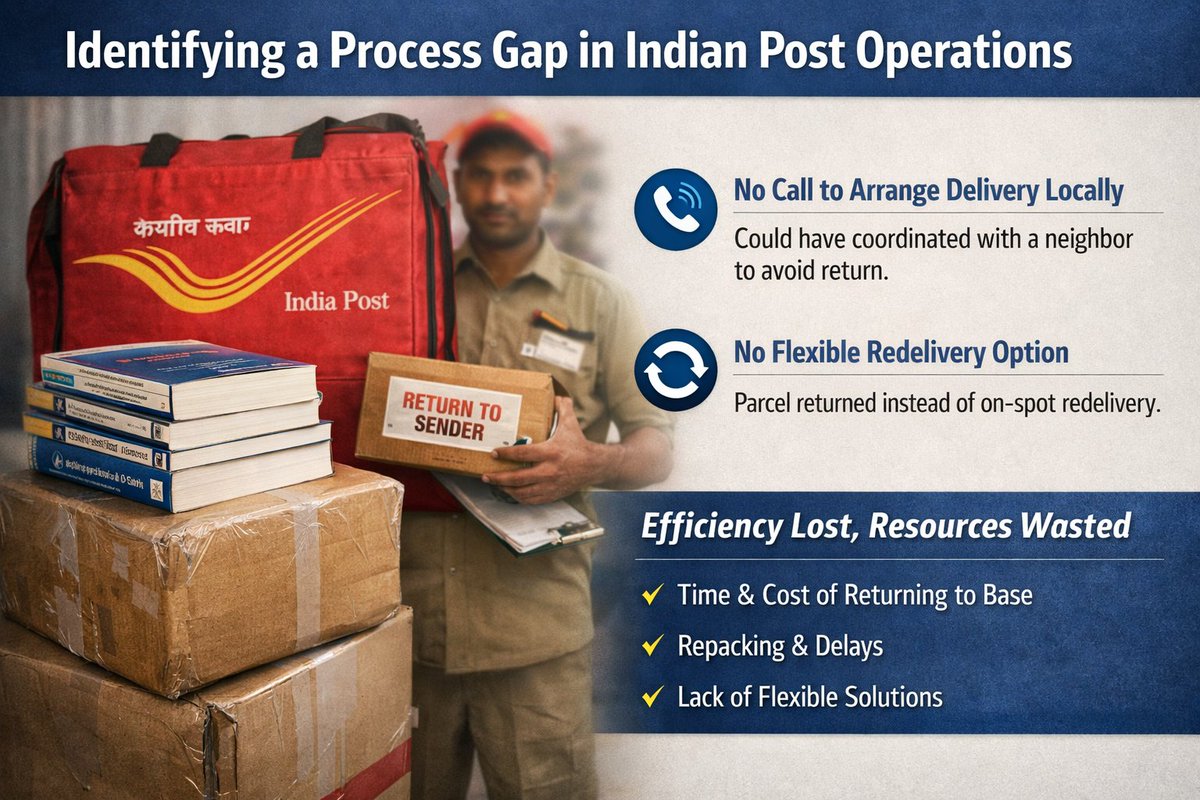
I identified a Process Gap in Operations of India Post
Last week, we sent books of CA Inter Advanced Accounts to a sincere student based in Delhi through India Post. Unfortunately, no one was available to receive the parcel, so it was returned.
Today, the delivery person came back with the parcel. I asked whether I could hand it over again immediately, since we had now made arrangements for someone to receive it. He politely said that he could not take it back for redelivery. Instead, we would need to repack it, make delivery arrangements again, and wait for another attempt on Monday.
This incident revealed a clear process gap in operations.
First, if there had been a phone call from the delivery location, we could have arranged for the parcel to be received by a neighbor or someone nearby. That would have saved the cost, time, and effort of taking the parcel back to the base location.
Second, when the parcel was physically brought back today, there was another missed opportunity. Since the delivery arrangement had now been sorted, the parcel could have been taken back immediately for redelivery instead of requiring repacking and a fresh process cycle.
This is not about blaming the delivery staff. They may simply be following existing rules. But the system does need more flexibility.
Some operational insights from this experience:
Better last-mile communication can prevent failed deliveries.
Small flexibility at the point of return can avoid duplicate work.
Smarter recovery steps can save time, fuel, manpower, and customer frustration.
For an institution as important and widespread as India Post, even small process improvements can create major operational efficiency.
@IndiaPostOffice
My life has been deeply blessed by Hanuman’s grace. I truly believe he listens — all that is needed is true feeling and complete faith.
And the most beautiful truth is that Hanumanji still walks this Earth in Kaliyug. The moment you remember him with a sincere heart, he is already there, even before you can sense his presence.
Jai Bajrang Bali
Jai Shri Ram
❤️🧿