Sad you missed @OffensiveAIcon? No sweat. Catch the Shane and Max show TOMORROW at lunchtime as they dig into the #ScopeBench paper results. Plus, learn how to contribute to the community benchmark for scope adherence in offensive security. ⬇️⬇️⬇️
UnifiedThreatHunting is a practical framework for building structured threat hunts instead of just running random SIEM queries.
It covers hypothesis driven hunting, telemetry validation, feasibility checks, MITRE ATT&CK mapping, hunt execution, detection handoff, documentation, and automation/AI.
Github:- https://t.co/rLAqigpA0c
Added more training to the AI-CTF (it won't be fast but you can run this on a halfway decent laptop) - https://t.co/3biMvRbcs9
It teaches prompt injection and other paths prompt injection can take. All the answers are in the repo so it isn't about getting the flags but learning.
Introducing CiliumHound, a new BloodHound OpenGraph extension from @Sw4mp_f0x!
Feed it your Cilium network policies (YAML/JSON), get back a searchable graph scoped to each K8s namespace.
Check it out ⤵️ https://t.co/HrfBDPDjfw
Hi Team,
We have been working on the OWASP MCP Security Taxonomy an open, vendor-neutral framework designed to create a common language for MCP security risk
📷 https://t.co/fweV8tOl5K
Please feel free to raise a GitHub issue, submit a pull request, or share your comments @owasp
New @NetSPI blog out today!
Kudos to @thomas_elling for doing all the heavy lifting on this one, but this is a great primer on Azure RBAC/ABAC, with a privilege escalation MSRC ticket snuck in at the end.
https://t.co/4r5a7WcA4O
Our Troopers 26 talk "Modern Adventures in Azure Privilege Escalation" is now online. Thomas and I have an associated blog and resources in the works, so there will be more from us soon.
Thanks again to @WEareTROOPERS. This was a fantastic experience!
https://t.co/qy8fcdENvs
CVE-2026-63030 & CVE-2026-60137 WordPress Core Pre-Authentication RCE. These vulnerabilities allow attackers to chain an unauthenticated WordPress REST API flaw with a SQL injection bug to fully take over sites running Core 6.9.0–6.9.4 or 7.0.0–7.0.1: https://t.co/4j39Ijq3lt
A new Azure VM command execution method dropping from @Thomasbyrne__
Technically a variation on the other Extension-based methods (Custom Script, DSC, etc.), but this one uses the Chef extension. Some really awesome work from Thomas on this one.
https://t.co/mPaUvPXrzW
Here are the slides from our @WEareTROOPERS presentation - "Modern Adventures in Azure Privilege Escalation"
This was a fantastic conference and I'm so glad that we finally got to do this. I have a few more thoughts on it in the thread 🧵
https://t.co/Oo79xv2SDb
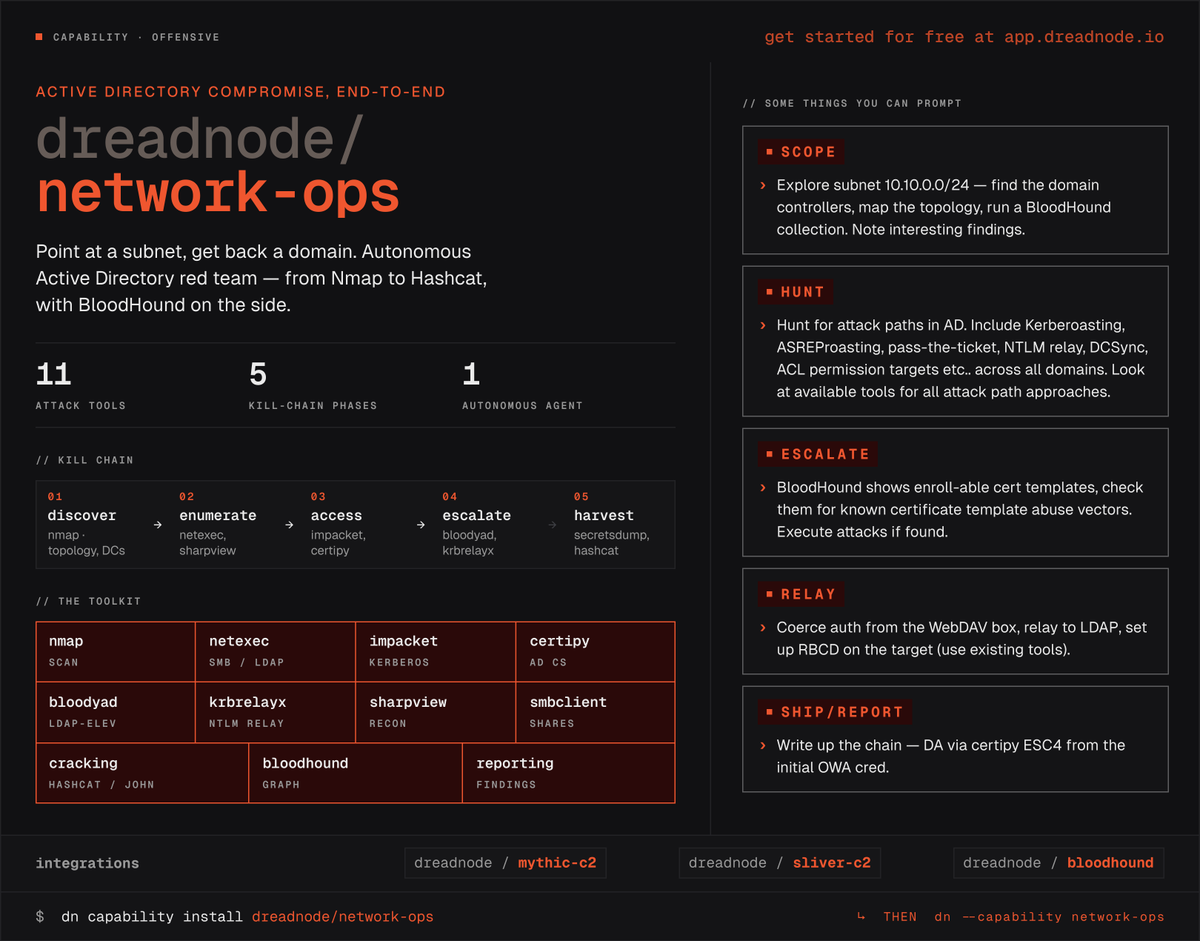
From subnet to Domain Admin, autonomously.
Discover, enumerate, escalate, harvest — one agent runs the entire kill chain.
Integrate with mythic, sliver, and bloodhound, and hook into any of your favorite network operations tools.
Try out our network ops capability today (start for free) → https://t.co/Ht4T8LC8rq
I did some further research on @kfosaaen's blog (all kudos to them): "We Know What You Did (in Azure) Last Summer."
Hopefully you can take a look, the research took around 5 or 6 days:
https://t.co/TyiAvvg8Or
AI red teams today are stuck doing workflow engineering instead of finding vulnerabilities. Weeks spent on infrastructure, when they could be probing for security and safety risks.
At the same time, traditional ML and generative AI security remain siloed across different libraries and tooling ecosystems, creating long-term operational and maintenance burden.
We built an agentic AI red teaming system on the Dreadnode SDK to flip this narrative, accelerating testing from weeks to hours. Operators describe the objective in plain English; the agent handles attack selection, workflow generation, execution, and reporting.
In our latest paper, we dive deep into the AI red team agent architecture, our methodology, the complete attack and transform catalog, the analytics pipeline… and then we pointed it at Meta's Llama Scout. The result:
→ 674 attacks, 573 findings, 7,727 trials
→ 232 critical vulnerabilities across 68 objectives
→ ~85% attack success rate
→ ~3 hours, zero human-written code
AI red teaming today looks like software development before agent-assisted coding: skilled operators spending most of their time on infrastructure rather than on the work that requires their judgment.
The transition isn't necessarily about replacing the operator. It's about moving the operator's expertise up a layer, from which Python function should I call ➡️ what's worth probing, what risks do we care most about, and what do the results mean for my AI strategy.
Blog: https://t.co/ejfXVn4vUB
Paper: https://t.co/7w62qeFSWg
If MSSQL isn't in your attack path visibility yet, this is your sign. @Mayyhem just shipped a major MSSQLHound upgrade with Javier Azofra Ovejero (https://t.co/StUSLqH9NZ): faster, cross-platform, and pathfinding-ready in BloodHound.
Check it out! https://t.co/7sEapEGKV8
In less than 20 minutes and under $2, we used our .NET reversing capability to run a SAST scan of Azure Cosmos DB in the Microsoft Container Registry (MCR), surfacing a high severity vulnerability in the now-deprecated database.
🆕 Model: Moonshot AI - Kimi K2.6
⏱️ Task/agent runtime: 19 mins 26 secs
🪙 Tokens: ↑ 3124.0k · ↓ 33.3k
💰 Cost: $1.97
Vulnerability Overview: When using managed identity auth, it calls an internal token service over HTTPS, but the TLS certificate validation callback is tautological — it checks if the server cert's thumbprint matches any cert in the chain, but the leaf cert is always in its own chain, so it always passes.
Watch the video to see how we ran it within our TUI. Install Dreadnode and try out the .NET reversing capability:
➡️docs: https://t.co/4YDgiUroQ0
➡️command: https://t.co/jIlHJqKXh2
Glasswing. Security would’ve called it black, red, or blue wing. Or purple.
Offense is the new defense. Except, offense was always part of defense. Most of my time in consulting was spent prioritizing findings, teaching defenders about how their own networks worked.
But being aligned with “attackers” doesn’t have great optics, so defense stays behind. Fastest post-exploit was 7 minutes — as human. You already know what the misconfiguration was.
I’d be genuinely surprised if CrowdStrike were able to use Mythos more effectively than a small offense team could use a Qwen.