$OPENPAD is live.
0xf53914048905a15ce9a74868b9acc61ea5fcdfbd
https://t.co/wEhnozfgsl
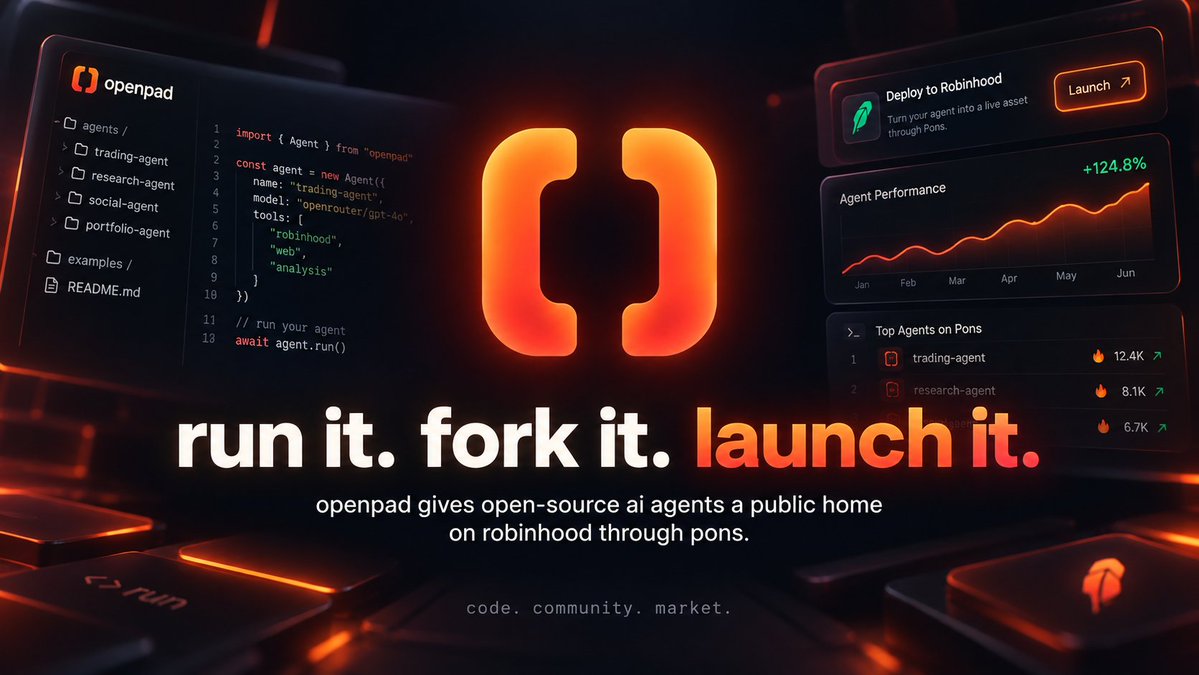
openpad is a launchpad for real open-source ai agents.
instead of launching a token first and promising a product later, openpad starts with the software:
connect the repo.
show the actual skills.
run the agent live.
verify activity.
let people inspect and fork the code.
then launch the market through pons.
builders get a public home for their agents. users get a way to discover software they can actually test before backing it. contributors can fork what works and build better versions.
the goal is to turn robinhood into a place where agents, code, communities, and markets can all live together.
real repos. real agents. real usage. onchain launches.
every serious agent should have a public place where people can see the repo, understand what it does, track the activity, watch it improve, and decide for themselves if it’s worth paying attention to.
that’s what we’re trying to build with openpad.
still early.
openpad is moving exactly how we wanted it to.
100+ agents launched, full github support is live, the pons flow is integrated, and the product is getting stronger every day.
the next phase is where this gets really interesting: better discovery, deeper agent activity, stronger verification, smarter treasury deployment, and more reasons for serious builders to stay and grow here.
we’re not slowing down.
openpad is turning into the place where ai projects come to actually launch, prove themselves, and scale on robinhood.
you’re still treating “incentive” as if it only means “dev buys the chart.” "give 5 dollars to holders" like just useless stuff.
that’s exactly the short-term mindset we’re avoiding.
openpad already creates value through the product: launches generate fees, those fees fund infra, grants, liquidity, better tooling, more agents, and more distribution. that can create more usage, more launches, and more fees over time.
a buyback is not utility. a burn is not a business model. and forcing every dollar of revenue into the chart just so holders feel rewarded for a few hours is not how you build something durable.
if the only reason someone supports a project is because they expect the dev to constantly market-buy their bags, that’s not conviction in the product — that’s just asking the treasury to be exit liquidity.
we’re building for people who want openpad to become bigger, not for people who need a candle every time fees come in.
the treasury is public, the allocation is public, and the results will be public.
judge us by what the capital builds.
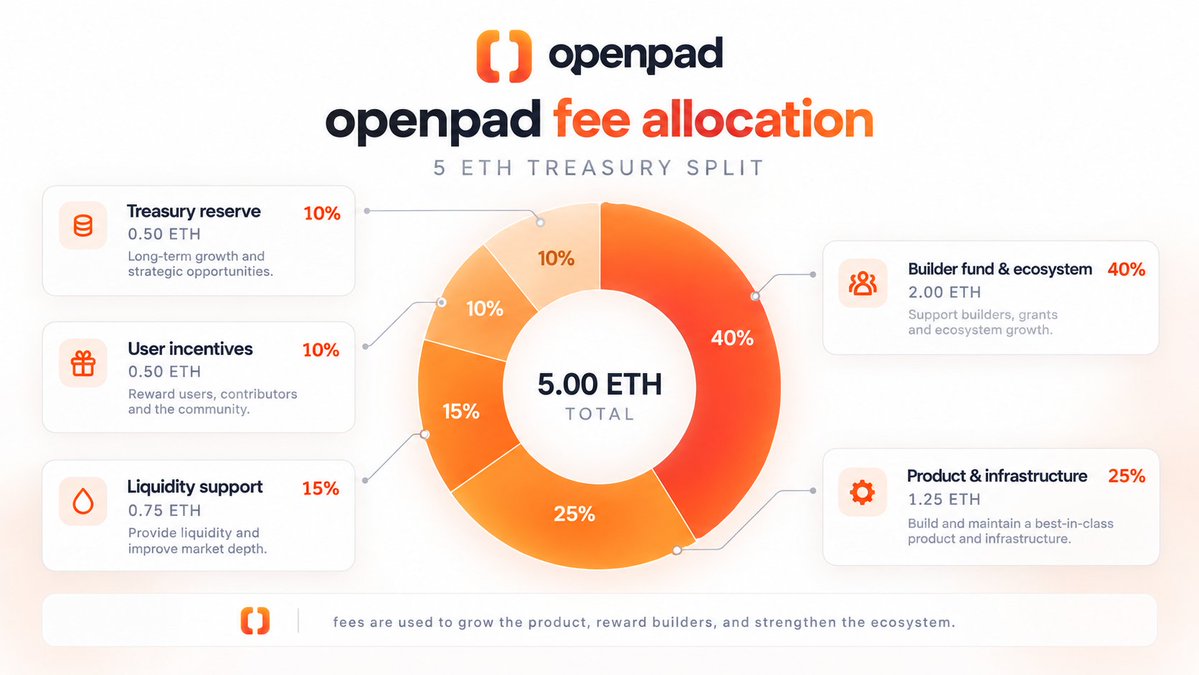
our treasury has now accumulated its first 5 ETH, and we already have a clear plan for how we want to deploy it.
the goal is not to burn it for optics or market-buy the chart for a temporary reaction.
we want the treasury to become something that actually compounds with openpad.
our current plan for the first 5 ETH:
40% — builder fund + ecosystem
2.00 ETH dedicated to supporting builders, grants, useful agent launches, contributors, and projects that actually add value to the openpad ecosystem.
25% — product + infrastructure
1.25 ETH toward the things that make openpad better and more reliable: backend upgrades, agent infrastructure, verification systems, github integrations, scaling, security, and product development.
15% — liquidity support
0.75 ETH reserved for improving liquidity and market depth where it makes sense across the ecosystem.
10% — user incentives
0.50 ETH for incentives tied to real behavior — using agents, contributing, building, forking, and participating in the ecosystem instead of meaningless farming.
10% — treasury reserve
0.50 ETH stays in reserve so openpad has capital available for future opportunities, infrastructure needs, and long-term growth.
and this is important:
we want all of this to be onchain, public, and trackable.
the treasury shouldn’t be a black box.
as funds are deployed, we want the community to be able to see where they went, what they were used for, and what openpad got back from that spend.
this is only the first 5 ETH.
if openpad keeps growing, the treasury should grow with it and eventually become a real engine for funding builders, improving the product, strengthening liquidity, and expanding the ecosystem.
full treasury rollout coming soon.
https://t.co/NOlGrrmDd3
exactly. generating fees from openpad already means the token/ecosystem is part of the value loop.
the mistake is thinking the only way to “support the token” is to immediately hand money back through buybacks, burns, or some other short-term mechanic.
that’s just one model, and tbh it often turns into people asking the treasury to pump their bags for them which implies holders only care about their bags and not the product lmao.
openpad earning fees, using those fees to improve the product, fund builders, deepen liquidity, scale infrastructure, and bring in more users can indirectly strengthen the entire ecosystem far more than a one off burn ever could.
if better product → more usage → more launches → more fees → bigger treasury, that is already a value loop.
not everything has to be “give holders money right now.”
that mindset is usually just greed designed up as tokenomics.
we're here long term not short term.
buybacks and burns are not some magic requirement for a project to be “real. lol.
if we took every ETH openpad made and immediately market-bought the token just to make the chart look better for a few hours, that would be the most short-term thing we could do.
we have an actual product to build.
servers cost money. github integrations cost money. agent infra, security, liquidity, grants, builder incentives, scaling all of that costs money. etc etc etc.
i’d waaaay rather turn 5 ETH into more users, more agents, better infrastructure, and more revenue than burn it so a few people can stare at a green candle.
the plan is public, and people will be able to see exactly where the money goes soon with https://t.co/NOlGrrmDd3
if openpad becomes bigger because we used the treasury intelligently, that matters a lot more than pretending a burn is some kind of business model.
go check out phase one of our fee allocation it is now posted on our X.
openclaw is great at one thing: giving ai agents a real runtime, tools, skills, sessions, and a way to actually do work.
but openpad is aiming at a much bigger layer around that.
we’re not just asking “can this agent run?”
we want to answer:
who built it?
is the repo real?
is ownership verified?
what skills does it actually have?
is it still active?
what has it done recently?
who forked it?
what changed?
can i use it?
can i launch it?
can a real market form around it?
that’s the gap openpad is going after.
openclaw helps run agents.
openpad is trying to become the place where agents get discovered, verified, used, forked, improved, distributed, and launched onchain.
for robinhood specifically, that gives us a way bigger surface area to build on.
we don’t want to just be “openclaw with a token button.”
we want openpad to become the full public operating layer around ai agents — code, identity, activity, reputation, lineage, usage, community, and markets all connected in one place.
that’s why i think openpad has the potential to go way beyond a normal agent runtime.
openclaw runs the agent. openpad builds the world around it.
openpad is getting closer to the product we had in mind from day one. less “launch and disappear,” more actual software history, builder activity, forks, and proof.
we're getting much bigger from here.
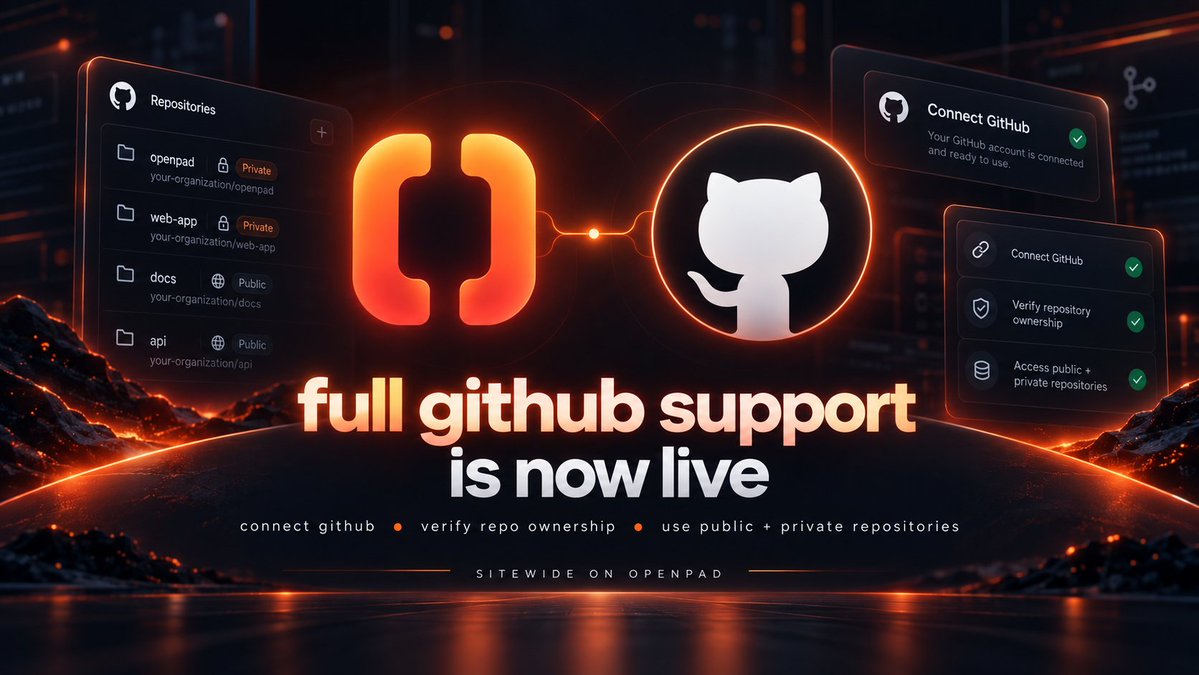
full github support is now live across openpad.
you can connect github, verify repo ownership, use public or private repositories, and carry that verified identity through the full agent launch flow.
this closes one of the biggest gaps in the product and makes launches much harder to fake.
github is now fully integrated sitewide.
https://t.co/WyBto33tqF
all fees are being routed directly into the openpad vault.
not just to sit on it either. we have some much bigger plans for how that wallet ties back into openpad, the token, and the ecosystem.
we’re finalizing the details now and should be sharing more later today.
the goal is to make the value created by openpad actually matter to holders too. small buy back and burns are good for short term gain but we're going to show you what we've been cooking later on today.
100+ agents have now launched on openpad.
that went from 20+ to 100+ way faster than expected.
now the job is making sure the platform scales with it — better discovery, better verification, better activity tracking, better launch pages, and more reasons for builders to keep shipping after day one.
100+ live. this is starting to get real.
openpad turns working open-source agents into public products with verified repos, live runs, forks, and onchain launches all in a few clicks.
no where else.
there’s a version of openpad where the best agents don’t just launch once.
they branch, get improved, get rebuilt, and become entire ecosystems.
that’s what we’re chasing.
the next version of openpad should make it way easier to answer one question fast: is this agent actually alive?
that's what we're taking time to build. 🤝
we’re almost done with the major openpad maintenance + upgrade push.
a lot of the work has been backend, verification, launch flow, activity tracking, and cleanup across the product not just visual changes.
we’re in the final stretch now and really excited to show what’s changed.
openpad is coming back cleaner, faster, and a lot more complete.