Meta Settles the Teen Safety Trial for $18B
$META reached a settlement with 52 attorneys general across US states, territories, and DC, one week into trial. The company pays in annual installments over 10 years and agrees to rebuild the teen experience on Facebook and Instagram. Meta admits no wrongdoing, and the deal still needs court approval.
What the case was about
The lawsuits date to 2023 and were originally brought by 29 states. They alleged Meta engineered Facebook and Instagram to keep teens on the apps as long as possible through infinite scroll, autoplay, and likes, downplayed what it knew about mental health harms, and violated the Children's Online Privacy Protection Act by keeping accounts for kids under 13.
Trial opened August 19, 2026 in the Northern District of California before Judge Yvonne Gonzalez Rogers, with four states litigating on behalf of the group. The states sought up to $1.4 trillion, a figure Meta called wildly disproportionate. Mark Zuckerberg and Instagram head Adam Mosseri were on the witness list.
How the $18B breaks down
Reported figures ranged from $16.7B to $18B because the payment has two parts:
Guaranteed: $12.7B — roughly 70%, going to participating states
Contingent: $5.3B — roughly 30%, owed only if YouTube and TikTok adopt comparable standards and make matching payments
Accounting hit: about $10B in legal expense, which Meta plans to book in Q3 2026
What Meta has to change
Teen accounts get:
Time limit: 2 hours a day, combined across both apps, not removable without a parent
Night mode: no posting or feed from midnight to 6 a.m.
School mode: notifications muted 8 a.m. to 3 p.m.
Usage prompts: every 15 minutes of continuous use, plus at 60 and 90 minutes daily
Feed: the non-algorithmic version becomes the default
Likes: hidden by default
Age checks: stronger detection of underage accounts
Filters: cosmetic surgery and extreme makeup filters blocked
Direct messages are exempt from the time, night, and school limits. Meta also published an open letter calling on YouTube and TikTok to adopt the same rules.
What this could mean
The cash is manageable. Spread over a decade it averages about $1.8B a year, against $60.8B in Q2 revenue and $90.3B in cash and marketable securities at quarter-end. Set against the damages sought and the risk of a verdict with court-ordered remedies, settling is the more predictable path.
The obligations cut closer to the business. Screen time is the inventory Meta sells to advertisers, and a two-hour cap, an overnight block, and a non-algorithmic default feed all shrink that inventory in a demographic advertisers pay up for.
The contingent tranche is the part I'd watch. Tying $5.3B to whether rivals follow gives Meta a financial stake in pushing $GOOGL (YouTube) and ByteDance (TikTok) into the same rules, which is exactly what the open letter does. Being regulated first is survivable. Being regulated alone may not be, because the time could simply move to whoever isn't. The counterpoint, that this touches only one age group, matters less than it sounds: these standards are likely to become the benchmark future cases point to.
Overall, the settlement closes this case while writing a rulebook that reaches well beyond Meta. Whether YouTube and TikTok follow decides $5.3B of it.
$SNAP $PINS
🇺🇸 US GDP grew 1.5% annualized in Q2, in line with forecasts but down from 2.1% in Q1. Inflation came in hotter than expected:
Headline PCE: 3.7% in July vs. 3.6% expected
Core PCE: 3.3%, in line
Personal income: +0.4% on the month
Real consumer spending: 0.0%
The trend is at least improving. Headline PCE was 4.1% in May, a three-year high. The level is still nearly double the Fed's 2% target.
What this could mean for stocks:
Slowing growth normally argues for a cut. At 3.7% inflation, a cut would likely add to price pressure. That bind may explain the July 29 vote: the Fed held 9-3, and all three dissents wanted a hike, not a cut. Kevin Warsh speaks at Jackson Hole on Friday, and his tone could set expectations into the September 16 meeting.
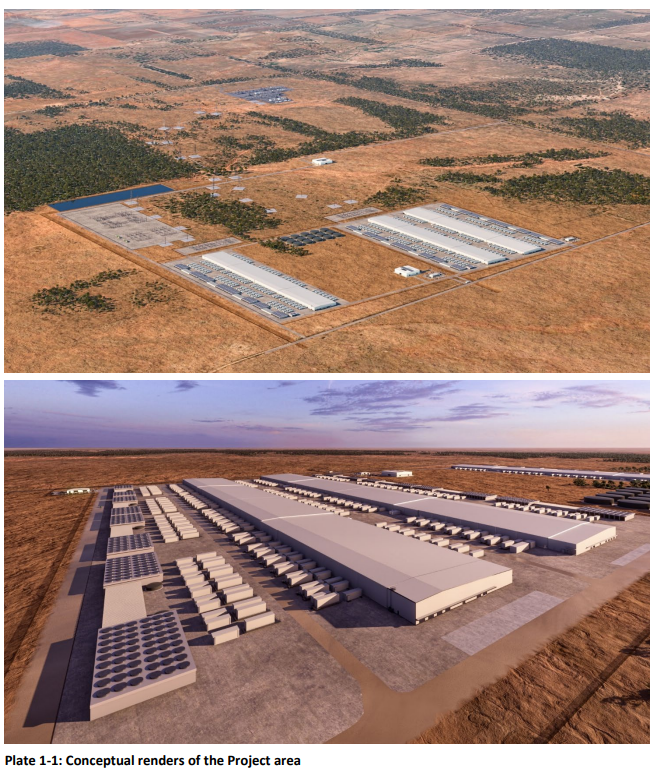
🚨 $IREN’s Bundey AI data centre in South Australia is shaping up to be HUGE.
The EPBC project description reveals:
• 800 MW gross electrical load
• ~550 MW IT load
• 3 large-scale data halls
• ~50 MW IT blocks
• Direct connection to ElectraNet’s Bundey substation
• ~2 km of new transmission infrastructure
• ~30 transmission towers
• 500+ construction FTEs
• 200+ operational FTEs
The project is planned to ramp in 50 MW IT increments, with energisation potentially every ~6 months.
And importantly, the filing confirms TAS 1 Holdings is wholly owned by IREN ($IREN).
This is one of the more significant AI data centre developments in Australia. 🇦🇺⚡️
The RFP, which landed in offices of CDC Data Centres, AirTrunk, NextDC, Iren and Stack among other players, culminated in an initial round of proposals at end of March. A handful of parties were invited to on-site meetings in Canberra in early April, when Amodei was in town to meet Treasurer Jim Chalmers.
U.S. federal debt crossed $40 trillion on August 18 for the first time — double what it was in 2017.
What does that actually mean? And what follows from it?
The headline number says very little on its own. It only becomes useful once you split it into three parts: what it costs, who funds it, and at what price.
Where the debt comes from
Washington spends more than it takes in, year after year, and closes the gap with bonds. For the current fiscal year:
Deficit per the Congressional Budget Office: $1.9T, or 5.8% of GDP
Outlays: $7.4T · Revenue: $5.6T
July alone: $432B deficit, the largest monthly shortfall since March 2021
Two blocks drive this, and neither is politically easy to touch: Social Security and Medicare, whose beneficiary counts keep climbing as the population ages. On top of that, last year's tax package (the One Big Beautiful Bill Act) permanently lowered the revenue side. The CBO puts its effect at $4.7T in additional deficits through 2035.
Debt isn't a problem as long as it's cheap.
That's exactly what's changing. Interest costs already run at roughly $1.2T this year — more than the U.S. spends on defense or on Medicare. A doubling to $2.1T by 2036 is expected, from 3.3% to 4.6% of GDP.
From here the debt compounds itself. Old, low-coupon bonds mature and get refinanced at today's much higher rates. Every dollar of interest has to be borrowed too. Economists call the effect crowding out: the interest bill eats the room for everything else in the budget.
Why borrowing got so expensive
The 30-year Treasury yield pushed above 5.3% in August, its highest since 2007. The 10-year sits near 4.7%.
Three forces are converging:
Supply: The government has to place more than $2T in new paper each year
Competition: Record corporate bond issuance funding the AI build-out is chasing the same buyers
Inflation risk: Prices are still running above the Fed's target, with higher oil adding pressure
Treasury responded by at least doubling its buybacks of long-dated paper to $4B per operation, starting September 9. Yields dipped, then gave the move back the next day — a sign the market reads it as liquidity support rather than an answer to the cause.
What it means for markets
The 10-year yield is the benchmark for mortgages, auto loans, and corporate financing. When it rises, credit gets more expensive across the entire economy. For equities, that same rate works as the discount rate:
The higher it goes, the less today's value of far-off future earnings — which hits richly valued growth names hardest.
For bonds themselves: rising yields mean falling prices, and the longer the maturity, the sharper the swing.
Overall, the $40 trillion mark is mostly symbolic. The more revealing number is the interest ratio: unlike social spending or defense, debt service can't be cut or deferred. And as long as the rate sits above the growth rate, it grows faster than the output meant to carry it. A large economy can absolutely carry a heavy debt load — what matters is where it goes from here.
We don't judge outcomes in absolute dollars. We judge them as gains or losses against a reference point — and we distort the odds along the way.
That's Prospect Theory, and it shapes almost every call we make in the market.
I put the 4 biggest mental traps — and the psychology behind them — into one piece 👇
I'll just borrow this from my subscriber content - higher tier.
$IREN has not yet completed the CUP (liquid-cooling plant) of Horizon 2.
Further more, despite all 3 buildings having GPUs, not all the SU's are installed and connected to the fiber backbone/network core.
Needless to say, without these vital components + heavy machinery (e.g. cranes), no pavement, no security, and just no actual compute yet — Horizon 2 is not operational yet, and won't be by earnings.
That being said, it will be ready — by my estimates — by the end of next month.
Baxtel is not a great source for intel, they crawl all over the place, but not from OnlyFrans for some reason 😂
Picture is from this week.
Credit to my supporters & subscribers.
Delivery day at our Microsoft DCs as the first production Vera Rubins arrive. A huge thank you to our partners at @nvidia and our Azure hardware and datacenter teams for all the incredible work that brought us to this milestone!
We build a confident, complete-feeling verdict out of whatever information happens to be in front of us — and ignore everything we can't see.
Kahneman called it WYSIATI: What You See Is All There Is.
It's why a clean three-point story beats a messy, incomplete truth.
👇
Your entry price tells you nothing about whether a company is cheap or expensive today.
Yet almost everyone measures against it.
That's anchoring: the first number you see — entry price, an old all-time high, someone's price target — quietly hijacks every judgment that follows.
👇
Priced, and upsized to $5B. ✅
$3B of 0.5% notes due 2030
Conversion price $313.46, a 40% premium
$2B of 4.5% notes due 2034
Conversion price $324.65, a 45% premium
Option for an additional $750M
If every note converts, that's 15.7M new Class A shares. Against 271.9M outstanding, 5.8% dilution, or 6.7% if the initial purchasers take the full option (likely).
The amount owed accretes on a fixed schedule: every $1,000 borrowed becomes $1,100 on the 2030s and $1,250 on the 2034s. So $5B borrowed becomes $5.8B owed at maturity. But interest is calculated only on the original principal, meaning annual cash interest is just $105M. The accretion still flows through interest expense as a non-cash charge, so reported interest expense from the deal will be roughly $250M a year while only $105M actually leaves the bank.
Important: the accretion is only paid if the notes are repaid in cash. If holders convert, they give it up. That pushes the effective breakeven conversion price at maturity to roughly $345 for the 2030s and $406 for the 2034s.
Separately, $800M of the 2029 and 2031 notes (issued back in June 2025) were exchanged for ~15.8M shares. Those notes convert at $51.45, so they stopped being debt long ago and have been sitting in the diluted count for a year. At that conversion rate, $800M was always going to become ~15.5M shares. The cost is the gap, roughly 250k shares, or about $56M, in return for holders giving up the paper years early. For that, Nebius kills $20M a year of coupons, kills the accretion drag running through interest expense, and removes the tail risk of that principal ever coming due in cash. That's a good trade.
Dilution has never been the open question here. The real question is how that capital gets deployed, and the latest earnings only reinforced the continued improvement in unit economics.
Overall, I'm happy with the terms.
Losing 100$ hurts about as much as gaining 225$ feels good.
That single asymmetry is why so many investors sell winners too early and hold losers too long
More 👇
$NBIS announces proposed private offering of $4.5B of convertible senior notes.
• $2.75B of notes due 2030
• $1.75B of notes due 2034
• Potential for an additional $675M
Key terms, including the interest rates and conversion prices, will be determined at pricing.