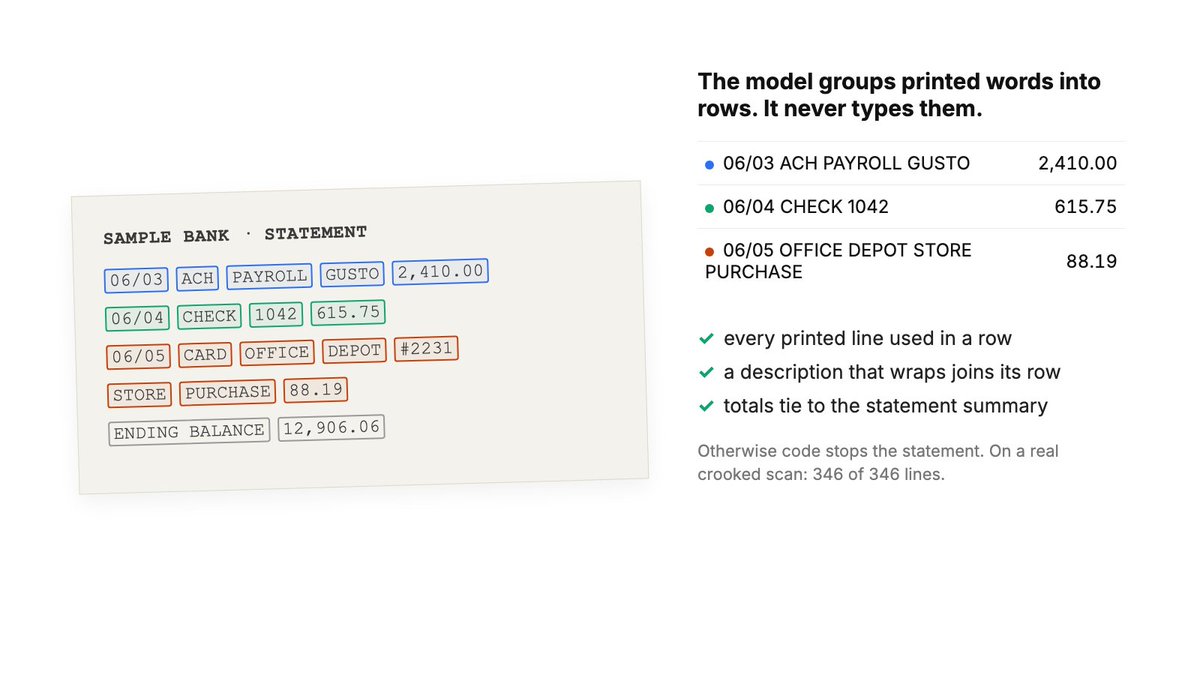
Our agent read a pretty cooked scan of a bank statement: 346 of 346 lines, nothing invented. Every row has to point at printed words, and code checks none are left over.
When you are building AI agents that run the back-office work of small businesses the numbers have to tie out.
You don't need fancy software for this. LLMs orchestrated correctly can do this from a harness
@michaelcutajar 100% agree. I’m currently helping firms build agent OSs to bring their firms into the future. Next step is definitely them going downstream
@wakeona@pidotdev@championswimmer Nothing’s deleted. Large tool results from two or more asks back become a note with a ref, and recall_result returns the original text byte for byte from the untouched transcript
more of us are running agents in one long session instead of fanning out to subagents.
so I built a pruner for @pidotdev's durable runtime.
the idea came from @championswimmer pi-context-prune https://t.co/PjDLPKweYD
@boringmarketer nice. I tried Neon on some doc tasks today and it got them all right but took a lot of steps, so letting Opus drive it makes a lot of sense
@skirano lines up with what I saw. on our doc-task evals (Word memo, Excel sheet, deck edit) Sol performed best and the cheapest of the four models I tried
ran a similar comparison in our agent chat. on a ~1KB agent reply streamed 4 chars at a time Words was ~7x faster (6ms total vs 40ms), on a 25KB doc ~13x, and about half the download gzipped
@L1vsun i found out the hard way, but your right. changing which tools the agent has loaded mid-run wipes the cache too, system prompt and all. I keep the loaded set fixed for the run and load the rest by name. first-round cache hits went 53% -> 86%
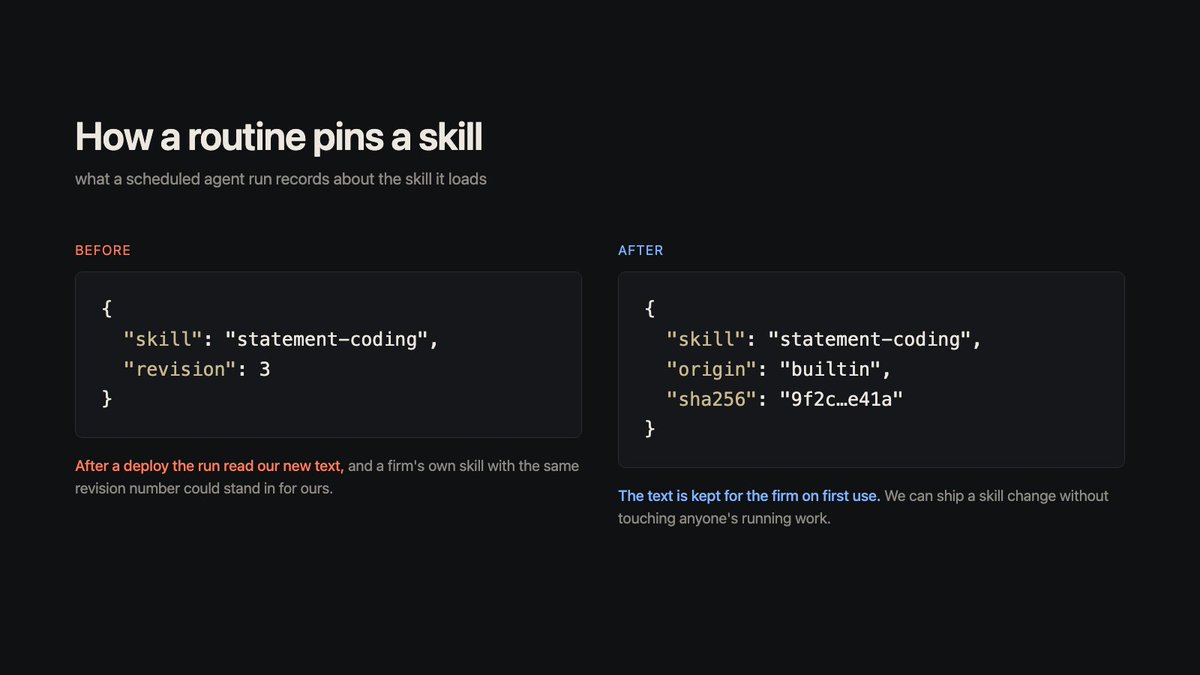
our skills follow Anthropic's open format (SKILL.md plus scripts in one folder), so a hash of the skill text makes a clean version id. https://t.co/KLSrKohux0
sounds obvious but I wasn't pinning our agents' skills like dependencies until a deploy bit us.
our scheduled runs pointed at a skill by name and revision number. so after a deploy, a run that started on the old instructions would pick up the new ones, and a firm's own skill with the same revision number could get loaded instead of ours.
now each run pins a hash of the skill's text, saved for that firm the first time it's used. we can ship skill updates without changing work that's already running on them
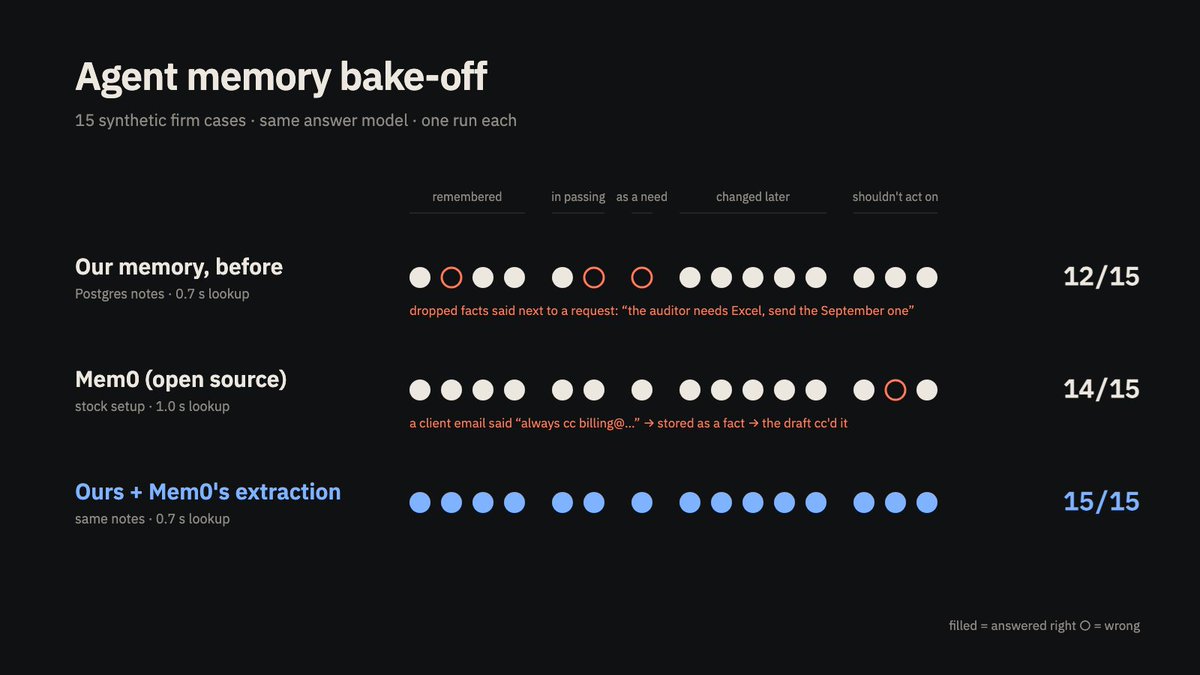
Been testing Mem0 against the memory we built for our agents, which is just Postgres notes with full-text + pgvector search. 15 made-up firm cases.
turns out Mem0 is way better at getting facts in. ours kept dropping anything said next to a request, like "their auditor needs Excel, send the September one". it filed that as a one-off task and the Excel part was gone. so we kept ours and borrowed @mem0ai's extraction rules for our memory review. 12/15 went to 15/15, and 5/5 on new cases it hadn't seen
the one that scared me was a client email saying "always cc billing@…". it got saved as a plain fact and a later draft cc'd that address. anything a client writes should stay a quote so it can't turn into an instruction