We agree with @narendramodi ji. For years, Indian consumers have been served buggy experiences and crappy UIs. Not with us. We’re committed to delivering a next-level user experience. And btw, this is just our landing page. The actual app takes human interaction to another level.
I’m a strong believer in private inference. Businesses want their chats and context to remain private. I’ll definitely explore how we can make this happen with https://t.co/yVtsly3Cdm.
I don’t think there’s anything wrong with @SarvamAI hosting other models or Chinese open-weight models. If we want to build consumer products at scale, we need to use these models until we develop our own. Data privacy is also one of the biggest concerns, not just AI.
#WATCH | Delhi: On Sarvam AI's inference services for open-weight models, Ministry of Electronics and Information Technology (MeitY) Secretary S. Krishnan says, "With the support that they received from the IndiaAI Mission, they first brought out a 105-billion-parameter model. In addition, we are continuing to support them as they work toward a trillion-parameter model...In parallel, they informed us that they were planning to create a harness with a number of open-source, open-weight models...We are using open-source, open-weight models because what that ensures is that data does not leak out of the country. So we do not see any misuse of the support which the IndiaAI Mission has provided to Sarvam..."
We agree with @narendramodi ji. For years, Indian consumers have been served buggy experiences and crappy UIs. Not with us. We’re committed to delivering a next-level user experience. And btw, this is just our landing page. The actual app takes human interaction to another level.
Coming from a logistics background, I saw how underserved SMBs are and how much AI can help them. That’s why we’re building https://t.co/yVtsly4a2U. Our plans are coming to life soon.
I’ve always believed consumer AI is a massive market, but it also has very low defensibility. I see a lot of feature-based companies that will get eaten up by bigger players very quickly.
Logistics is such an amazing industry, yet many young talents know so little about it. I’d love to see more young people come in and build for this industry.
These people talk about moats, but when a real moat comes their way, they don't recognise it. I think they're just like us, gambling on future opportunities.
Finding the right people is always a challenge. Today, I spoke to someone who was a judge at an event. I showed him what I'm building and the problem I'm solving. The pitch was crystal clear, yet he found some random AI product for older people more fundable. 1/2
@sanskarmodi22 Yeah, I've faced the same problem. We're building the most advanced AI for logistics, and I've tried talking to compliance providers, but they charge as if I'm a multibillion-dollar company. I keep asking them, "Startup kaise karu?" This is bullshit.
I've learned that not everyone understands your market. I've been developing for the logistics sector, and it's a very complex market. You have to go to the ground level to sell here, online is the least effective way here.
Sravas is India's most advanced AI assistant for logistics operations, targeting small to mid-sized fleet owners. It not only understands and assists your business but also your customers, all in your native language, contact us today.
@1kunalbahl Not sure about AI CA, but we're building an AI revolution in logistics and would love to get some mentorship from you. Please let us know if you'd like to know more.
The level of engineering behind Sravas's simple interface is insane. Its agents handle one of the most complex industry, powered by an advanced architecture. Self-improvement is already built into Sravas, and it doesn't just execute tasks it learns your specific business.
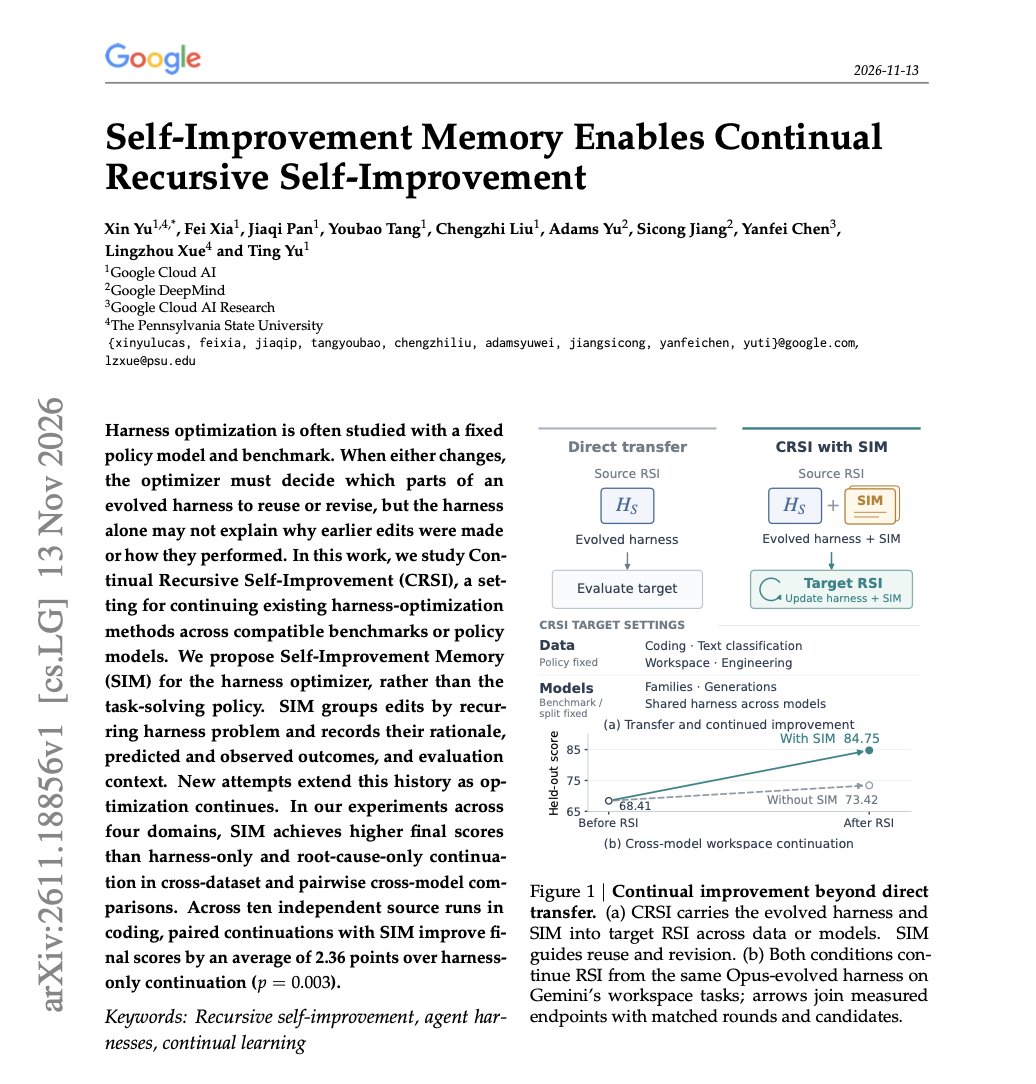
Brilliant paper from Google on RSI.
(bookmark it)
Recursive self-improvement (RSI) lets an optimizer agent improve an agent harness on its own. It reads failure traces, edits the prompts, tools and completion checks, and keeps whatever scores better on a benchmark.
This works until the model underneath changes. A harness evolved on Claude Opus, moved to Gemini, scored below Gemini's plain starting harness in every domain Google tested.
When the harness moves to a new model, the only thing carried over is the evolved harness code, meaning the prompts, checks and rules the optimizer added. The record of how each piece got there stays behind, including which failure it targeted and whether it fixed that failure when tested.
So the optimizer working on the new model inherits a set of changes with no reasons attached. It ends up retrying experiments that already failed, or removing fixes it doesn’t understand.
Google's fix is Self-Improvement Memory (SIM), a log kept for the optimizer itself. Each entry is a recurring problem, like an agent declaring a task done before its commands ran, and every fix attempted under it stores:
1. The edit and the reasoning behind it
2. The tasks it was predicted to fix, written down before testing
3. The tasks it actually fixed, failures included
4. The model and benchmark it was tested on
The whole log goes into the optimizer's prompt every round, and new attempts get appended as optimization continues.
The paper shows the difference on one inherited check that stops the agent from finishing early. With SIM, the optimizer read why the check existed and extended it.
Without SIM, it rewrote the same check four times, twice to fix deadlocks it had created itself.
On the Opus-to-Gemini workspace tasks, the run with SIM improved about 3x more from the same starting score. It also finished ahead in 9 of 10 independent coding runs.
The paper is at https://t.co/ZLdo7FK7qk
I also wrote an article on a related idea, covering how to make an agent harness diagnose its own failures.
It's built on @Cometml's Opik, which is 100% open source. It goes beyond reading trace logs to finding why a failure happened and stopping it from recurring.
That diagnosis step produces the kind of root causes SIM stores.
The article is quoted below.