I ran my first SQL command on Dune and created my first dashboard for PUMPSWAP ANALYSIS🏆
https://t.co/7fZmxLUUb6
Thanks to @cryptall3 for the blockchain analysis class, thanks to @SamuelXeus and @TheNirvanAcad for Koinophobia
I started the Web3 journey this year
#HeyGenVideoContest
600 years of avoiding the sun. Dracula is finally on vacation and Alfred has completely lost the plot.🧛♂️☀️
DAYBORN™ - Making daylight a lifestyle since 1476.
Made with HeyGen Video 1.0 via MCP. @HeyGenMCP#AIFilmmaking#Dracula
My mind is a very wild place cause how I do randomly just think of stuffs like this, even after seeing this image you can't accurately say what the video would really be about... new video drops today #aigenerated
United Senior & Ayangburen senior High School, lkorodu 10th Nov ✅ .
Agnus Memorial Memorial High school - 11th Nov ✅
Ojota senior secondary school - 17th Nov ✅
Ogudu Senior Grammar school - 17th Nov✅
Ipakodo senior grammar school - 18th Nov ✅
5/7 schools done.
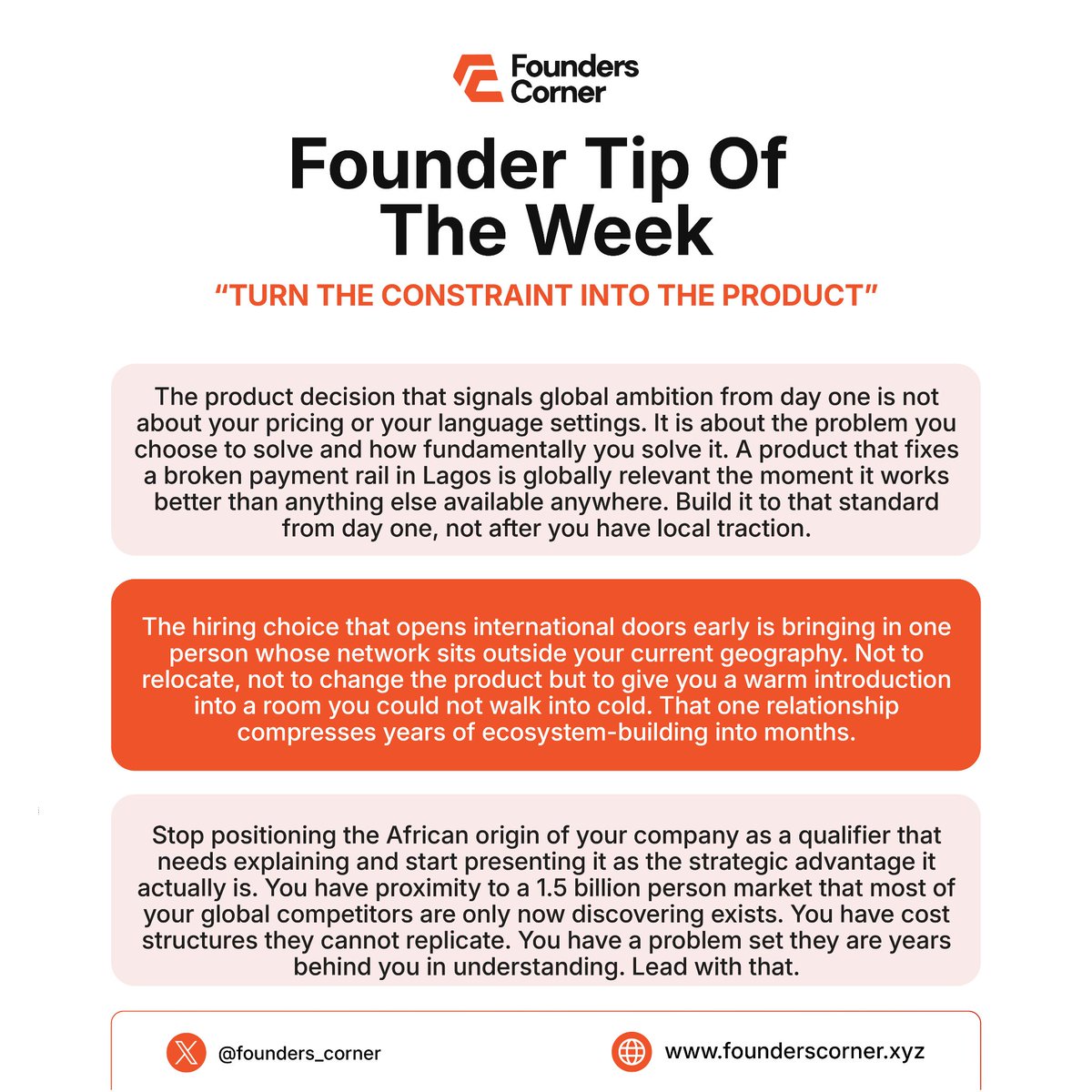
Building an African solution for an African problem is a noble starting point. But when you limit your Total Addressable Market (TAM) strictly to local zip codes, that is a fast track to capping your operational ceiling.
Those founders who have built the continent’s most resilient category-defining companies made a critical architectural choice at early stage: they designed for global scale from the very first line of code, even when their initial launch was confined to a single neighborhood in Lagos or Nairobi.
The trap is not to solve a hyper-local pain point but to build localized technology that cannot easily be exported.
When you adopt a global-from-day-one orientation, every operational decision instantly changes:
➾ You architect for cross-border interoperability: Instead of hacking together a localized database that breaks at the first land border, you build modular infrastructure that is capable of handling multi-currency routing, international regulatory compliance, and cross-border API integrations automatically.
➾ You set pricing to global benchmarks: If your unit economics only make sense when subsidized by hyper-cheap local labor or low operating costs, your business model is fragile. Build pricing structures that capture margin in hard currency from day one.
➾ You hire for borderless execution: You don't just recruit people who know how to navigate the local market, you build team operations, documentation, and engineering standards that allow you to attract talent and execute pilots anywhere in the world.
When you solve an African problem, it gives you a massive high-friction proving ground. But if your software, governance, and business model cannot be deployed in Latin America, Southeast Asia, or Europe, you are leaving massive enterprise value on the table.
You need to build locally to be able solve the immediate operational pain, but engineer globally so the entire world can eventually run on your rails.
🔥 THE HANDS OF WAR | Official AI Movie Trailer
Two brothers. Two ancient weapons. A forgotten war between humanity and the gods.
And something far worse is awakening.
Would you watch this movie? ⚔️
Created for the AKOOL AI Film Challenge - COMING NEVER.
@AkoolInc
#AKOOLClash #AKOOLFilmChallenge #AIVideo #AIFilm
Broken payment infrastructure across fragmented borders looked like an impossible financial wall until it became @theflutterwave. Unreliable offline freight logistics across East Africa looked like a money pit until it became @lorisystems. A vast pool of brilliant invisible software talent with zero access to global tech hubs looked like a structural dead end until it became @Andela.
There is a clear consistent pattern driving the most valuable companies across the continent, and this: the best African founders don't complain about infrastructure gaps, and they don't wait for governments to fix them. They
turn the gap itself into the product.
In mature markets, founders often focus on marginal convenience like; building apps that deliver groceries three minutes faster or optimize digital ad spend by half a percent. In emerging markets, you don't have the luxury of building for marginal convenience. You build out of necessity.
When you encounter a massive operational bottleneck, you have two choices: either view it as an insurmountable wall, or realize that whoever builds the bridge gets to collect the toll for the next thirty years.
Developing this lens requires three mental shifts:
➠ Stop looking for "clean" markets: The messiest, most chaotic operational environments hold the highest
concentration of trapped value.
➠ Build the foundation first: If the underlying rails don't exist, whether for payments, identity verification, or last-mile deliver, then build them as proprietary infrastructure and license
them to everyone else.
➠ Reframe friction as defensibility: A problem that is painful to solve is an automatic moat. The harder it is to build the initial solution, the harder it will be for a well-funded competitor to copy you.
An infrastructure gap is not a sign to turn back. It is a blueprint for a category-defining business.
The successful founders are not the ones looking for smooth roads but the ones who build the pavement and own the highway.
AI-film creators should learn how to ride with the trend.
Trending narrative is a huge factor to capitalize on when you're looking for visibility. When you create clips around trends, the audience easily relate to what they are watching, especially when the edit, character sytle and dialogue is good!