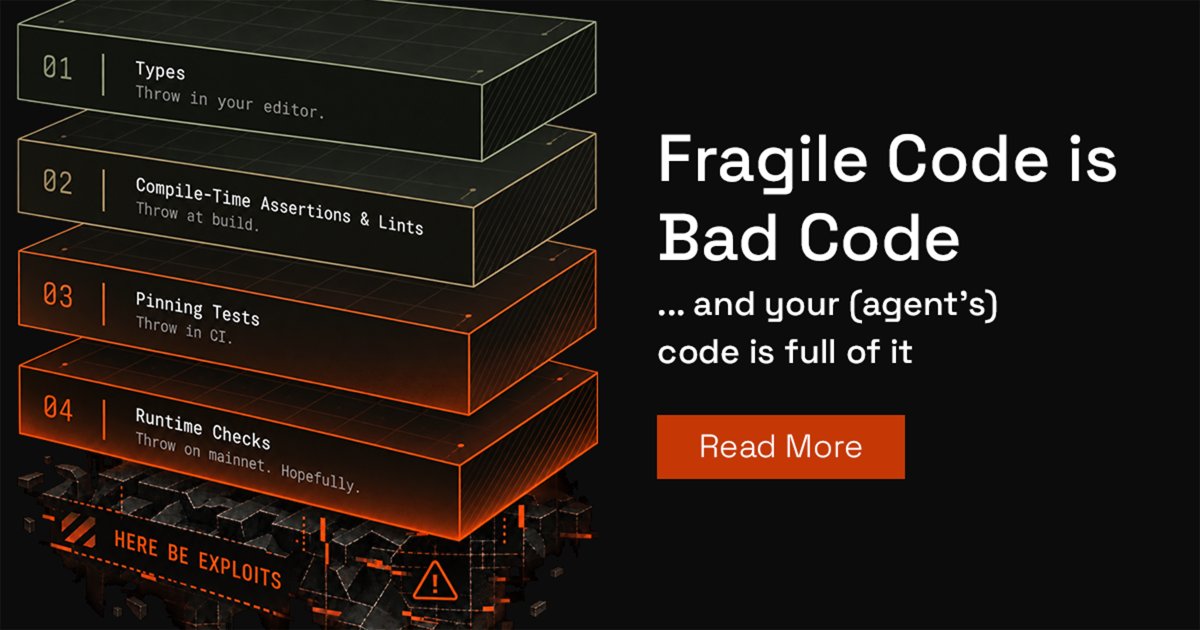
Most Solana programs are one typo - or one agent mistake - away from disaster.
Security pros warned us 5 years ago to not do this, but everybody does it. Examples do it. Agents do it. Auditors clear it. Millions drain.
fn withdraw(...) -> Result {
if record.owner != *user.key {
return Err(IllegalOwner);
}
if amount > record.quote {
return Err(InsufficientFunds);
}
// more `if`s here - hope we have enough!
record.quote -= amount;
transfer_out(destination, amount)
}
For both safety and performance, it's time to learn from decades of critical systems engineering, embrace the strength of Rust, and "Parse, Don't Validate." Runtime checks don't belong in a program's internals. They belong at the boundaries.
Read Here 👉 👉 https://t.co/KgqLDnjSzt
Prediction:
2027 Solana will have a breakout perps protocol.
The tech is there and will only improve moving forward. The differentiator is go-to-market strategy and distribution to get quality traders. It’s the only thing stopping it at this point, and so far no one on Solana has nailed it.
@uriklarman Block building is a great entry for new teams. I just want them all to eventually move up the stack. Build markets and front ends. Thats where the revenues are.
Why Build On Solana?
Last week, at a few conference side events, multiple people brought up the on-chain cost of running a heavy, compute-intensive application like a PerpDex on @solana.
It was always phrased as if running your application on Solana was basically not worth it, extractive by the chain or merely a marketing play.
The L2 and corpo-chain narratives have unfortunately muddied the water here and I think a stronger re-invigoration of the messages around real ‘DeFi’ is necessary; a clear and clean call. Let me try.
The chain fees paid by application developers, operators and users are not ‘wasted’; we are paying for and receiving a service.
Firstly, we are paying for compute à la AWS; we publish a program which is executable on a VM that at some point in the stack runs on real hardware someone has to maintain; computers, networking infra and more. That’s just the beginning, and with centralized computing it’s ‘cheap’ because you’re trusting whoever runs it.
Secondly, and mainly, we are paying for consensus and security of the state the computer operates on. At the time of writing, the state of the network is secured by staked SOL valued at 65 billion USD (take 1/3 or 2/3 of that depending on whether you’re talking about halting or finalizing).
If decentralization and verifiability are goals, you need a credibly decentralized, high-stake-TVL chain. How much do you think that will cost you? What do you think the developers, devops, computers and seed capital will cost you to build an L1 and start a network? At the very least a few million a year, with far less stake valuation, high start-up costs, and a massive distraction.
Now, you are no longer building your application and all the domain-specific aspects of it; you are now bogged down building a chain stack, from code, to infra, to marketing and BD.
Just use Solana.