If you have a business and are trying to figure out EU regulations like GDPR, AI act or PPWR, shoot me a message and we'll work together to get you compliant!
@Ekaeoq Any LLM should be able to do this, eg ChatGPT, especially in the Work mode, you shouldn’t even have to copy anything it can browse course websites etc for you
@MarioSaputra Definitely an issue with Mac and iOS, I have the same issue on my Mac mini, but it’s a desktop so I can have an external drive without it being annoying
3 GDPR privacy policy mistakes I commonly see in the wild:
- the data controller isn’t identified (often legal entity is missing)
- not mentioning the right to complain to a supervisory authority
- not stating the purpose and legal basis for each type of processing
US company selling into Europe?
If you’re trying to figure out GDPR, the EU AI Act or the new EU packaging rules (PPWR), shoot me a DM.
I’ll help you get and stay compliant so you can focus on growing your business.
How is it that a language course can teach advanced vocabulary while leaving learners unable to express surprisingly basic ideas?
When designing a language course, two essential decisions are what to teach and in what order. This applies whether you are planning individual lessons, writing a textbook, or building a language-learning app. Vocabulary frequency and thematic groupings can help, but neither automatically produces a well-rounded conversational foundation.
When I look at existing courses, I always find glaring gaps in everyday expressive vocabulary. Some courses introduce specialized words for discussing politics or science while overlooking meanings needed in ordinary conversation. Beginner lessons, meanwhile, can devote considerable attention to lists of fruits, animals, or furniture before learners have the tools to explain a simple thought. Almost any course will teach “good.” But will it explicitly teach how to say that someone is “good at” something?
Years ago, I completed a first draft of a “Master”: a collection of ideas and concepts selected to form a broadly useful foundation for everyday communication. I then adapted it to French, arriving at roughly 2,500 words. The intended foundation includes the relevant uses of those words and the grammatical patterns needed to put them together.
I developed the Master through years of close attention to language in daily life. During particularly intense periods, I would note every word or expression that caught my attention, check whether its meaning was already covered, and consider whether it represented a common need or could be expressed adequately in simpler terms. My knowledge of several languages helped me compare different ways of expressing the same idea and identify gaps that might be less apparent from the perspective of one language alone.
Although the Master is mostly written in English, adapting it requires more than translating English words. The starting point is the situation and the meaning a speaker wants to convey.
Consider “warm.” We might be describing the temperature around us, how we personally feel, something that is warm to the touch, or a jacket that keeps us warm. We might also want to talk about warming ourselves or heating something up. These related meanings need to be considered individually: another language may distribute them across different words and constructions.
Looking across languages can also reveal useful expressions that a translation-led approach might overlook. The Swedish verb hinna, for example, covers situations expressed in English with phrases such as “make it in time” or “have time to do something.” Translating “have time” directly might lead to Swedish ha tid, a valid expression, while missing situations where hinna is the natural choice.
For most languages, I would expect 2,000 - 3,000 words to make it through final selection. These words then need to be put in a progression, based mainly on the usefulness of the words.
“To say” is one of a small set of foundational verbs in the Master. Many more specific verbs describe aspects of saying something: whispering, shouting, lying, or complaining. Those verbs belong in the curriculum, but they do not all need to be introduced at the beginning. Early on, being able to construct a sentence such as “what he is saying is not true” can be more useful than knowing another isolated verb. The patterns in that sentence let a learner express many other thoughts as well.
The Master assigns rough levels to concepts. Those levels are then adjusted during adaptation, taking account of how the particular language expresses them.
Another guiding principle is to give learners dependable choices for their own speech. For a familiar situation, the curriculum should recommend a broadly useful expression. Learners can practice “thank you” and “you’re welcome” without first choosing among numerous alternatives. Similarly, “good” and “great” provide useful starting points without requiring simultaneous mastery of “awesome,” “amazing,” “incredible,” and “fantastic.”
Understanding other speakers requires a wider range of recognition. An adaptation therefore distinguishes recommended expressions for active use from additional forms worth learning to understand. In French, I would prioritize la police (the police) and un policier (police officer) for active use, while including flic (cop) as an informal alternative for recognition. Its presence in speech and films can justify teaching learners to recognize it without making it their default choice.
Related word forms require similar judgment. Depending on the language, an adjective such as “important” may deserve active attention before a noun such as “importance.” Some derived forms can be understood through their roots and context without receiving equal teaching time. These decisions must ultimately be guided by natural usage in the target language.
The scope is deliberately selective. A conversational foundation cannot anticipate every learner’s interests, circumstances, or specialized knowledge. Someone interested in politics will need additional vocabulary for political systems and policies; someone reading fiction will encounter a substantial vocabulary of narration and description. Local institutions introduce further needs: terminology for school grades in France may matter greatly to a parent living there, while having little relevance to another learner of French.
Even apparently simple categories raise difficult questions. Should the shared foundation include gold, silver, diamond, brick, or cement? Each inclusion needs to justify its place; including one material does not require teaching the whole category. The aim is to keep the shared foundation manageable while leaving room for individual and local needs.
A learner with this foundation will still encounter unfamiliar words and sometimes express an idea awkwardly. The curriculum should explicitly prepare them for that. Expressions such as “the thing that…,” “one of them,” or “he went like this with his hands” help people explain, demonstrate, and refer to things they cannot yet name precisely. Asking what something means, or how to say it, is itself an essential conversational skill.
The Master remains a work in progress. I still have thousands of manually collected notes to review, including duplicates and potential additions, and the boundaries will continue to require judgment.
The goal is a manageable, adaptable foundation that helps learners express a broad range of everyday meanings, understand common alternatives, and use conversation itself to keep learning.
I’m interested in connecting with people working on language-learning products, curriculum design, and AI-supported education to explore how this work could contribute to their projects. If that overlaps with your work, I’d welcome a conversation.
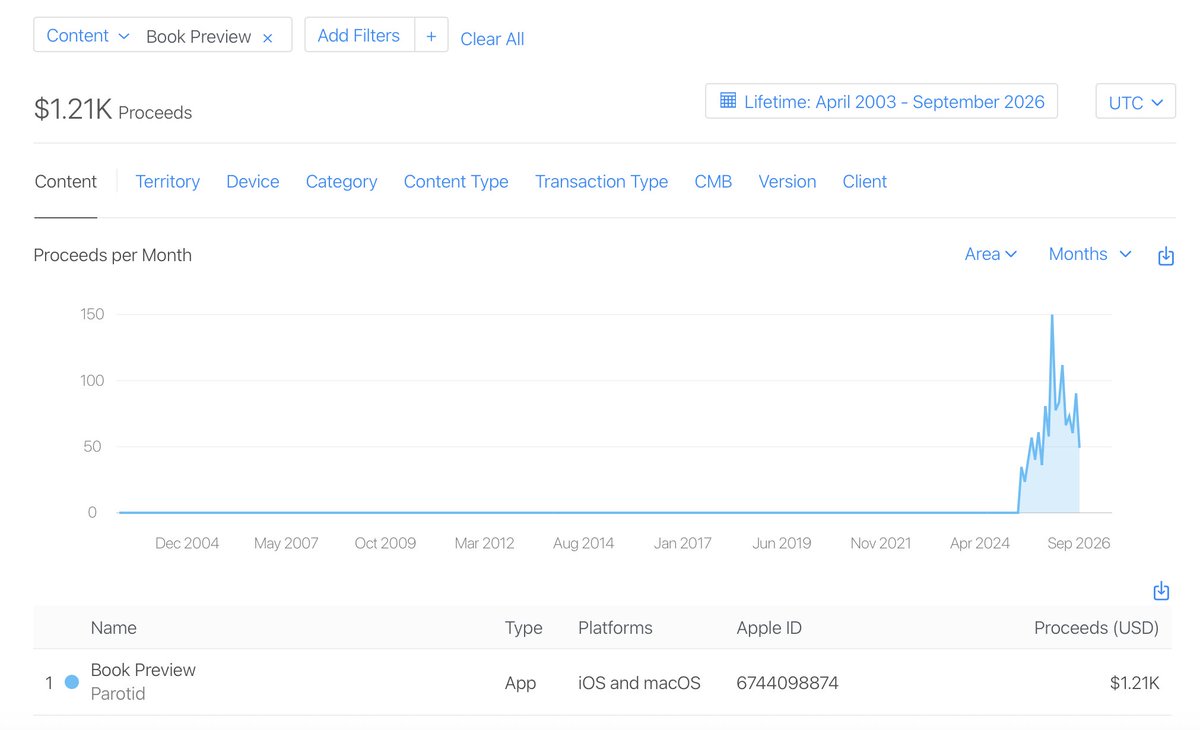
Not all apps have to be a crazy success.
One of my apps on the App Store has made $1.21K in proceeds in the last year. Not life changing, but enough to cover the Apple Developer fee!
Grateful for everyone who have found enough value in my app to be willing to pay for it.