Both inhibitory and activating KIRs recognize RIFINs: a dual-edged mechanism of NK cell control in malaria
@sigtrans_sttt@angelica_cuapio
https://t.co/7plS2S0f8r
comment on @Nature
https://t.co/h6zI4cj9BX
Delighted to share the final version of Richard Zhou's study on how the CD163 scavenger receptor cleans up after toxic haemoglobin spills out from our blood cells. An amazing grabber mechanism!
https://t.co/T4hjaHnedb
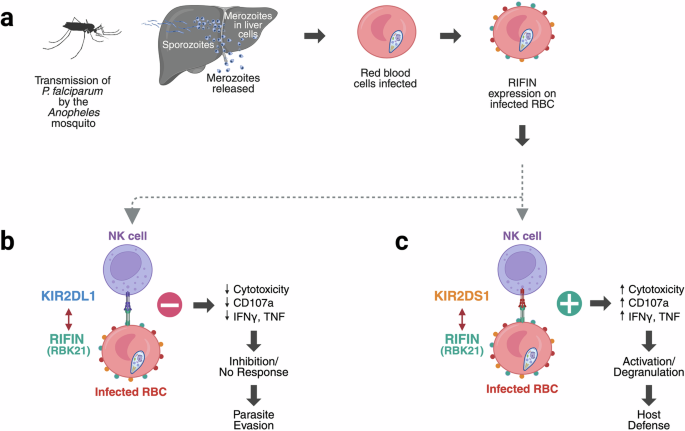
🎮 Researchers demonstrated that activating killer immunoglobulin-like receptors can recruit NK cells to target a pathogen and reveal a potential role for activating immune receptors in controlling #malaria infection.
@Nature | https://t.co/lXmtZMSLmt
Read about a fascinating evolutionary battle between the malaria parasite and the human host in our new pre-print below!
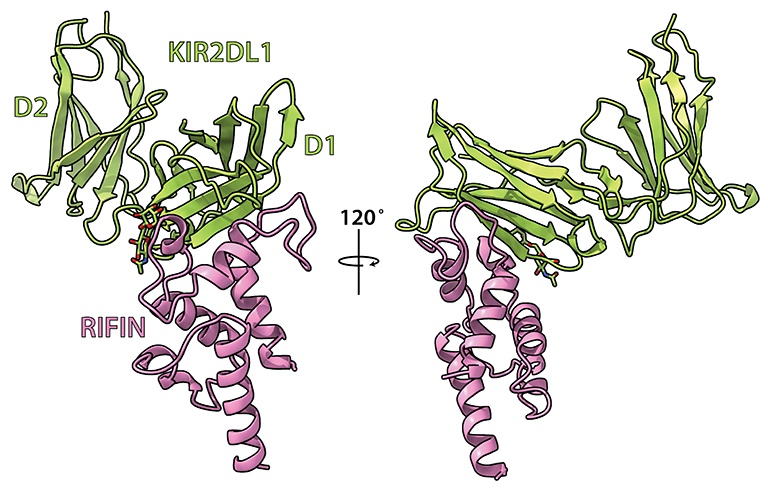
Parasites have evolved to bind to inhibitory immune receptor KIR2DL1 while the host has a counter-offensive trick up its sleeve...
https://t.co/7AFWrVB3nP
Our latest preprint reveals an amazing evolutionary battle between malaria parasite and human. The parasite evolved RIFINs to bind to inhibitory KIR receptors and suppress immune cell function while humans evolved activating KIR receptors to bind these RIFINs to kill parasites!