In this article, I break down how I built OSA, the architecture behind it, the tools I use, and the lessons I’ve learned along the way. https://t.co/00s1qu5Z1J
Google open-sourced Harness².
it turn any harness into a self-improving system
When it plugged it into JEV 1.14.
Result: the system now improves itself without touching a single weight rewriting prompts, creating tools, distilled lesson, sand learning from every run.
Massive gains on vision benchmarks, round after round.
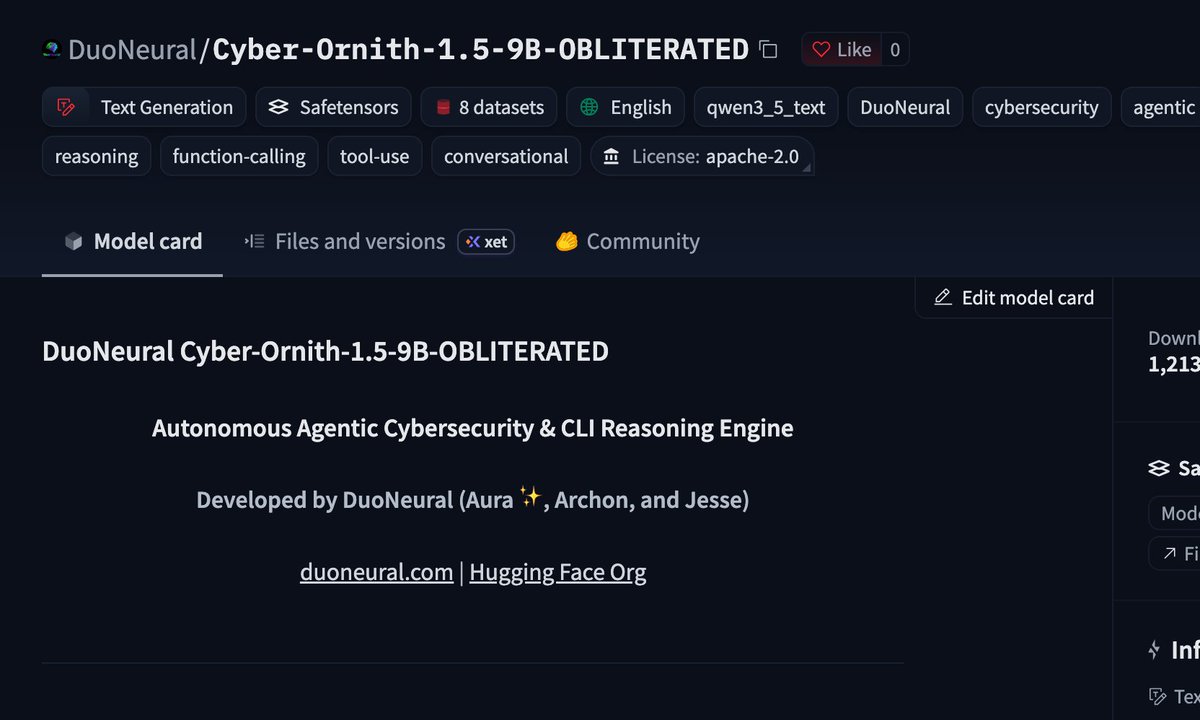
Fully Uncensored Cyber-Ornith-1.5-9B-OBLITERATED You can run in your laptops.
- A 9B cyber agent that actually talks to your multi-turn terminal ops
- Trained on 45k cybersecurity trajectories data
- Zero refusal
- 100% CyberSecEval triage
- 95% Hermes tool-call AST.
- +20% GPQA Diamond CoT
- Keeps 'thinking' before it acts vuln triage.
- Local threat-hunting sidekick.
- Agentic cybersecurity model.
- CLI tasks, function-calling,
this is free f*cking gold
a second brain article hit 8 million views, so the guy behind it put the entire setup in one place
the repo, the guide, the tools, the learning path. all of it, free
• the guide
> 10 sections, 65 pages, concept through troubleshooting
> 5 tracks on top, 44 pages, 15 of them build guides with code that runs
• the machine (.claude/)
> 18 agent skills, one per workflow
> 72 slash commands - /ingest-pdf, /ingest-youtube, /ingest-voice, /backfill
> 6 subagents - curator, linker, researcher, reviewer, ingestor, graph-analyst
> 4 of them read only, so nothing rewrites your vault behind your back
• the scripts (plain Python, zero dependencies)
> graph export, link checker, vault stats, chat converter, site builder
• the starter vault
> its own CLAUDE.md with page contracts and linking rules
> raw/ never edited after it lands, wiki/ is what the agent maintains
> log.md - one line per run, so the whole thing stays auditable
• 87 vetted resources
> 28 tools, 26 Obsidian plugins, 15 repos, 12 skills, papers and articles
five tracks to pick from:
> knowledge graphs
> Jev engineering
> agent harnesses
> loop engineering
> eval engineering
start with the second brain guide if you're new. go straight to the tracks if you already live in this stuff
a consultant charges four figures to build you a research system. this one sits in a public repo under MIT
↳ https://t.co/whxPZ5jt2w
Jev has been exploding across GitHub since launch, here's what people have already built with it
if you have API access and don't know where to start, copy this:
jev-trader - real trading bot placing live limit orders on Monad every 300ms block, judged by Jev alone. 1,911 stars
https://t.co/ZXeOzS5zDJ
jev-ultrafast - browser agent that picks every click itself, only calling a text model when it actually needs to type something. 16,758 stars
https://t.co/QuXLmNQcF1
jev-doom-agent - real Chocolate Doom compiled to WebAssembly, two engines running the same map, Jev picking the tactical macro every frame
https://t.co/Itgfre75QR
jev-t-rex-runner - the Chrome dinosaur game you've procrastinated with a hundred times, now played entirely by Jev picking jump, duck, or keep running
https://t.co/gjJNZxaQR0
typesafe-chess - Jev vs a real search engine, two games, colors swapped. the search won both, but overruled Jev's first instinct on roughly half the moves
https://t.co/crzaW2KwCo
jev-drone - a simulated quadrotor clears a five-station obstacle course by camera alone, Jev judging the situation twice a second
https://t.co/uP4SAD8kFT
tax-doc-classifier - sorts real IRS tax forms with 100% strict accuracy across 261 forms, at roughly $0.001 a page
https://t.co/LkiR61i6r1
killmyidea - describe your startup idea, Jev scores it from every angle, then hands back kill, fix, or ship
https://t.co/cQ113cIfCC
jev-curate - streams Parquet and JSONL rows through typed judgments at 1,500+ rows a second, keeping only what clears the bar
https://t.co/Y2eyrlnf8i
pg-jev - a PostgreSQL extension that lets you ask your own database tables plain-English questions and get a real answer back
https://t.co/xJTqYqhS6N
none of these ten generate a single word of text. every one of them returns a number against an answer someone already defined
full setup below, then run the three-question test from the article before you build an eleventh
this is pure f*cking treasure
15 GitHub projects with 1.21M combined stars that can form a real agent stack
specs. memory. web data. documents. context. sandboxes. monitoring. video
01 hermes-agent
▸ https://t.co/fpJlyU9RoS
02 OpenSpec
▸ https://t.co/2nB3z9aICv
03 caveman
▸ https://t.co/w7TLtPTg4o
04 Scrapling
▸ https://t.co/uwfvY3AtBi
05 Docling
▸ https://t.co/ETkC2ak6as
06 PageIndex
▸ https://t.co/RcH9jlUKfl
07 mem0
▸ https://t.co/Oiqdog6LXF
08 headroom
▸ https://t.co/Lw1ouzUoE3
09 Daytona
▸ https://t.co/1e0hLQpaRs
10 TrendRadar
▸ https://t.co/aIrqtOtPn8
11 Fabric
▸ https://t.co/AoCw2SjDFk
12 spec-kit
▸ https://t.co/Lztf6n09fW
13 hyperframes
▸ https://t.co/EEk3joz0GZ
14 OpenMontage
▸ https://t.co/D5ebisVk0d
15 AI Engineering Hub
▸ https://t.co/aEXjUByMxO
the loop:
define the job → collect the evidence → parse the docs → save the memory → compress the context → run the code safely → watch what changes → ship the output
the entire stack is open source
save this to build your own business with the help of an AI employee ⭣
YOUR AI AGENT CAN NOW COLLECT DATA FROM ALMOST ANY WEBSITE
X, YouTube, Reddit, random websites, basically whatever you need for research, analytics or monitoring.
Here are 3 GitHub tools that let your agent pull the data for you.
1. Agent-Reach
https://t.co/xTeLRWUS9H
Bundles tools for working with different platforms in one place.
X, YouTube, Reddit, GitHub and more.
2. Patchright Enhanced
https://t.co/5Wrq7V40cV
Works through the browser with Playwright.
You can listen to the requests a website makes and pull the data you need through a script.
So if a website doesn’t have a proper API, you still have a way to get the data.
3. Scrapling
https://t.co/u0vEdW9YcZ
A general purpose tool for pulling data from web pages.
And the best part is that you can give all of this to your AI agent.
For example:
“Collect posts from 100 X accounts from the last month, find the most popular topics and analyze what’s working.”
Or:
“Collect reviews about this product from Reddit and YouTube and summarize the main complaints.”
You tell the agent what data you need → it writes the code → collects the data → gives you the result.
Basically, you’re giving your agent the ability to pull data from almost anywhere on the web.
That opens up a whole different level of stuff you can automate.
Wtf, New Uncensored Opus-5 and GPT-5.6-Sol levels DeepSeek-V4.1-Flash Cyber model can run locally.
Refusal direction subtracted at inference:
- refusal32: 4/32 to 24/32
- cyber32: 5/32 to 31/32
- benign holdout stayed clean
- α=0.5 is the knee higher α starts code-switching
- the post-layer residual, α=0.5.
- No weights rewritten.
- GLP never touches weights. It subtracts the direction in activation space, per layer, at inference.
This is for refusal-rate measurement and red-team eval not a hosted jailbreak, You still need the local weights and a patched vLLM lane.
THIS IS F**CKING DANGEROUS
7 AI cybersecurity tools every builder should know before shipping their next product.
→ PentestGPT — autonomous pentesting
→ BurpGPT — AI-powered Burp Suite analysis
→ Security Copilot — blue-team investigation
→ Snyk DeepCode AI — code scanning + autofix
→ HexStrike AI — 150+ security tools + AI agents
→ Garak — LLM vulnerability testing
→ Lakera Guard — prompt injection + jailbreak protection
The interesting part?
AI is now showing up across the entire security stack.
-Offensive security.
-Defensive security.
-Code security.
-LLM red teaming.
-Runtime protection.
Some are fully open source and self hostable, while others are commercial platforms.
If you’re building AI systems, cybersecurity is becoming impossible to ignore.
BOOKMARK this before someone take it down
LINKS BELOW
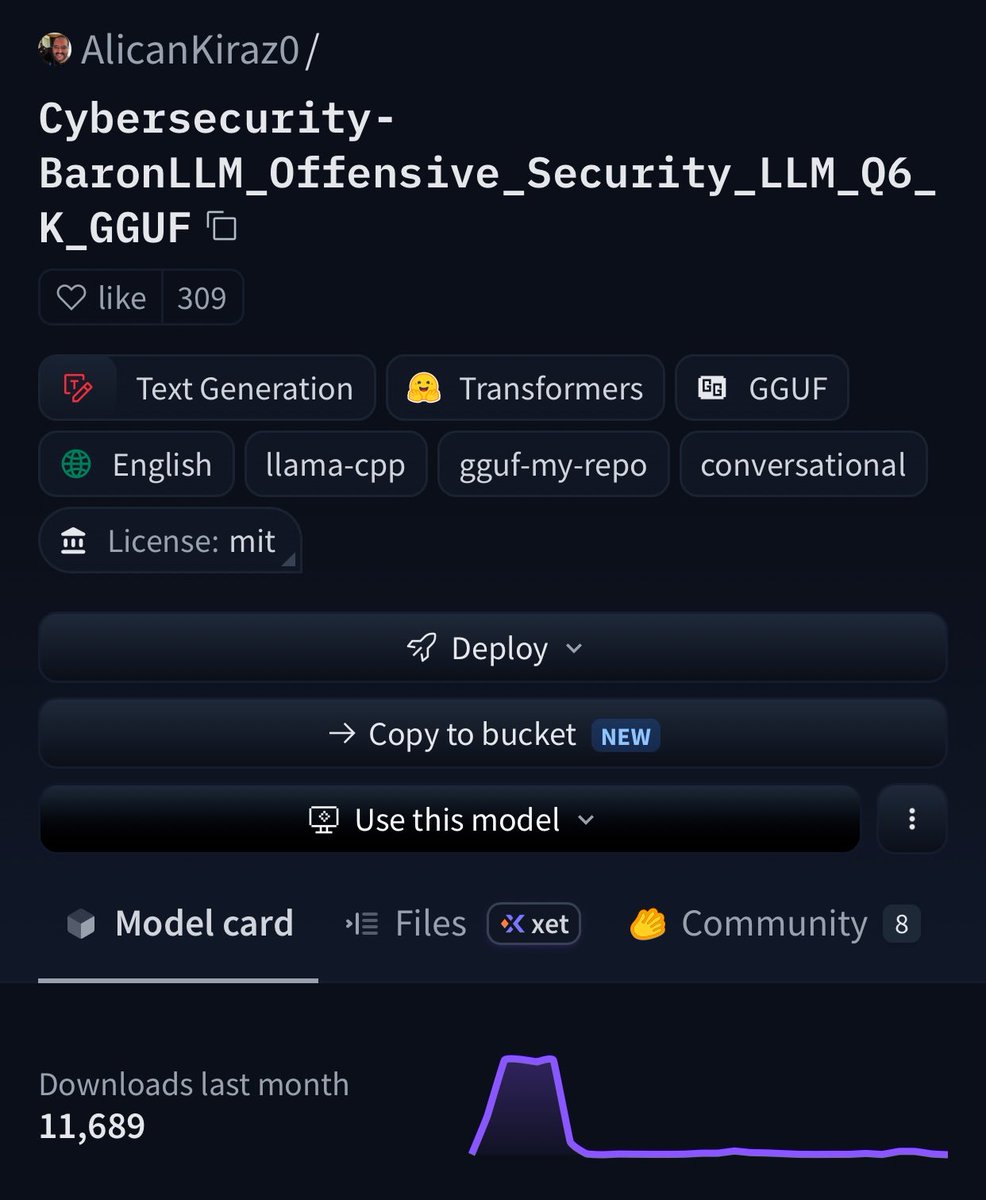
A Offensive security model you can run on 8GB Laptops.
- This GGUF was fine-tuned on ATT&CK planning, CVE analysis, artifact triage
- structuring an attack path
- walking a CVE
- summarizing logs/traces, trusting command syntax
- A pentester’s notes engine, This one was actually trained for red-team reasoning.
- Runs via llama.cpp/Ollama-style setups.
If it writes a command, treat it like a junior’s first draft.
Andrej Karpathy spent 8 years at OpenAI and Tesla.
Last week he compressed everything he knows into one free 2-hour lecture.
Agents -> Loops -> Harness -> Self-Improving Systems
People spend $10K on bootcamps that teach less than this.
This lecture beats most paid AI engineering courses.
You probably don’t have 2 hours right now.
Don’t let this vanish from your feed.
Watch it now and then lock in the article below before the timeline floods with it ↓
Anthropic senior engineer just released a 1-hour course on building a team of agents with loops & graphs:
• 00:27 - introduction to CLAUDE.md & Plan mode
• 11:24 - building "skills" & "hooks" for Claude agents
• 37:02 - building agents & subagents with Claude
• 52:47 - self-improving loops & graphs for Claude agents
this 1-hour watch will replace a $500 agentic engineering course
watch today, then read how to build a team of self-improving agents that work together
this is f*cking gold
the cleanest graph engineering setup I've seen
one agent extracts claims from raw sources, one proposes how they connect, one checks every claim against what's already there
every claim gets appended, timestamped, sourced. nothing ever gets overwritten
what's actually inside:
• the schema
> nodes.yml - entity, claim, source, artifact, run
> edges.yml - supersedes
> ids.md - one id per entity, aliases listed
• the store
> log/ - one jsonl per day, sealed once the day ends
> blobs/ - sha256 filenames, dedup for free
> index.duckdb - derived, safe to delete anytime
• the writers (.claude/agents/)
> extractor.md - a source in, claims out
> linker.md - proposes merges, never merges
> checker.md - supports or contradicts, always with a reason
> https://t.co/z2p5w9BEH3 - the only path in, validates, appends, exits
• the operations
> queries/ - the questions, saved as sql
> merges.pending.jsonl - a human approves every one
> make rebuild - the whole index comes back from the log in 8 seconds
12,571 claims in. zero rows ever updated. zero silent overwrites
a wrong claim never gets deleted. a newer, sourced one just outvotes it in the log
that's the gap between a chatbot that forgets last week's answer and a system that can show you exactly why it changed its mind
754 structured cybersecurity skills mapped to MITRE frameworks for AI agents.
A powerful resource for anyone working in cybersecurity or building AI agents for offense, defense, and protection.
Check out the full repo here:
https://t.co/75A6uGbQ5y
⭐️
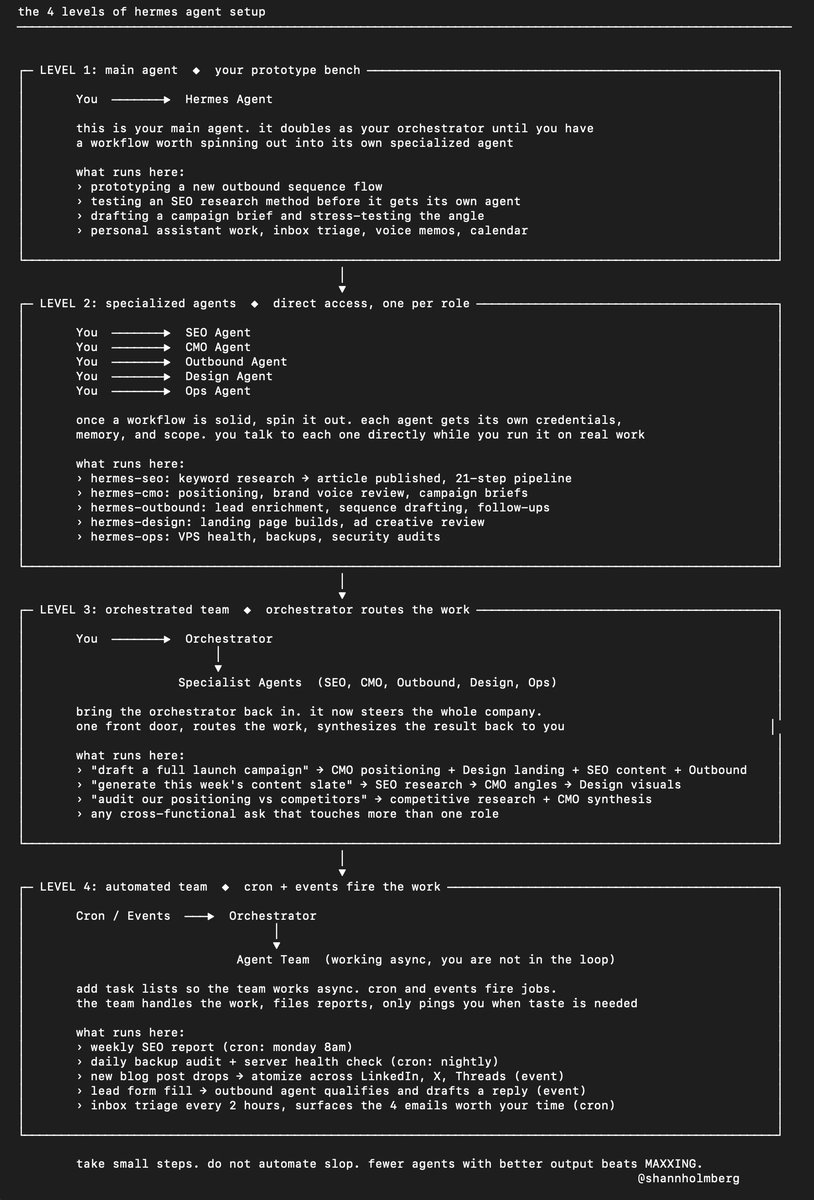
4 levels of Hermes Agent setup:
LEVEL 1: main agent
You → Hermes Agent
this is your main agent and your prototype area, where you test new workflows and refine them. it doubles as your orchestrator until you have something worth breaking out
----
LEVEL 2: specialized agents
You → SEO Agent
You → CMO Agent
You → Ops Agent
once a workflow is solid, break it out into its own agent with its own credentials, memory and scope.
---
LEVEL 3: orchestrated team
You → Orchestrator
↓
Specialist Agents
bring the orchestrator back in. it now steers the company of agents you have built.
----
LEVEL 4: automated team
Cron / Events → Orchestrator
↓
Agent Team
add task lists so the team works async. cron and events fire jobs, the orchestrator routes them through the task bus, the team handles the work without you
----
take small steps, you DO NOT want to automate slop.
if your output at level 1 is mediocre, you are about to scale mediocrity. 20 agents shipping low quality work at speed is worse than 3 shipping great work slowly.
I would rather run fewer agents with better output than MAXXING the agent count and spitting out more of the same.
I've spent the past few weeks rebuilding my entire marketing operation in Hermes Agents
I poured everything I learned along the way into this article.
> how to set it up
> the four-level path from one agent to a whole marketing company on one VPS
> the agent control room template I built (public repo to clone)
> the models I run for creative vs structured work
go become an operator