@LynAldenContact Great call Lyn. Just re-listened to this in the audiobook—perfect for this situation. And I love that you have the accompanying PDF, a lot of books don’t have that.
Everyone should know about this. In December 2021, Russia sent a peace treaty to the US essentially asking to stop the expansion of NATO eastward (which the US agreed to a long time ago but went back in their word several times) and to remove troops/military equipment away from Russia’s borders. (See link to treaty below). The US declined, in private. Two months later Russia invaded Ukraine. Russia was still wrong for doing so, but the Biden administration could have prevented the deaths of 100s of thousands of Ukrainians.
https://t.co/tgNXlZsDua
The only logical explanation is that he’s trying to suppress the price for his own benefit before Bitcoin inevitably goes higher.
From Grok:
“JP Morgan Chase has indeed invested in Bitcoin through spot Bitcoin Exchange-Traded Funds (ETFs). According to SEC filings, the bank disclosed holdings in various Bitcoin ETFs from leading asset managers such as BlackRock, Fidelity, Grayscale, and Bitwise. The total value of these investments was reported to be around $760,000 across these ETFs. This information was made public in filings with the U.S. Securities and Exchange Commission (SEC) on May 10, 2024. Additionally, posts on X have discussed this involvement, indicating that despite public skepticism from its CEO, Jamie Dimon, regarding cryptocurrencies, JP Morgan has taken steps into the crypto market through these ETFs.”
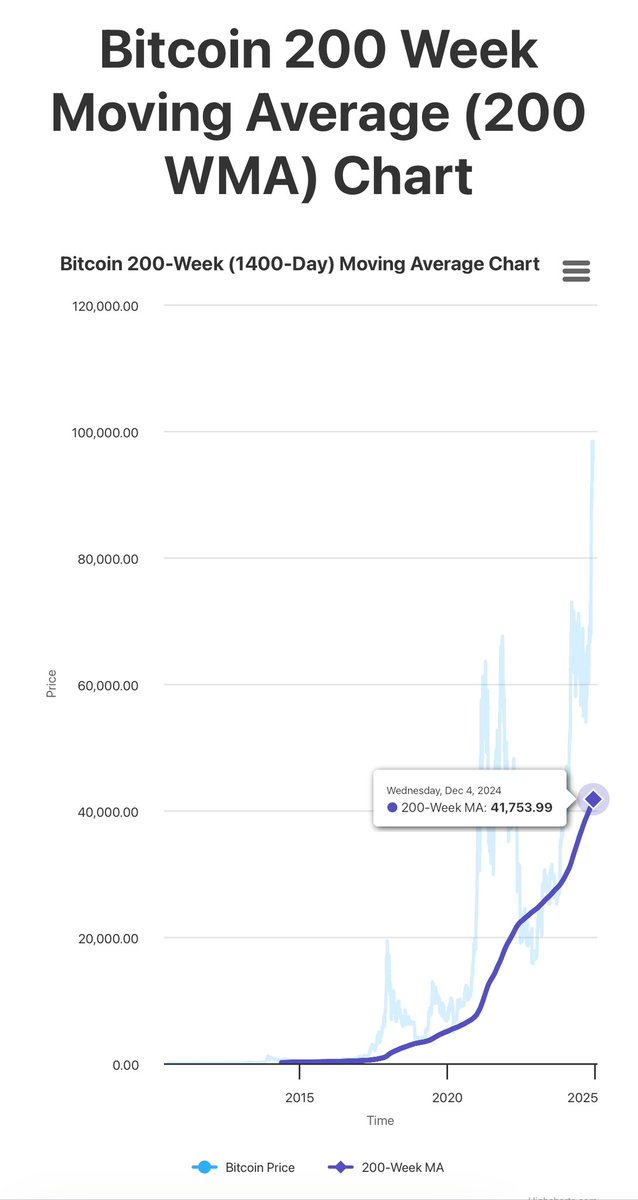
The only chart you need: Bitcoin’s 200-week (~4-year) moving average.
Money is your hard spent time and energy. Buy your freedom back.
#Bitcoin $BTC
(Chart from https://t.co/kQ46WE6wSM)
Dr. Casey Means: “I learned virtually nothing at Stanford Medical School about the tens of thousands of scientific papers that elucidate the root causes of why American health is plummeting.”
“I did not learn that for each additional serving of ultra-processed food we eat, early mortality increases by 18%.
This now makes up 67% of the foods our kids are eating. I took zero nutrition courses in medical school.
I didn’t learn that 82% of independently-funded studies show harm from processed food, while 93% of industry-sponsored studies reflect no harm.
I didn’t learn that 95% of the people who created the recent USDA food guidelines for America had significant conflicts of interest with the food industry.
I did not learn that one billion pounds of synthetic pesticides are being sprayed on our foods every single year. 99% of the farmland in the United States is sprayed with synthetic pesticides, many from China and Germany, and these invisible, tasteless chemicals are strongly linked to autism, ADHD, sex hormone disruption, thyroid disease, sperm dysfunction, Alzheimer’s, dementia, birth defects, cancer, obesity, liver dysfunction, female infertility and more.
I did not learn that the eight billion tons of plastic that have been produced just in the last 100 years … are being broken down into microplastics that are now filling our food, our water, and we are now even inhaling them in our air, and that very recent research … tells us that now about 0.5% of our brains by weight are plastic.
I didn’t learn that there are more than 80,000 toxins that have entered our food, water, air, and homes by industry, many of which are banned in Europe, and they are known to alter our gene expression, alter our microbiome composition and the lining of our gut, and disrupt our hormones.
I didn’t learn that heavy metals like aluminum and lead are present in our food, our baby formula, personal care products, our soil, and many of the mandated medications like vaccines, and that these metals are neurotoxic and inflammatory.
I didn’t learn that the average American walks a paltry 3,500 steps per day even though we know, based on science and top journals, that simply walking 7,000 steps a day slashes by 40-60% our risk of Alzheimer’s, dementia, type 2 diabetes, cancer, and obesity.
I certainly did not learn that medical error and medications are the third-leading cause of death in the US.
I didn’t learn that just five nights of sleep deprivation can induce full-blown pre-diabetes. I learned nothing about sleep, and we’re getting about 20% less sleep on average than we were 100 years ago.
I didn’t learn that American children are getting less time outdoors now than a maximum security prisoner, and on average, adults spend 93% of their time indoors, even though we know from the science that separation from sunlight destroys our circadian biology, and circadian biology dictated our cellular biology.
I didn’t learn that professional organizations that we get out practice guidelines from, like the American Diabetes Association and the American Academy of Pediatrics, have taken tens of millions of dollars from Coke, Cadbury, processed food companies and vaccine manufacturers like Moderna.
I didn’t learn that if you address these root causes that all lead to metabolic dysfunction and help patients change their food and lifestyle patterns … we could reverse the chronic disease crisis in America, save millions of lives and trillions of dollars in healthcare costs per year.
This is a spiritual crisis. We are choosing death over life, we are choosing darkness over light.
We need a return to courage. We need a return to common sense and intuition. We need a return to awe for the sheer miraculousness of our lives.
We need all hands on deck.”
Source: Sen. Ron Johnson’s Roundtable on “American Health and Nutrition: A Second Opinion”
The DNC would rather see President Trump in the WH than me. Why? Because I am even more of an anti-establishment candidate than he is. And the DNC is the establishment
@BoLoudon Finally another candidate besides RFK addressing the health crisis of this country. Might just be for voters but at least it’s being recognized.
Today we’ve formalized an important hiring policy at Scale. We hire for MEI: merit, excellence, and intelligence.
This is the email I’ve shared with our @scale_AI team.
———————————————————
MERITOCRACY AT SCALE
In the wake of our fundraise, I’ve been getting a lot of questions about talent. All of our external success—powering breakthroughs in L4 autonomy, partnering with OpenAI on RLHF going back to GPT-2, supporting the DoD and every major AI lab, and the recent $1bn financing transaction—all of it is downstream from us hiring the best people for the job. Talent is our #1 input metric.
Because of this, I spend a lot of my time on recruiting. I either personally interview every hire or sign off on every candidate packet. It’s the thing I spend the plurality of my time on, easily. But everyone can and should contribute to this effort. There are almost a thousand of us now, and it takes a lot to hire quickly while maintaining, and continuing to raise, our bar for quality.
That’s why this is the time to codify a hiring principle that I consider crucial to our success:
Scale is a meritocracy, and we must always remain one.
Hiring on merit will be a permanent policy at Scale.
It’s a big deal whenever we invite someone to join our mission, and those decisions have never been swayed by orthodoxy or virtue signaling or whatever the current thing is. I think of our guiding principle as MEI: merit, excellence, and intelligence.
That means we hire only the best person for the job, we seek out and demand excellence, and we unapologetically prefer people who are very smart.
We treat everyone as an individual. We do not unfairly stereotype, tokenize, or otherwise treat anyone as a member of a demographic group rather than as an individual.
We believe that people should be judged by the content of their character — and, as colleagues, be additionally judged by their talent, skills, and work ethic.
There is a mistaken belief that meritocracy somehow conflicts with diversity. I strongly disagree. No group has a monopoly on excellence. A hiring process based on merit will naturally yield a variety of backgrounds, perspectives, and ideas. Achieving this requires casting a wide net for talent and then objectively selecting the best, without bias in any direction. We will not pick winners and losers based on someone being the “right” or “wrong” race, gender, and so on. It should be needless to say, and yet it needs saying: doing so would be racist and sexist, not to mention illegal.
Upholding meritocracy is good for business and is the right thing to do. This approach not only results in the strongest possible team, but also ensures we’re treating our colleagues with fairness and respect.
As a result, everyone who joins Scale can be confident that they were chosen for their outstanding talent, not any other reasons.
MEI has gotten us to where we are today. And it’s the same thing that’ll get us where we’re going, as we embark on our next chapter focusing on data abundance, frontier data, and reliable measurement to accelerate the development and adoption of AI models.
Alex