How writing a microscopy essay typically goes: Do a bunch of reading. Write what I think is a good explanation. Try to explain it to my husband. Get frustrated when his questions reveal that I in fact don’t fully understand it. Go back and do a bunch more reading. Come back with a better explanation. And end with “isn’t light so amazing!”
The master biographer reflects at 91. The Robert Caro interview.
0:00:00 – How Caro gets people to talk
0:05:03 – Does America need a little more Moses today?
0:12:42 – Moses the young idealist
0:17:57 – Watching Moses lose power
0:24:01 – Did Moses realize he was changing?
0:27:53 – Building during the Great Depression
0:32:51 – The threats and promises of Lyndon Johnson
0:36:08 – Could Kennedy have passed Johnson’s laws?
0:41:00 – Getting a book down to one sentence
0:46:21 – All the material that never made it into the books
0:52:59 – Loneliness
We’re in constant battle with the squirrels to get them off our porch at home.
Also at home, 3yo has been watching an abridged version of the lion king every week (scar scenes are cut per her request).
At home this morning, walking by the porch, 3yo: “Squirrels in the pride lands!”
Our newest book is finally here!
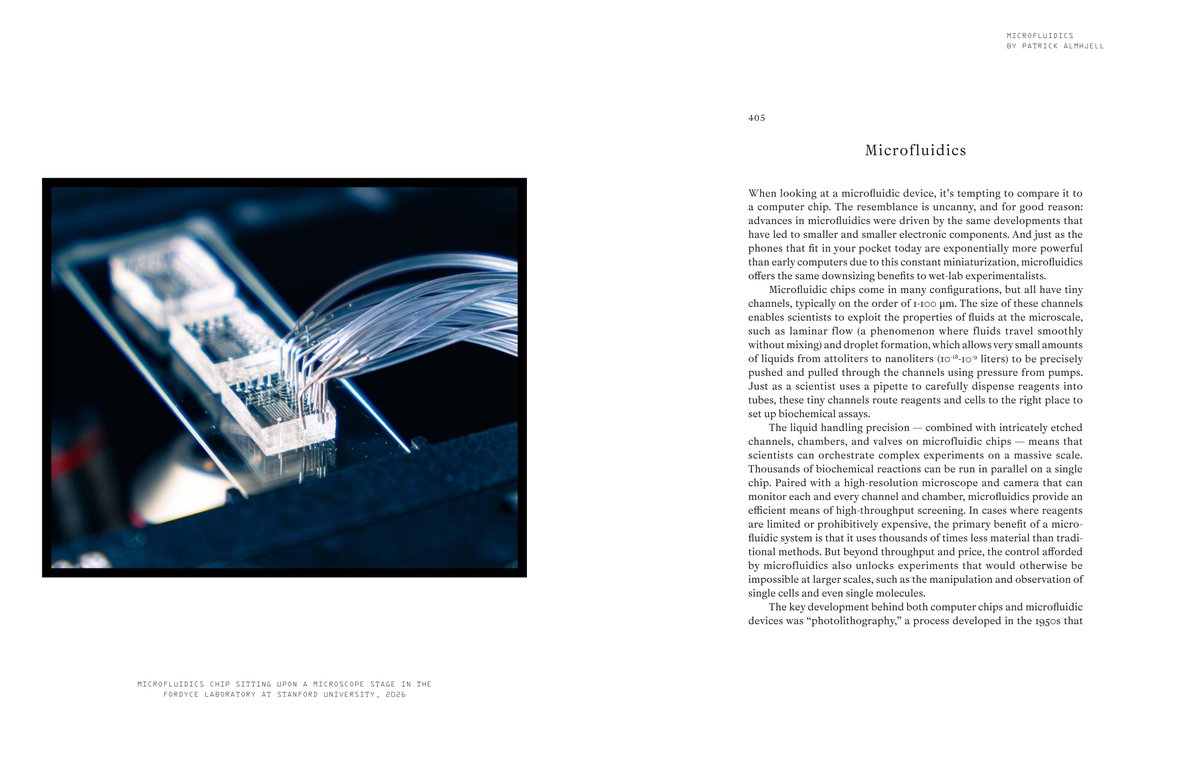
Making the Modern Laboratory is a spectacular 504-page hardcover that tells the story of everything in the research laboratory and how it came to be, from pipettes to heat-resistant glass to microscopes and more.
It features dozens of articles (most of which will never appear in print), 100+ full-color images, and original writing from 36 authors. It's printed on Arena Natural Rough paper from Fedrigoni. These books are THICC and would make a great gift for both the science-curious and the working scientist. :)
We have spent the last year working on this project. It has been an insane labor of love. The best way to support our independent science journalism is to buy a copy. <3
Pre-order for $49, with free shipping: https://t.co/7d9L2Ual0c
1. I love the idea of curing most (or all?) diseases. I just wrote an article about it https://t.co/t3LMmqWyjW and gave a TED talk about it too! https://t.co/hrg4GynBfF
We should be a lot more ambitious with medical innovation, and the history of science makes me more, not less, optimistic about what’s possible. Many diseases we once thought were untreatable turned out not to be.
2. But what’s possible isn’t the same as what’s going to happen, and it’s very different from claiming it’s possible within a timeline of 10 years.
Even if we grant exponential improvement in our technological capabilities, we still wouldn’t be able to cure most diseases within ten years, because technology is just one part of the equation.
One clear illustration of this is Eroom’s law, where the cost of drug development has risen despite massive technological advancement.
3. In our episode ‘Will AI solve medicine?’ (https://t.co/0VxwKjJZlt) Jacob Trefethen and I talk about how funding, institutions, incentives, better measurement, and a lack of data mean that we’ll still have massive gaps in solving diseases despite progress in AI.
These problems fall most heavily on neglected diseases, like rare and tropical diseases, where funding is often the barrier to progress. But they also affect diseases whose clinical trials are long and onerous, disease progression itself is slow, or poorly measured.
4. All this means that, if we want to speed up medical innovation and scale it up worldwide, we should also be unblocking the other barriers to medical progress with clinical trial reform, better data collection, better measurement instruments, better funding models, and more. (See our ‘Clinical Trials Abundance blog’ for some ideas https://t.co/FVLrSmPibQ)
It’s going to take a while before we solve these to the point where we can cure most diseases!
5. I thought the policy proposals in ‘Policy on the AI Exponential’ relating to drug development were quite vague and too brief to be useful.
But even if they were all implemented ideally, we would still be lacking cures for diseases for which financing or clinical trial infrastructure are the barrier, or where we’d need entirely new drug modalities to reach targets safely.
FWIW, I’m fairly skeptical of the use of ‘synthetic control arms’ if we actually want reliably effective medicines, not just faster clinical trials. But platform trials, which include shared control groups that many drugs are tested against, probably get at the intention.
6. I’m very skeptical of the idea that “many of the steps in the clinical process that previously required expensive and slow experiments may soon be done via AI simulation or analysis” ... but maybe this depends on one’s definition of ‘many’.
Human biology is extremely complicated and interactions between drugs and molecules in our body are very hard to predict, in part because of the number of combinations and biological states, and the level of measurement that’s possible in the lab; the way we get around this is through experimental data collection, i.e. clinical trials, but for some diseases, progression is very slow, so we’re not going to be able to collect that amount of data in time, even with perfect measurement.
Unfortunately public health datasets typically don’t include much drug-human body data, with the exception of, e.g., prescription datasets, which would be somewhat useful for analyzing historical drugs.
Getting pharma companies to pool sufficient individual participant data from clinical trials to improve these predictions, though, that would be exciting.
7. I sometimes worry about the deluge of AI ‘slop’ science that’s going to enter the academic literature.
We already needed to reform peer review, catch scientific fraud, improve data quality and rigour before AI (see e.g. my articles ‘Real peer review has never been tried’ https://t.co/7IP539vhoy and ‘The speed of science’ https://t.co/qw31iABVHY), but now it seems like science reform is even more important.
I could imagine a Pangram-like model for AI-written science papers, but that seems like it merely catches the tip of the iceberg of how deep the slop might go, if it involves unpublished data, for example. If AI use increases exponentially, we might end up seeing an AI science slop tsunami, which could affect predictions based on the literature. What’s the solution to this?
It's finally here! I gave a TED talk in April in Vancouver, and it was released online today.
You can watch it here:
https://t.co/kNYNzElUvJ
I've also adapted it into an article, which was published last week: https://t.co/XojHa75ZpJ
Announcing the 2026 Roots of Progress Blog-Building Intensive
Apply to the 4th cohort of this highly-regarded program for progress writers and intellectuals!
https://t.co/nuAzyNlW9q
I think this is one of the most important articles we've published at @AsimovPress. If you read carefully, there are at least 3-4 ideas in here that *should* be large, well-funded research programs.
The article begins by arguing that existing AI models are good at predicting things *within* an existing framework, but are not good at building new frameworks (and, thus, cannot do paradigm-shifting science). As AI models become more widespread in science, they therefore risk "hypernormal science," meaning we will have less actual breakthroughs and more incremental discoveries.
The author (Alvin Djajadikerta) supports this argument with several examples, one of which comes from germ theory:
"In the mid-nineteenth century, doctors thought that illness was caused by noxious air, and kept meticulous records accordingly. The physician William Farr mapped cholera deaths across London and found they correlated strongly with low elevation, which he thought was because noxious vapors accumulated in low-lying areas. He was actually picking up a real signal: low-lying districts were closer to the contaminated Thames River. But because his data was organized around air quality, he could not find the true cause..."
"An AI trained on Farr’s records could have found even subtler correlations, and would have been genuinely useful for predicting which neighborhoods would be hit hardest in the next outbreak. But it would not be able to derive the concept of a waterborne microorganism, as this was not a variable anyone had yet recorded."
After giving other examples of this, Alvin begins mapping out ideas to solve this problem and create AIs that are "visionary" rather than "merely predictive." My favorite idea, of his, is to use AI agents as a model organism for metascience.
The gist is that many paradigm shifts seem to happen under particular conditions. "Bell Labs, Xerox PARC, and the early Laboratory of Molecular Biology at Cambridge all produced extraordinary concentrations of paradigm-shifting work," Alvin writes, "mostly because they were small groups with enough institutional protection to pursue ideas that looked unproductive by conventional measures."
Alvin continues:
"We have never been able to run controlled experiments on scientific institutions; it is impossible to create labs that differ in only one respect and compare the results. But we could run AI agents in parallel populations under different research conditions, and analyze the results...In this sense, AI scientists may give metascience its first model organism."
"For instance, one could test how group structure shapes discovery: do small, isolated teams produce more conceptual reorganization than large, well-connected ones? Do flat hierarchies outperform rigid ones? One could run AI agent populations that vary these factors independently and measure the results — something that is impractical to do with real institutions..."
This essay is excellent throughout and I hope you'll read it.
And finally scientists -- share your hypotheses for structural or systemic bottlenecks that we could run experiments on. New essay competition dropping today to give you a voice: https://t.co/W8KzRENu4z
My weekly blog is back. And my first essay is about the fallout at eLife, the scientific journal.
Two years ago, Michael Eisen was fired from his job as editor-in-chief after retweeting a satirical article (from The Onion) about the war in Gaza.
Except... that's not really why he was fired. Tensions had already been growing between eLife’s leadership team and its editors and readers. The journal had spent years reforming scientific publishing, and many people were upset about it.
First, eLife required authors to publish preprints before submitting to the journal. Then, they got rid of accept-reject decisions entirely. But Eisen increasingly found these policies to be at odds with the norms of the scientific community he was trying to reform. So when Eisen sent out his tweet, the board had an excuse to get rid of him.
This is that story. I hope you'll read it.
P.S. This story is actually not about eLife or Eisen or his firing or free speech or anything else. It is about what happens to those who try to change the incentive structures of science. eLife is just a journal — one journal of thousands — in a sea of other journals. Its rise, fall, and continued existence is arbitrary, as is so much else about the way we do science.
Blog: https://t.co/eUKDz4flfH
We're excited to introduce the 2026 cohort of Brains fellows!
These ambitious scientists and technologists are working on ambitious coordinated research programs to create everything from electric noses, to bacteria-fighting viruses, atom-tracking cameras, and more.
🧵
New essay: “Which Future?”
On how to wisely navigate risks from transformative technology, especially artificial superintelligence (ASI). This condenses much of the key thinking from my more extended essays
I wonder with the rise of autonomous labs how much the gap will widen between the two modes of discovery. Data-driven discovery from atlases, virtual cells, various emulations, that can be scaled, parallelized, and run 24/7. And "insight"-driven discovery that relies on serendipity or observing the unexpected combined with expert judgment, like observing mold to discover penicillin, a glowing screen to X-rays, or a secondary green substance to GFP.
Both modes are needed and AI, at least as of now, is much better positioned to accelerate the former over the latter. I guess the ideal case is we set up AI to do more of the former brute-force data generation, freeing up our time to do more of the latter. Could this be the return of the renaissance scientist but now with a parallel science engine running 24/7?
@namankatyal14 It certainly could. And of course each one feeds into the other. I'm using insight here to perhaps convey something closer to creativity, surprise, weird observations... outlier type of research.
What's going on with measles?
There were more measles cases in a single week in January 2026 than all but 5 yearly totals over the past two decades.
https://t.co/kpFnoARzNh
@owl_posting’s great essay on lab robotics, plus the obvious AI macro, has a lot of us talking about automation and whether it’s the missing piece for AI to greatly accelerate breakthroughs in medicine. It is not.
A lot of the pushback is that “biology is hard”, but this doesn’t explain why another 50 IQ points or 20h of task length can’t solve this kind of “hard”. I’ll try to be specific:
What we call biology spans multiple physical 'layers of organization' with different behaviors and iteration speeds:
Layer 1 = Molecular - e.g. drug molecules binding to proteins, which we need to make medicines. This is AlphaFold etc territory. For DNA, RNA, and proteins at least, we're good at simulating biophysics and experiments can happen as fast as arms can move things around.
Layer 2 = Cellular - What's the response to a protein getting blocked? Some activity stops, the cell changes gene expression to compensate, and ends up in a new steady state (or maybe dies) minutes or hours later. New tech like CRISPR and single-cell sequencing apply here.
Layer 3 = Organs - What happens to an organ when cells change? Often other cells get involved, and the new steady state might be destructive or ineffective. But this happens as gradual changes and responses over weeks to years. Many of the diseases we hope to cure live at this layer: Heart failure, dementia, aging…
The key thing to understand, especially for non-biologists building AI for bio, is that layer 3 & beyond is emergent. The body is not the sum of all cells, thanks to feedback loops within and between cells. And with emergent complexity, scaling 1 and/or 2 alone does not mean 3 gets solved.
To give a software analogy. Layer 1 is optimizing individual functions where you can benchmark and test edge cases rapidly. Layer 2 is integration testing with simulated load, still controlled enough to iterate. Layer 3 is what actual users and competitors start doing after product launch, and how that affects your business. You can probably simulate users with agents now, but the real world still can't be predicted with confidence.
AI thinking about biology is useful, for sure. And speeding up experiments in layers 1 and 2 helps disease research, for sure. Some diseases live at layer 2: infections, single-gene disorders, some cancers. And indeed the automation and scaling of layers 1 and 2 we’ve been doing for decades has given us decent answers to those already.
But until we understand disease progression, any attempt to accelerate it (e.g. 'this protein is the problem, just put in a lot of it in the brain') risks creating a false goal. Neither more intelligence nor speeding up layers 1 and 2 can bypass the feedback loops of layer 3, which is where where most diseases we care about actually live.
This is the most important reason why we aren’t currently slated to double lifespan even if we get a ‘country worth of geniuses’.
@ATinyGreenCell Made me think of this post. I like the gym analogy. Many parts of doing science can be a bit like going to the gym. https://t.co/hjtQEWDFkC