Client: Sir, the Income Tax Department is questioning my bank account. I deposited cash of ₹2,30,000 during the year. Will the entire ₹2,30,000 be taxed as unexplained income?
Me: Not necessarily. The department may apply the Peak Credit Theory, depending on the facts of your case.
Client: Peak Credit? What's that?
Me: If cash withdrawn from the same account is redeposited later, only the highest unexplained balance (peak credit) may be taxed instead of every deposit separately.
Client: So, if I deposited ₹2.30 lakh in total, I won't automatically be taxed on ₹2.30 lakh?
Me: Exactly. If your running balance never exceeded ₹1,00,000, generally only ₹1,00,000 may be treated as unexplained income.
Client: Is Peak Credit available in every case?
Me: No. You must prove that the withdrawals and redeposits are linked and involve the same money. Otherwise, the Assessing Officer may deny the benefit.
Client: So proper documentation is the key?
Me: Absolutely. Prepare a date-wise cash flow showing every withdrawal and deposit. Each deposit should be linked to an earlier withdrawal with a reasonable explanation.
Client: What if I also have some cash that was already taxed in an earlier year?
Me: That brings in Telescoping. Already-taxed unexplained income can be treated as the source of a later deposit, preventing double taxation.
Client: So Telescoping and Peak Credit work together?
Me: They can. Peak Credit deals with recycling of funds within a year, while Telescoping uses already-taxed income as the source. Both prevent taxing the same money twice.
Client: You also said it's not an automatic entitlement. What do you mean?
Me: If the deposit-withdrawal pattern appears artificially created just to claim Peak Credit, the AO or Tribunal may reject the benefit.
Client: Under which section will the addition be made if things go against me?
Me: Usually under Section 68 for business accounts with books. For personal accounts, it may fall under Sections 69, 69A, 69B or 69C, depending on the facts.
Client: So the more organized my records, the stronger my case.
Me: Exactly. Peak Credit and Telescoping are fact-driven reliefs. A clean, credible cash trail strengthens your case.
Need opinion of all professionals in this case:
A salaried employee has:
- Salary income: ₹9 lakh
- F&O trading loss (non-speculative business loss): ₹20,000
Since the F&O loss cannot be set off against salary income, the total income before set-off exceeds the Basic Exemption Limit.
In this case, will Tax audit be applicable or not, given that Income is less than 8% and TI exceeds BEL.... ?
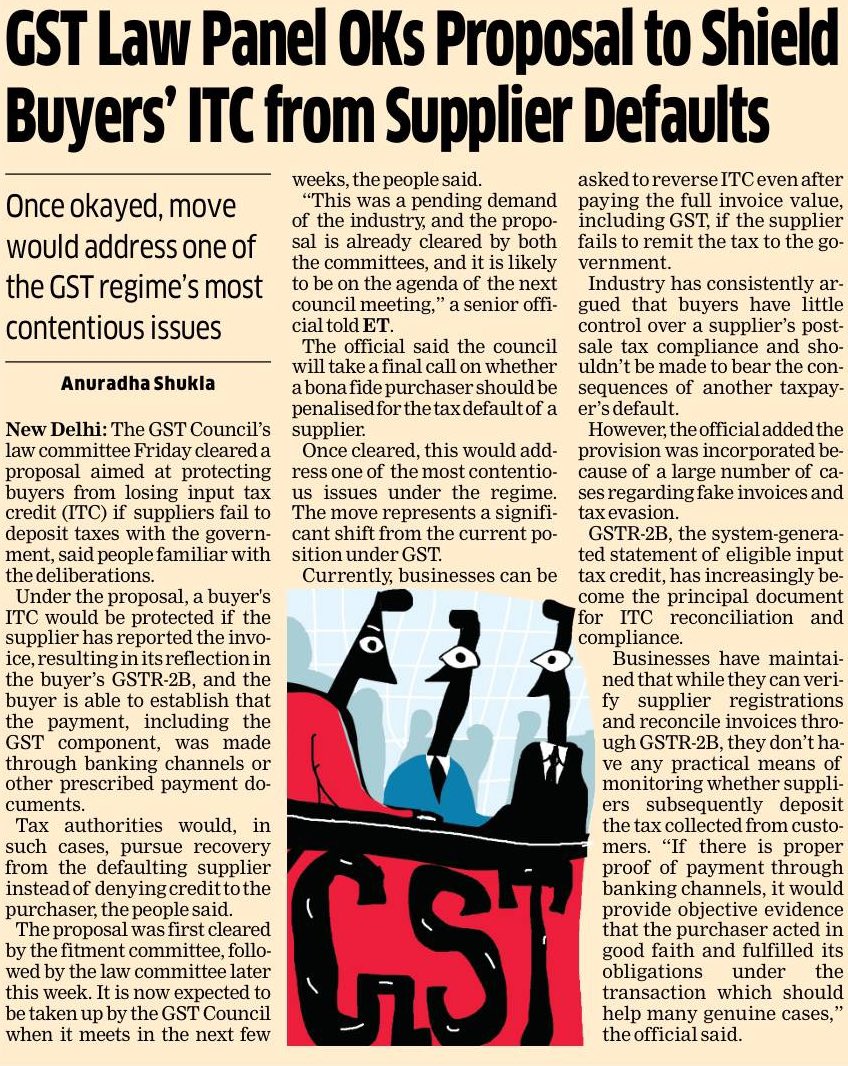
Genuine taxpayers may finally be safeguarded from ITC reversals caused by supplier defaults, reducing unnecessary litigation and compliance uncertainty.
Recommandation by GST Council Law Committee, to be discussed in Next GST Council Meeting
Ram Bajaj
8696424223
For Regular GST Updates, Join this Group
https://t.co/0FJcNngdhU
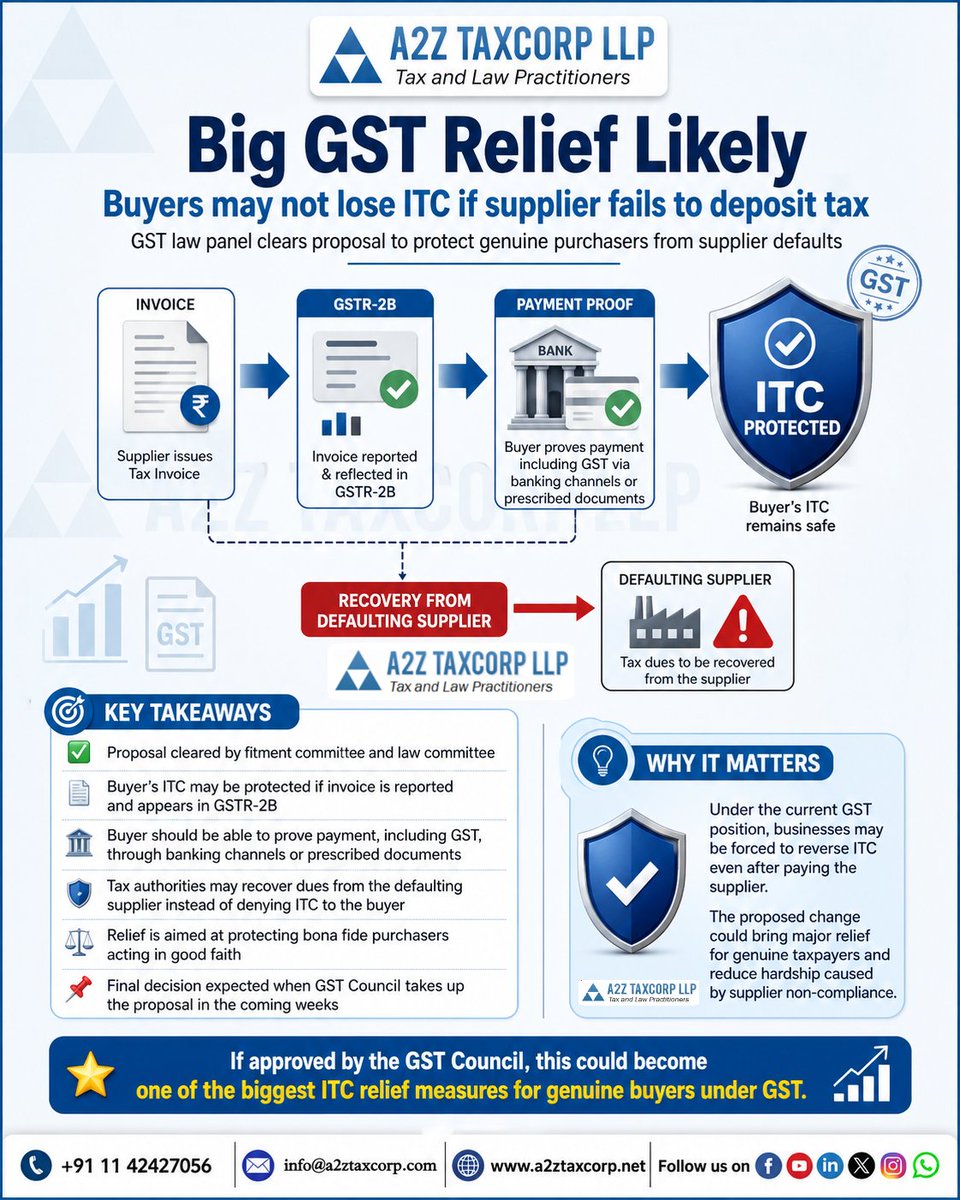
Big GST Relief Likely: Buyers may not lose ITC if supplier fails to deposit tax
The GST law committee has cleared a proposal to protect buyers from losing input tax credit when suppliers fail to deposit tax. ITC may remain available if the invoice appears in GSTR-2B and the buyer proves payment, including GST, through banking channels or prescribed documents. Tax authorities would recover dues from the defaulting supplier instead of reversing the buyer’s credit. The proposal, already approved by committees, awaits the GST Council’s final decision and could provide major relief to compliant businesses.
Read More at: https://t.co/wh8EW5dM8a
Stop memorizing Section 2(14). Start understanding why the law thinks the way it does. Once you know the logic, Capital Asset becomes impossible to forget. 📚⚖️
The Income Tax Appellate Tribunal (ITAT) just dropped a massive reality check for over-eager tax officers.
In a recent case, the Assessing Officer made a ₹24.70 lakh tax addition under Section 69, claiming the taxpayer made an undisclosed “on-money” cash payment for a property deal.
The sole basis?
Loose papers found during a search on a third party.
ITAT deleted the entire addition.
The tribunal made it clear: you cannot penalize a taxpayer based on external, third-party papers unless you have independent, corroborative evidence proving an actual cash transaction took place.
Guilt by association is not a valid tax assessment strategy.
#IncomeTax #TaxCompliance #TaxLaw
🚨 ITC DENIED JUST BECAUSE LR IS MISSING? NOT ANYMORE! 🚨
The Madras High Court has delivered a major relief for genuine taxpayers! ⚖️
✅ Supplier was GST registered
✅ GST was paid to the Government
✅ Returns were filed
✅ Invoices contained vehicle details
Yet ITC was denied merely because Lorry Receipts & Weighment Slips were unavailable.
🏛️ The Court made it clear:
Missing LR or Weighment Slip alone cannot be a ground to deny ITC.
This judgment is a strong reminder that GST assessments should be based on substance, not on a hunt for every piece of paperwork years later. 📚
📝 I've summarized the entire judgment in handwritten notes for easy reference.
Save it. Share it. Use it in your GST representations. 🔥
#GST #ITC #GSTUpdate #GSTLaw #MadrasHighCourt #Taxation #IndirectTax #GSTLitigation #CA #CharteredAccountant #TaxProfessionals #GSTCompliance #TaxUpdates
@taxologyin@cbic_india It is suggested that the GST Dept coordinate with other departments to help citizens correct mismatches in names and addresses across documents such as Aadhaar, PAN, property records, EB records, and driving licences. This could make GST compliance much easier for many people.
While filing for deduction of TDS on purchase of property from Non Resident, we are going to E-Pay tax
As soon as we select Non-Resident, it is saying Form 144 is applicable, but it is nowhere to be found in the portal.
Even in the TDS login of another taxpayer, this sort of deduction is not coming....
What to do in this case if anyone has encountered this??
@IncomeTaxIndia
GSTAT Filing: When compliance takes more time than the Appeal itself
One inherent issue with the GSTAT form, which also stands out from practical experience in filing, is that the form is highly complex and the time involved in filling the form is, in several cases, even more than the time required for preparation of the appeal itself.
The primary problem lies in the fact that while the appeal is drafted in a continuous and structured manner, the form requires the same information to be broken down into multiple separate fields, necessitating culling out and re‑structuring of the contents in the prescribed format, thereby resulting in duplication and substantial re‑writing.
For instance, with regard to the sequence of events in chronological order, while the same can conveniently be prepared in a single document, the requirement of entering each event separately with individual dates on the portal involves considerable time and effort, leading to unnecessary fragmentation of an otherwise continuous narrative.
As a result, the process becomes less about presenting the case and more about re‑entering and re‑formatting content that already exists in a complete and coherent form.
This is not to suggest that any necessary information ought not to be placed before the Hon’ble Bench, as the same would in any case be duly provided by way of a detailed appeal; however, the present format, by its very design, results in avoidable duplication and procedural burden, making compliance more time‑consuming.
@RenukaJain6 Company and shareholders are different in the view of income tax act, tax paid for profit earned by company and shareholders receive dividend is new income hence taxable