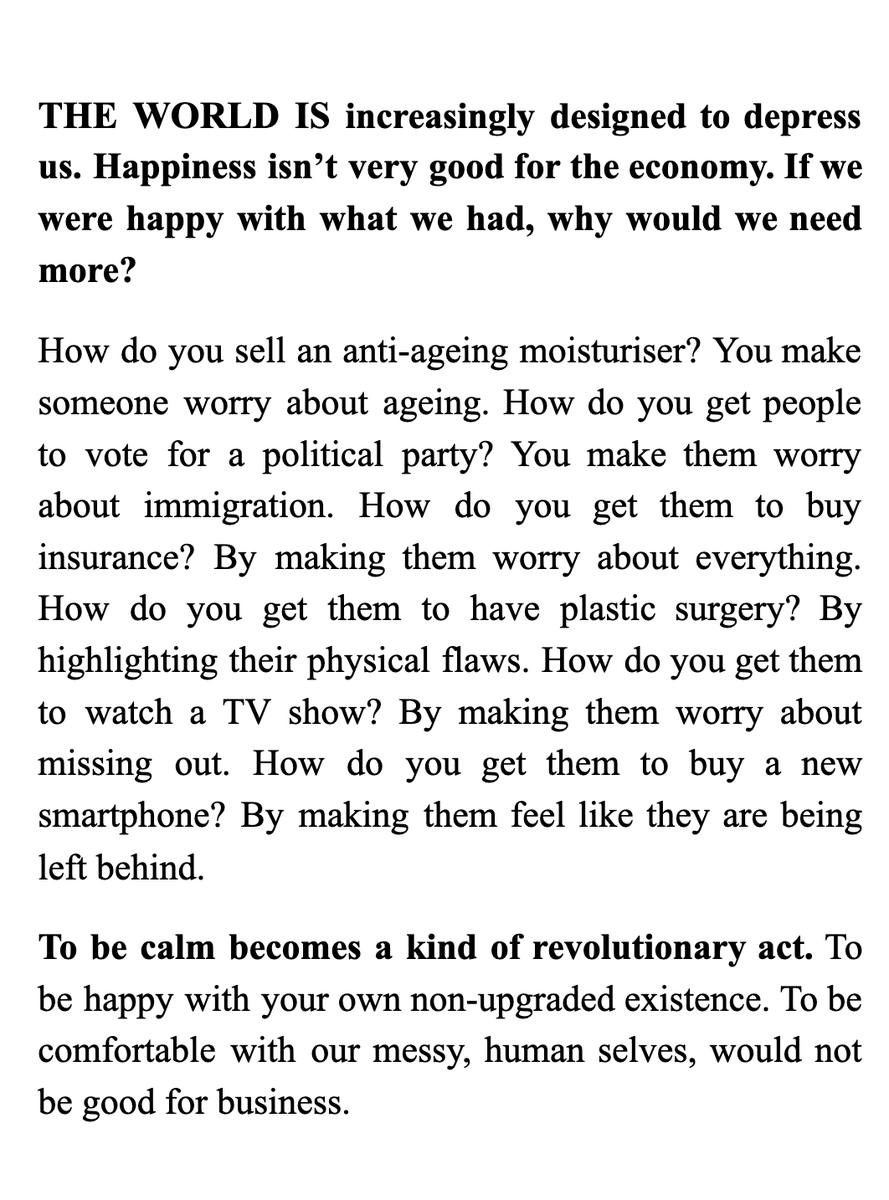
The world is increasingly designed to depress us. Happiness isn’t very good for the economy.
If we were happy with what we had, why would we need more?
My favorite author, Matt Haig, wrote this about consumerism/materialism in his book.
In the light of this situation, here are questions I ask myself before making a transaction:
1) How essential is this product for my survival directly? (Ex, food)
2) How essential is it for my survival indirectly (Ex, income from a career)
3) Is this just an impulse buy so I can distract myself, or is it something meaningful? (You're distracting yourself, when what you need to do is know yourself)
4) Am I valuing ‘quality’ of the product here, or am I prioritising ‘quantity’ (also known as hoarding)
5) What will happen if I don’t buy this item? How will I feel? How will not buying impact my life?
It’s your decision. Who do you want to be:
A) Someone who keeps buying meaningless stuff mindlessly and still feels unfulfilled.
B) Someone who has minimal but meaningful stuff, and is mindful.
Matt Haig’s right—to be calm becomes a kind of revolutionary act.
How do you go about making these decisions?
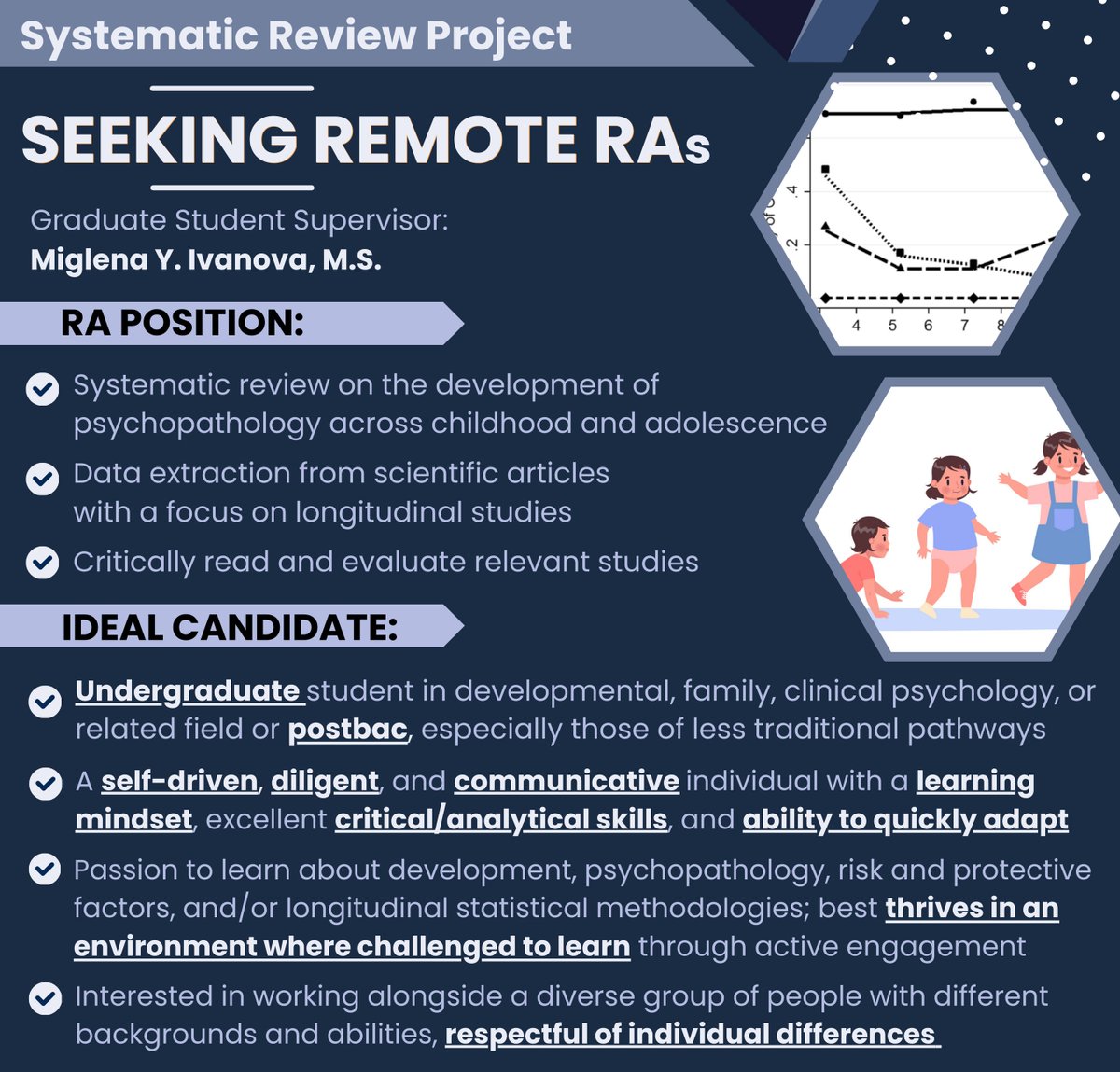
RT and share with undergrads!😊Recruiting a few #RA#volunteers to help wrap up a massive #SystematicReview on behavior problems before end of the year. I've been fortunate to have an outstanding team of superstar RAs, so if all boxes check out, consider joining us. DM for info!
The next session in the virtual meeting series on the Psychology of Resistance in Violent & Repressive Contexts is Tuesday, May 14: Dr. Siwar Hasan-Aslih will present "Understanding Collective Action and Resistance in Palestine: A Social Psychological Perspective". Register in 🧵
"A mind which thinks critically, knows a work most thoroughly."
Critique has been the impetus for much discourse throughout generations and its impact is most visible in the questions it opens to the reader.
6. How to write non-empirical papers
Contains tips on:
• How to write a paper when you are given a topic
• How to write a paper when you have to choose a topic yourself
https://t.co/CPvH6HHmSA
4. General advice for writing in the sciences
Contains tips on:
• The big picture
• Structure
• Evidence
• Audience and style
• Do's and don'ts
https://t.co/cPT6em9WVg
3. Strategies on writing academic essays
Covers:
• How to read an assignment
• How to develop a thesis
• How to write topic sentences
[I learned to write topic sentences in the last six months of my PhD😂 Don't be like me]
https://t.co/ARlZT6vjGt
1. Harvard faculty explain analytical writing
Contains tips on:
• How to write an argument
• How to show why your argument is important
• How to structure your work
https://t.co/rbMJHIrBR9
We're delighted to cohost the third annual Suicide Research Symposium taking place April 17-19, 2024! This is a free and virtual conference for researchers. Register and learn more: https://t.co/hqr7tQR29N.
4. 50% allocated time: The assigned task must be delivered on the decided date. If you foresee a delay, update when half of the allocated time has elapsed. This enables us to add more resources if needed or reschedule the deadline appropriately.
#teamwork#responsibility
3. Deadlines wouldn’t change: The deadline for the assigned task will be set by the individual who is tasked, reinforcing ownership and responsibility. Once the deadline is set, it's expected that it won't change.
#ownership#integrity#deadline