Are recommendations for “safe” lifting technique physically feasible? Can someone’s starting posture affect their ability to reach down for an object and stick to a “safe” lifting technique? New pub out! @ChiroHPL@_Tyson_Beach@_stevenhirsch https://t.co/hYoeTxY0e1
We are incredibly excited to partner with @DrivelineBB@drivelinekyle to provide portable, markerless motion capture for their biomechanics assessments. Stay tuned for the validation work we will collaboratively share in both the short & long term! #motioncapture#sportsscience
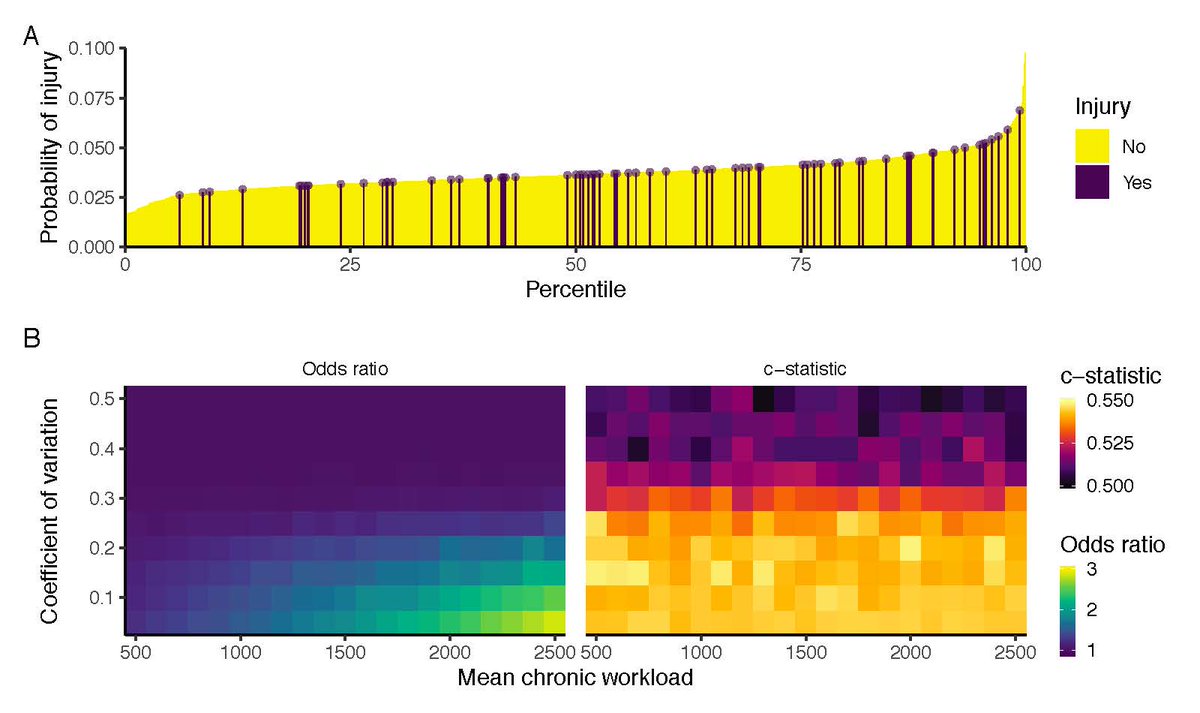
ACWR dividing the acute load by a random generated chronic load or fixed values gives same results. We warned there was something wrong. In the preprint the details. Thanks to all my co-authors @avigotsky, @AaronCoutts, @Maurizi13707619, @Alan_McCall_, https://t.co/LEXysr4YMe
#ASB2023 week is here! We are thrilled to share this terrific line-up of sessions and events. Thanks to the organizing committee for putting it all together!
https://t.co/64otSQCAbf
But it's entirely possible for factors that can predict injury/performance to have no causal link to that outcome, and factors that do not predict outcomes can still be causal factors! This has significant implications for designing training or rehabilitation programs.
https://t.co/28bV4qq2kd This is a crucial concept to understand! It's common to falsely equate variables with predictive capacity of some outcomes as a causal factor, especially when assessing human movement to reduce injuries or improve athletic performance.
Labels matter for both researchers & clinicians
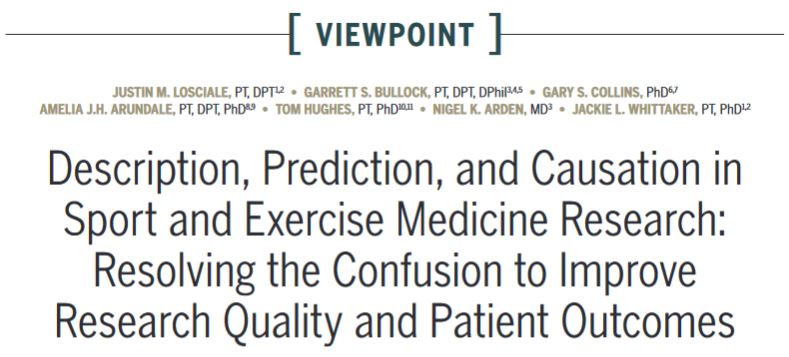
So understanding the critical differences between 'Description, Prediction, & Causation in Sport and Exercise Medicine Research' will help us improve clinical care 🤝
Learn more 👉 https://t.co/B1Dcf1xFiL
#yourJOSPT
…We have provided some sample R code in the supplementary materials of this paper, but I'll be putting together more comprehensive (and generalizable) R code in the future that will also include more thorough equivalence testing!
…(similar to how it is important to check other statistical assumptions when performing data analyses, such as ensuring the residuals of your regression models are normally distributed)…
If you're at #ACSM23, I'm hiring for both a Master's and PhD level biomechanist! DM me to chat about it at the conference.
Please spread the word and join me at @WVURNI!
@AcsmBig@ACSMNews
JUST PUBLISHED!! CMCC's Director Human Performance Research, Dr. Howarth, questions conclusion re. spine flexion and its association with LBP from recent study in @ergonomics1957. 50 FREE DOWNLOADS
https://t.co/hNtLG654GX
To lift without rounding your back, necessary motion must be reallocated to other joints. To find out where and how this motion is redistributed, check out our new pub! @_Tyson_Beach@JackieZehr@ChiroHPL https://t.co/1XE2Uy9i6z
“…even with an extensive data set, including anthropometric, clinical, neuromuscular, genetic, and sophisticated 3D biomechanical measurements, ACL injury prediction was poor…”
Do we need to predict injuries to prevent them? Risk reduction heuristics? https://t.co/8Z8Sxdty6R
Too many studies that apply machine learning to science & medicine employ incorrect methodologies.
Many make very basic mistakes, such as not having separate training & test sets, using the test set (not a separate validation set) for feature selection, hyperparameter tuning, etc