Hi @X,
AI Researcher | AI Engineer
Exploring Computer Vision, Continual Learning & MLOps.
Building models from scratch, turning research into systems, and constantly learning.
Looking to connect with AI researchers, engineers & builders.
#AIResearch#ComputerVision
There is no prompt that replaces:
→ Fundamentals
→ Debugging
→ System design
→ Mathematics
→ Model understanding
→ Reading code
→ Asking the right questions
Don’t compete with AI at typing code.
#AI#SoftwareEngineering#MachineLearning#Programming
Hi X 👋
I’m an Applied AI student and researcher exploring AI Engineering,
Computer Vision,
Continual Learning,
Transformers,
VLA & World Models.
If you’re into AI research, ML engineering, open-source, or building things from scratch — let’s connect.
It’s been nearly two days, yet it’s still difficult to put into words what Nepal is going through.
My heart goes out to everyone affected by the devastating flash floods, especially those who have lost their loved ones, homes and livelihoods.
🙏
#Nepal#FlashFloods
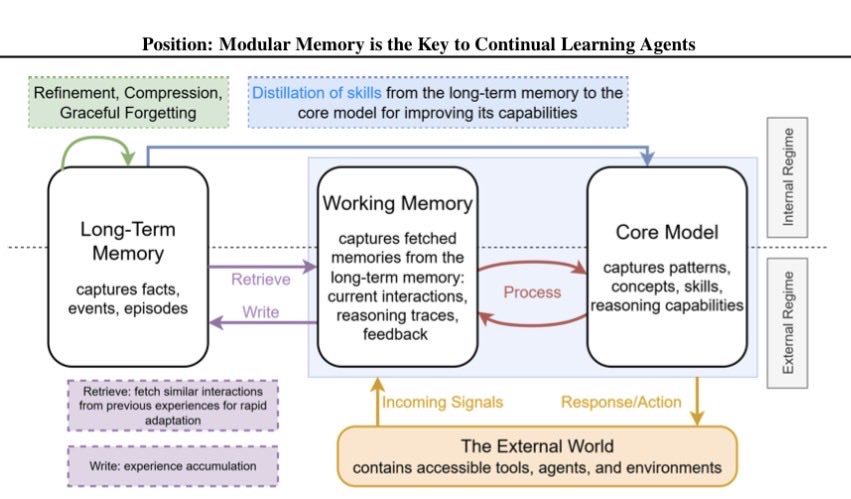
Our position paper “Modular Memory is the Key to Continual Learning Agents” (https://t.co/dv77KFe7ll) has been accepted to #ICML2026@icmlconf as a spotlight! 🎊
Read for a modern perspective on memory, continual learning, and sustainable adaptation at foundation model scale!
Titan - introduce a memory module.
Atlas - Work on to increase memory capacity and introduce new learning rule(Omega rule)
Nested Learning- work on to make a different loss function, context and parameters as layers grows taking inspiration from brain waves.
Thank you, Finance Minister of Nepal, @SwarnimWagle , for making sovereign AI a top priority. Nepalese youth are eager to build Nepal's own AI ecosystem.
// Memory as a Model //
The paper augments any LLM with a separate trained memory model that stores, retrieves, and integrates facts on its behalf.
It decouples memory updates from base-model weight updates. It achieves continual-learning robustness without catastrophic forgetting, which is a property that RAG fails to deliver.
A vector store is a database with a learned encoder bolted on. MeMo is a learned subsystem with explicit interfaces. That distinction matters, as agents need to be able to ingest fresh knowledge weekly without retraining or vector-DB churn.
At its core, the position here is that memory in agents should be modular, learned, and gated, not a context-window hack.
Paper: https://t.co/iMrghPtxWW
Learn to build effective AI agents in our academy: https://t.co/LRnpZN7L4c
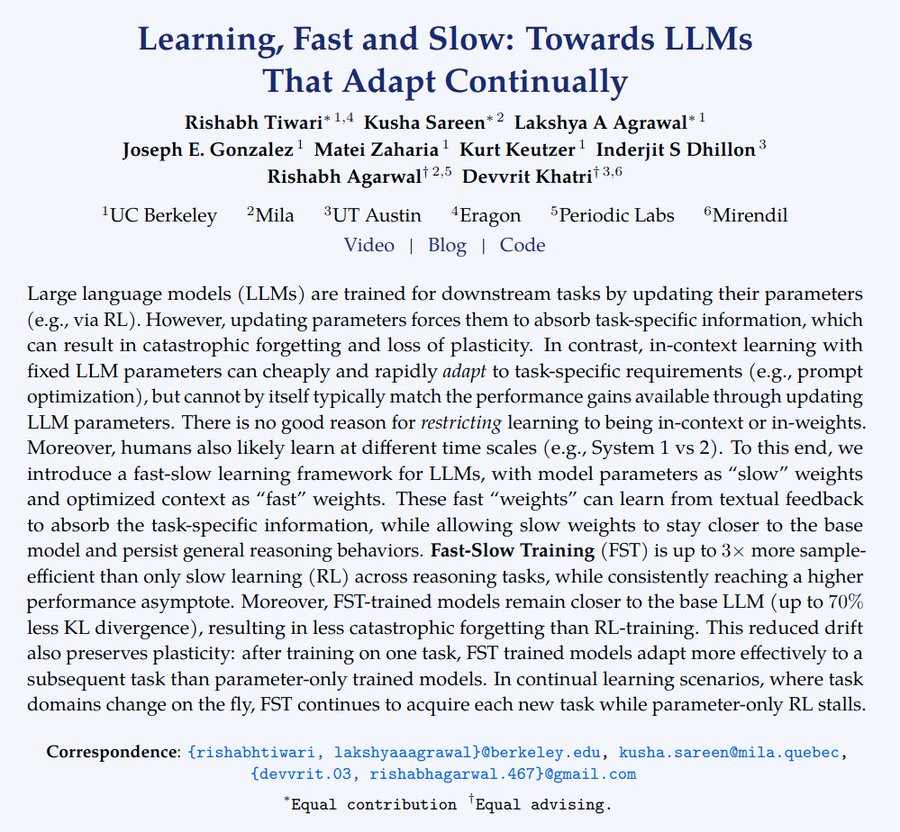
Announcing Fast-Slow Training (FST) pairing "slow" weights with "fast" context.
We try to answer the question, can LLMs adapt continually without losing base skills?
FST vs RL:
- 3x more sample-efficient
-Higher performance ceiling
- Less KL drift
- Continual learning: succeeds where RL stalls
@Vtrivedy10@hwchase17 Great opportunity.
I am pursuing a Master’s degree (by research) at MBUST, Nepal. My thesis focuses on continual panoptic segmentation.
Open to collaborating on research opportunities.
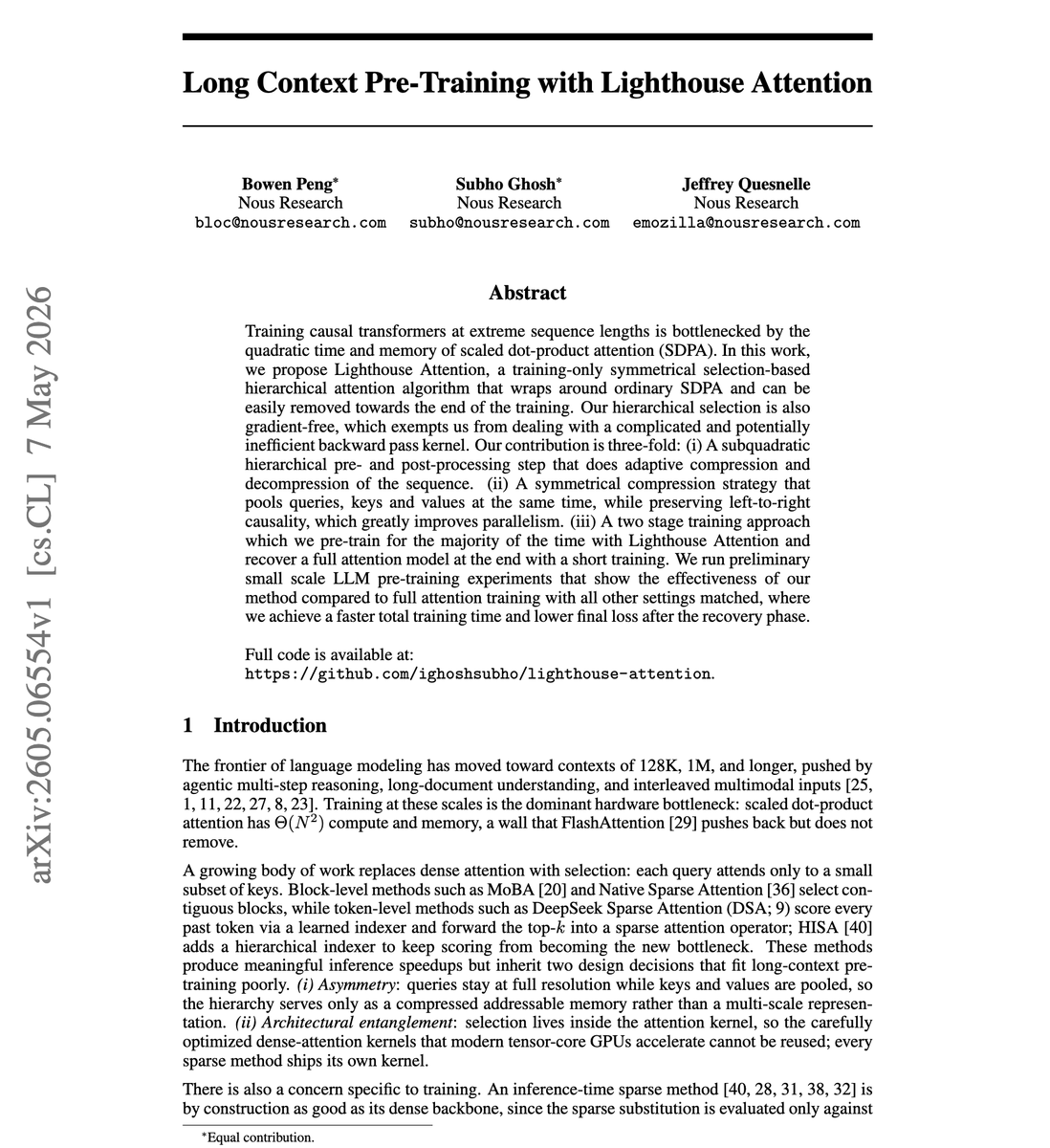
Cool idea from Nous Research.
What if you could speed up long-context pretraining with a subquadratic wrapper that you remove before deployment?
That is the idea behind Lighthouse Attention.
The method wraps ordinary SDPA with a hierarchical, gradient-free selection layer that compresses and decompresses queries, keys, and values symmetrically, preserving left-to-right causality.
Crucially, it can be removed near the end of training in a short recovery phase, so the deployed model still runs vanilla attention with no architectural cost at inference.
Preliminary LLM experiments report faster total training time and lower final loss than full-attention baselines.
Why does it matter?
Most efficient-attention work either changes the deployment-time architecture or pays a quality tax to do so. A training-only wrapper that survives a clean recovery phase sidesteps both. If it scales, this becomes an important training-time speedup for long-context pretraining.
Paper: https://t.co/9g5Ldnb1rV
Learn to build effective AI agents in our academy: https://t.co/1e8RZKs4uX